


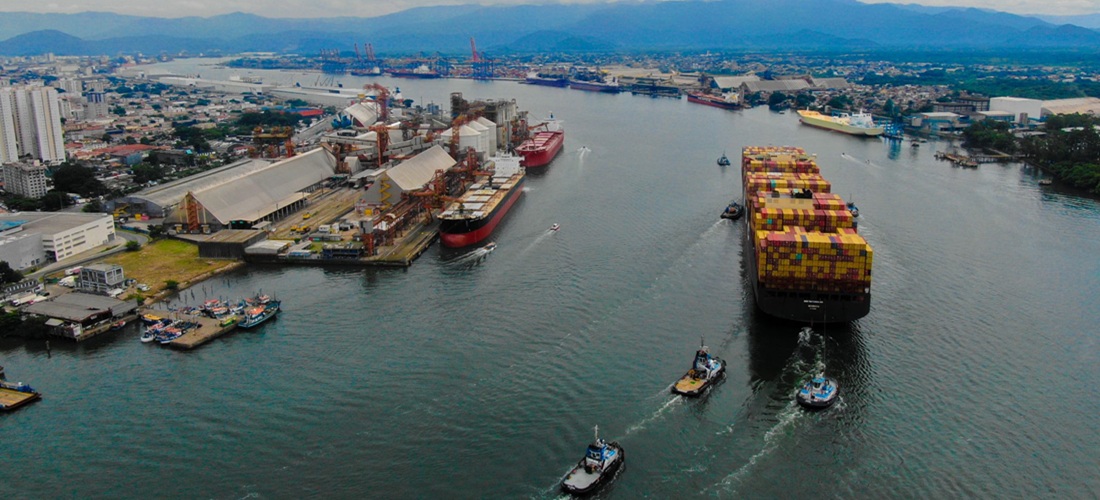
Study at Port of Santos Aims to Detect Fluid Mud and Improve Dredging Operations — See Details
May, 12, 2025 Posted by Denise VileraWeek 202520
The Santos Port Authority (APS) has launched a study to analyze sediment behavior in the Santos Port estuary. The goal is to implement more efficient dredging operations and detect the presence of fluid mud. APS signed a cooperation agreement with the Delft University of Technology (Netherlands) and the Port of Hamburg Authority (Germany) to achieve this.
Recently, APS established the Dredging Engineering Research and Innovation Program (PRIDE) to better understand sediment dynamics at the Port of Santos and Itajaí (in Santa Catarina, also managed by APS). The program seeks to build technical knowledge to support more efficient, cost-effective, and sustainable dredging technologies and practices.
According to APS, the program covers several areas—from developing predictive models for sedimentation in the channel to studying natural and human-induced seabed processes and driving technological innovation in dredging operations.
A key focus of the study is fluid mud—a transitional layer between the water column and consolidated seabed, composed of a mixture of water and fine sediments such as clay and silt. Fluid mud is more dense than water but less dense than compacted sediment. Common in ports and estuaries, it can affect navigation, vessel operations, and maneuvering efficiency, and presents challenges for dredging efforts.
APS stated it will evaluate the presence of fluid mud layers in the Port of Santos, especially regarding their characteristics and occurrence patterns. “This subject remains largely underexplored in the region and across Brazil,” the agency noted.
Despite the challenges, APS emphasized that navigation in fluid mud layers is technically feasible, provided continuous monitoring, an understanding of the material’s physical properties, and its interaction with vessels. These parameters help define navigational limits that ensure safe and efficient operations.
“Successful experiences in European ports show that, with in-depth technical studies, it is possible to establish operational criteria and appropriate safety margins,” the Port Authority affirmed.
Source: A Tribuna
-
Port Rankings
Jul, 15, 2019
1
TEU Exports and imports via ports of Brazil
-
Coffee
Apr, 13, 2023
0
Brazil’s coffee exports total 3.1 mt in March, down 19% year-on-year
-
Ports and Terminals
Jan, 06, 2021
0
Port of Paranaguá predicts 11% increase in grain exports in 1st quarter
-
Grains
Jul, 28, 2022
0
Mato Grosso police investigate deviations and frauds in soybean cargoes