


Investments in Rio Grande Port Operations to Surpass R$ 1 Billion
Jul, 02, 2025 Posted by Denise VileraWeek 202527
In early May, the Board of Directors of the Merchant Marine Fund (FMM), under the Ministry of Ports and Airports, approved financing of up to R$ 533 million for a modernization project at the Rio Grande Container Terminal (Tecon Rio Grande). This initiative ranks among the largest upcoming investments in port infrastructure, although Wilson Sons, which operates the terminal, has not yet disclosed project details or a timeline. It’s the first time in at least a decade—since the peak of the shipbuilding industry—that Rio Grande do Sul has benefited from FMM resources.
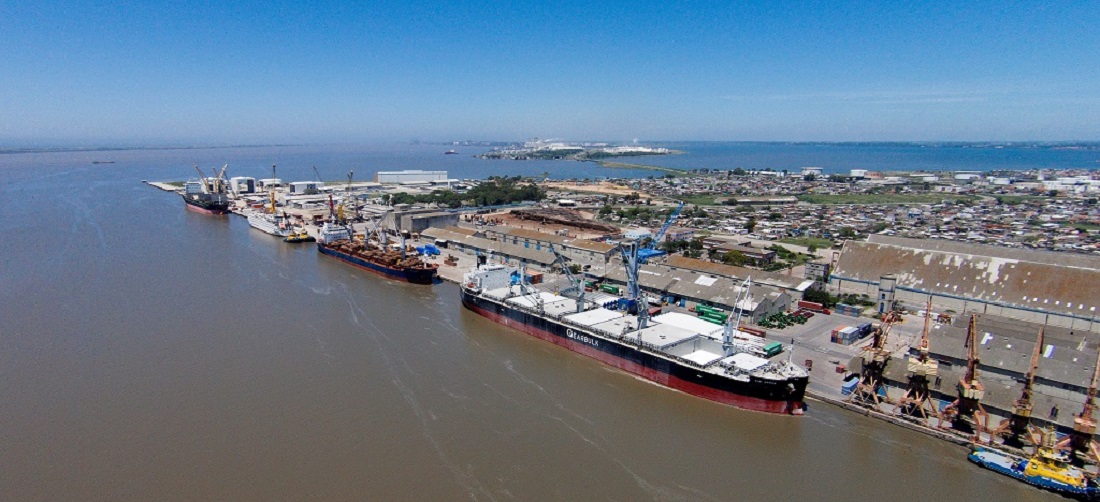
Following a record-setting first quarter, the Port of Rio Grande handled 9.8 million tonnes of cargo, up 15.5% compared to the same period in 2024. Of this total, around 2.2 million tonnes were containerized cargo, representing approximately 23%.
Below is a historical overview of cargo throughput from Rio Grande Port. The chart was prepared using DataLiner data:
Cargo Throughput from Rio Grande Port | Jan 2022 – May 2025 | TEUs
Source: DataLiner (click here to request a demo)
Since last year, Wilson Sons has invested R$ 9 million in new technologies for ship operations in Rio Grande, including artificial intelligence, reinforcing the terminal’s status as the most automated in Brazil. “The port is a complete logistics platform. That’s why cargo diversification is essential. In this context, investment in terminals plays a fundamental role,” notes Cristiano Klinger, CEO of Portos RS.
Among current works is the maritime terminal Termasa, operated by CCGL at the Port of Rio Grande, which suffered damage during the May 2023 floods and is undergoing reconstruction with a R$ 550 million investment. The two-year requalification project aims to restore and expand the terminal’s grain handling capacity. Last year, during high currents, a moored vessel collided with the quay, disrupting services. The rebuild includes platforms and mooring systems.
Another major investment on the horizon is a scheduled auction in the second half of 2025 for the construction and operation of a new pulp terminal, part of CMPC’s “Projeto Natureza.” The company has expressed interest in bidding. The terminal is expected to cost R$ 800 million, with operations planned between 2028 and 2029. Benefits will extend beyond pulp logistics.
The auction model includes a compensatory measure requiring the operator to deepen the public quay channel from 9.45 meters to 12.8 meters, potentially adding up to R$ 170 million in investments and benefiting the entire port operation. Future plans also include a new pier for chemical cargo operations, with bidding expected by 2026.
Investments in Dredging and Channel Recovery with Funrigs
A year after Rio Grande do Sul’s worst flood in history, state surveys show that 44.6% of the flooded areas were located in the South, Center-South, Campanha, and Western Border regions. Though fewer than 10% of people in these areas were directly affected, waterway logistics faced some of the most severe economic impacts.
As part of a R$ 690 million investment package from the Plano Rio Grande Fund (Funrigs), restoring the Lagoa dos Patos waterways and the ports of Pelotas and Rio Grande has become a priority for the region’s economic recovery and future waterway logistics potential.
“We’ve started this work by restoring pre-flood conditions, beginning with the navigation channels, including Lagoa dos Patos. In total, 13 channels will undergo updated bathymetry and dredging. Five are already underway this year. We’re also preparing to publish a dredging tender for the access channel to the Port of Rio Grande, with work set to begin in the second half of the year. The bulk of the dredging investment will take place in 2026,” says Cristiano Klinger of Portos RS.
About R$ 60 million will be disbursed by the end of this year, with the remainder in 2026. The goal is to restore navigational depths to 5.18 meters in Lagoa dos Patos and 15 meters in Rio Grande. More than 3,000 vessels travel this waterway monthly—1,800 in Rio Grande alone. While the investments do not include widening the channels, other parallel efforts aim to increase logistical flow and capacity via waterways.
A joint effort between Portos RS and the Navy is also improving nautical signaling on the waterway, seeking to lift the nighttime navigation ban on Lagoa dos Patos. Currently, a trip between Rio Grande and Porto Alegre takes up to eight hours longer due to the restriction.
Flood Impact and Recovery Overview
– 16,300 square kilometers were flooded in 2024 across the South, Center-South, Campanha, and Western Border regions (44.6% of the total flooded area)
– 970,700 people directly affected (17.5% of the state’s population)
– 108,200 registered companies affected (14.15% of all CNPJs in the state)
– 14,200 square kilometers of the flooded area were rural
– 9,800 rural producers affected (5.7% of state total)
– The South region had the largest flooded area: 3,400 square kilometers (10% of its territory), and the highest percentage of population (16.6%) and companies (17.3%) impacted
– Campanha was least affected, with 395 square kilometers (all rural) and only one registered company in Dom Pedrito impacted
– In Rio Grande, 42.3% of businesses were affected; in Arambaré, 41%
Source: Jornal do Comércio
-
Other Logistics
Dec, 27, 2021
0
LDC and Brado use railroad for unprecedented shipment of cotton lint
-
Fruit
May, 31, 2024
0
Fruits: Brazil grows many but exports few
-
Grains
Jan, 15, 2019
0
Brazil generates significant rice trade surplus in 2018
-
Other Cargo
Nov, 11, 2021
0
Footwear exports continue to rise in October