


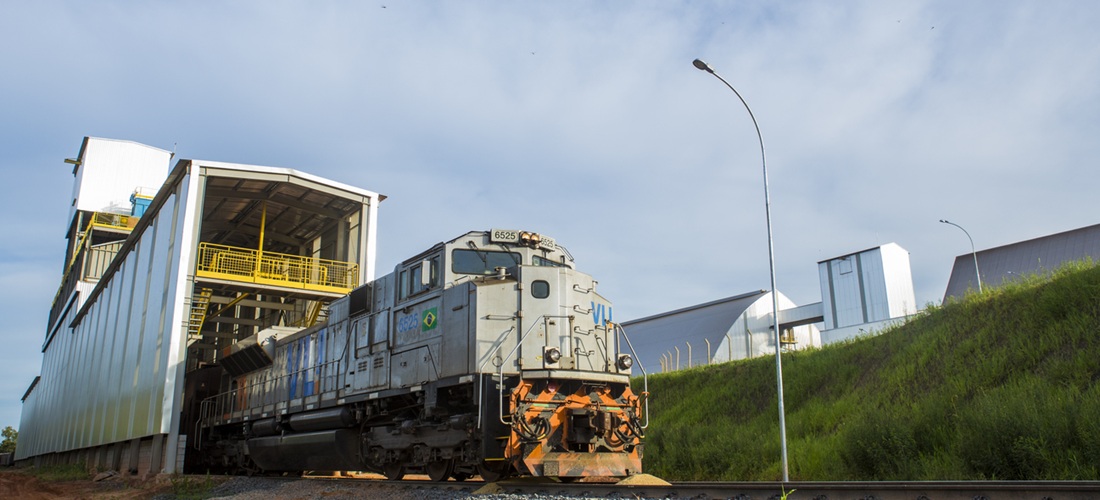
VLI cuts fuel use by 8.6% in Northern Corridor through energy efficiency efforts
Aug, 13, 2025 Posted by Lucas LorimerWeek 202534
VLI – the company that operates railways, ports, and terminals – has taken another important step in its sustainability agenda by reducing fuel consumption by 8.6% in its Northern Corridor, which connects the state of Tocantins to the port system in Maranhão. This achievement is the result of investments in operational optimization and energy efficiency solutions, which are part of VLI’s ESG journey, as outlined in the company’s 2024 Sustainability Report. The reduction avoided the consumption of approximately 1.3 million liters of diesel and the emission of 3 million tons of CO₂ into the atmosphere.
“The results further qualify the Northern Corridor as a benchmark for energy efficiency across the Brazilian railway system. Our efforts in training engineers, planning, and introducing new technologies are aimed at expanding this positive impact throughout VLI’s operations. This aligns with the company’s public commitment to reduce greenhouse gas emissions per ton transported by 15% by 2030,” said Alessandro Gama, VLI’s Executive Director of Planning, Engineering, and Technology.
One of the main tools used to achieve this result was the Leader system, implemented in the company’s premium locomotive fleet. With this system, once the train reaches speeds of 8 km/h or higher, the operator activates semi-autonomous driving. Leader reduces operational variables and equipment wear, while increasing safety and energy efficiency. It works in real time to optimize acceleration, braking, and power consumption, minimizing waste.
For trains equipped with the Leader system on the North-South Railway (FNS) alone, energy efficiency (EE) improved from 1.66 to 1.51 liters/ktkb (liters per thousand gross ton-kilometers), compared to trains without the system. This resulted in reduced diesel consumption and, consequently, lower gas emissions.
Leader is now used on more than 80% of the routes traveled by VLI trains in the Northern Corridor, which includes the northern section of the FNS – under VLI’s concession – and the Carajás Railway, where VLI operates under right-of-way agreements.
The system is also being used in the Southeast and East Corridors of the Centro-Atlântica Railway (FCA), also operated by VLI. These corridors connect Brazil’s Central-West to the Port of Santos and the Triângulo Mineiro region to the Espírito Santo port system, respectively. The company expects to expand the use of the system on the FCA to match FNS levels, which could yield around 7% in fuel savings by the end of next year.
VLI’s ESG Journey
VLI has been actively working to reduce greenhouse gas emissions in its rail transport services. As of May 2025, the company had already reduced these emissions by 10.79% compared to 2020, using the baseline year, across all its logistics corridors.
Believing that sustainable logistics is both possible and necessary, VLI is creating connections that generate value for people, businesses, and the planet. Since 2021, the company has maintained a public agenda of social, environmental, and governance commitments that support its transformation journey and legacy.
VLI’s ESG Journey, with commitments extending through 2030, is the path the company has chosen to continue transforming Brazil’s logistics sector and bringing sustainability to the entire supply chain.
Source: VLI
-
Other Cargo
Dec, 28, 2022
0
CSN miner no longer to build railway to Port of Suape, but promises connection to Pecém in less than 7 years
-
Shipping
Jun, 20, 2025
0
Japan weighs ‘national shipyard’ to revive shipbuilding sector
-
Ports and Terminals
May, 02, 2025
0
President of the Port of Recife Aims to Double Revenue by End of 2026
-
Ports and Terminals
Oct, 27, 2020
0
Wilson Sons to begin operating at Santarém port