


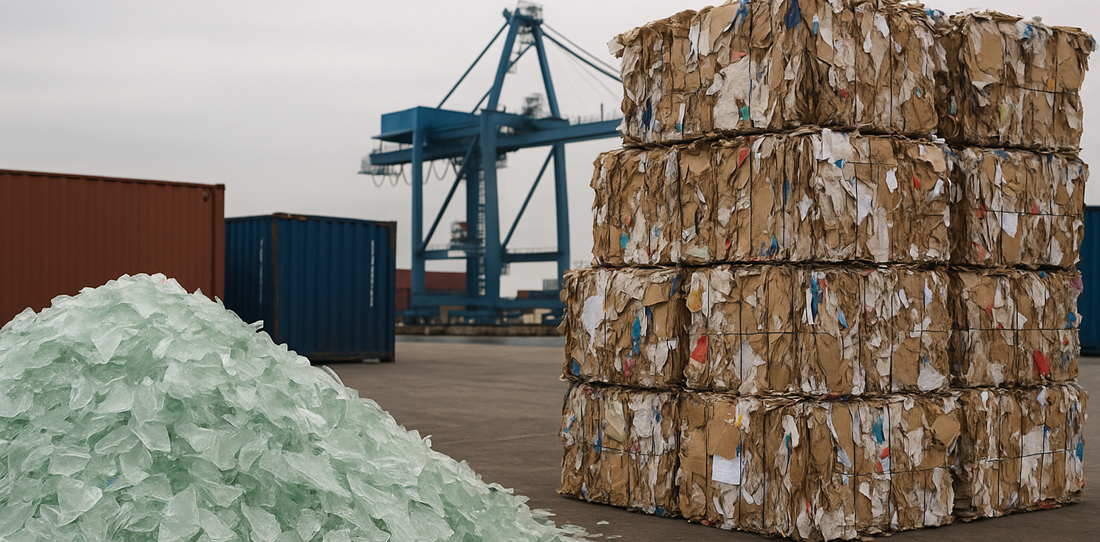
Brazil sets quotas for importing solid waste including glass and paper
Sep, 12, 2025 Posted by Lucas LorimerWeek 202538
The federal government published a resolution this Friday (12) establishing quotas for the import of solid waste. Since April, the Ministry of the Environment and Climate Change has relaxed the rules that govern these imports.
With today’s resolution, the following quotas are authorized:
- 19,000 tonnes of colorless glass cullet;
- 78,000 tonnes per year of long-fiber paper scrap — for this year, the limit will be proportional, at 26,000 tonnes.
The resolution was issued by the Executive Management Committee of the Foreign Trade Chamber (Gecex), linked to the Ministry of Development, Industry, Trade, and Services. The Secretariat of Foreign Trade will monitor compliance with the rules. If the authorized volumes are exhausted, any new import operations will be automatically prohibited.
Relaxation of rules
In April, the Ministry of the Environment and Climate Change published a decree easing the regulations for importing solid waste into Brazil. Experts, however, saw the measure as a risk to the development of the country’s sustainable economy.
Carlos Eduardo Canejo, professor and researcher in the Professional Master’s Program in Environmental Science at Universidade Veiga de Almeida, explained that the changes bring both challenges and opportunities.
“[The decree] is an ambiguous move, with both threats and opportunities. If properly regulated, it could help foster strategic industrial sectors in our country, contributing to innovation and market competitiveness,” he said.
“But on the other hand, it is worrying that it could weaken Brazil’s recycling chain, precarize the work of waste pickers, or even turn the country into a dumping ground for questionable-quality waste,” he warned.
Regulation challenges
The professor noted that the impact of the measure will depend on how these imports are implemented and adjusted over time. He pointed out that Brazil’s domestic recycling chain is still underdeveloped and “depends heavily on the value given to locally generated waste.”
“There’s also the risk that imported waste, even if classified as raw material, could harm cooperatives and companies operating in the domestic market. Another concern is the possibility of low-quality waste being shipped to Brazil under misleading classification, compromising environmental efforts and creating new liabilities the country may not be technically equipped to handle,” he observed.
Canejo stressed that priority must always be given to locally generated waste. “Otherwise, we risk undermining our own waste management structures by allowing in materials from abroad — structures that are not yet fully consolidated or prepared to expand capacity significantly,” he said.
Strategic position
The professor also highlighted the positive potential of the relaxed rules, which could put Brazil in a more strategic position.
“It signals that we are beginning to see waste not only as an environmental problem but also as an economic and industrial asset, which is fundamental for advancing toward a truly circular economy,” he said.
But he added that this potential will only materialize if there are clear public policies for social and environmental protection, as well as mechanisms to monitor and strengthen domestic recycling chains.
“In my view, this decree could mark a turning point for Brazil’s international circular economy agenda, but it must be implemented responsibly,” he said.
He emphasized the importance of environmental agencies in regulating procedures to ensure Brazil develops a sustainable model that supports a circular economy without reproducing new patterns of environmental vulnerability.
What the Ministry of the Environment says
According to the Ministry of the Environment and Climate Change, the main advances in the decree involve defining criteria for importing strategic materials and critical minerals.
“The decree takes a first step in distinguishing unusable waste from materials with potential for reuse that can substitute virgin raw materials (those not yet used in any production process and still in their original form and composition),” the ministry explained.
Another benefit, it said, is promoting the replacement of virgin raw materials with recyclable materials, strengthening the circular economy. The ministry argues that importing solid waste is sometimes necessary, as interruptions in the supply of recyclables could disrupt the recycling industry, “demobilizing it and encouraging the extraction of new raw materials rather than the reuse of existing ones.”
The ministry noted that the 2025 law did not include transitional provisions. As a result, some recyclable materials do not yet have fully developed domestic supply chains to meet industry demand. In this context, the April 17 decree allows for revisions depending on how the legislation performs, with the goal of protecting the environment without harming jobs or the economy.
The ministry also reinforced that Ibama (the Brazilian Institute of Environment and Renewable Natural Resources) controls the import of waste.
“It is important to stress that imports of rejects of any kind, hazardous solid waste, and waste that poses environmental or health risks remain prohibited. Only materials that meet the requirements of the Basel Convention and the terms of the April 17 decree will be accepted,” it said.
Q&A
Q: What is the federal government’s new measure regarding the import of solid waste?
A: The federal government published a resolution setting quotas for importing solid waste, such as glass and paper. The measure appeared in the Official Gazette and continues the relaxations adopted by the Ministry of the Environment and Climate Change since April.
Q: Who is responsible for regulating and monitoring these imports?
A: The resolution comes from Gecex (the Executive Management Committee of the Foreign Trade Chamber), linked to the Ministry of Development, Industry, Trade, and Services. The Secretariat of Foreign Trade will monitor compliance with the rules.
Q: What risks and opportunities do experts point out regarding this measure?
A: Experts, including Professor Carlos Eduardo Canejo, say the relaxation brings both challenges and opportunities. Opportunities include fostering strategic industrial sectors; risks include weakening Brazil’s recycling chain and the possibility of the country becoming a destination for low-quality waste.
Q: How could importing solid waste affect the domestic market?
A: Professor Canejo warns that incoming imported waste may harm cooperatives and companies operating domestically and undermine environmental efforts. He stresses prioritizing domestically generated waste to avoid compromising Brazil’s waste-management structures.
Q: What are the main advances in the decree published by the Ministry of the Environment?
A: Key advances include setting criteria for importing strategic materials and promoting the replacement of virgin raw materials with recyclables, strengthening the circular economy. The decree distinguishes unusable waste from materials with potential for reuse.
Q: What does the Ministry of the Environment say about continuing to import waste?
A: The ministry says importing solid waste is important to keep the recycling industry running, especially when supplies of recyclables are interrupted. Imports of rejects and hazardous waste, however, remain prohibited.
Q: What is Ibama’s position on waste imports?
A: Ibama (the Brazilian Institute of Environment and Renewable Natural Resources) controls waste imports and ensures only materials that meet the Basel Convention and the current decree are accepted.
Source: R7
-
Commodities
Nov, 06, 2023
0
Commodities Ranking for the East Coast South America | Jan-Sep 2022 vs. Jan-Sep 2023 | TEU
-
Automotive
Jul, 12, 2022
0
Brazil: Motor vehicle exports climb 23% in the 1st semester of 2022
-
Ports and Terminals
Sep, 10, 2019
0
ANTAQ concludes public auction hearings of four areas in Itaqui port
-
Dec, 26, 2023
0
Brazil Braces for Record Amount of Russian Diesel This Month