


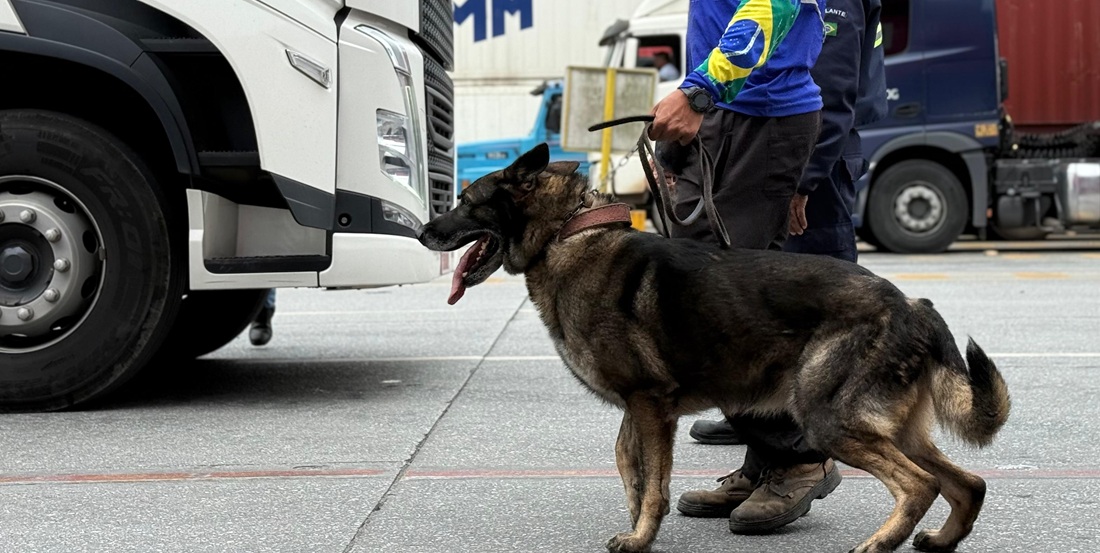
Drug trafficking simulation at the Port of Paranaguá uses sniffer dogs
Sep, 29, 2025 Posted by Lucas LorimerWeek 202541
Teams from the Portos do Paraná Security Unit (UASP) and TCP, the company that operates the Paranaguá Container Terminal, carried out a simulated anti-drug trafficking operation at the Port of Paranaguá. The activity, held last Wednesday (24), included four sniffer dogs searching for narcotics in bags, general objects, and the cabins of trucks.
“The goal is to integrate all terminals and all security teams so they can act as quickly as possible in combating illicit acts in the customs area,” said Vinicius Gomes dos Santos, UASP’s security and patrol coordinator, who supervised the simulation alongside another coordinator and five port security guards.
The operation took place at Paranaguá, in front of the access gate for light vehicles and the Gate (truck entry and exit). “The action against illegal activities and drug trafficking reinforces the partnership between security teams to act quickly and effectively in protecting the port area,” said TCP’s Health, Safety, and Environment Manager, Kayo Zaiats.
Although the simulation focused on team training, response time calculation, and the application of technical routines, some actions were real. Truck drivers accessing the terminal were approached and instructed to disembark so that the sniffer dogs could inspect the inside of the cabins and the exterior of the vehicles. TCP receives, on average, more than 1,000 trucks per day for container drop-off and pick-up.
Security investments
In 2022, the Port Guard unit was inaugurated, featuring a large monitoring center, as well as new guardhouses at the automobile yard and the liquid bulk public pier. Portos do Paraná also upgraded baggage scanners, replaced revolvers with semi-automatic weapons, acquired three new patrol vehicles, and installed a new radio communication system. In 2025, two patrol boats were purchased — one for the Port Guard and another for inspections, currently under construction.
Security professionals also undergo specific training. In November last year, three Port Guard classes completed their firearm license renewal course, which included theoretical and practical modules. After training, agents began using modern equipment, which was previously reserved only for situations of extreme necessity.
Beyond dockside inspections, the Port Guard also operates outside the customs area. During the 2024/2025 cruise season, Portos do Paraná installed 20 surveillance cameras at the Mega Rocio Complex, where passengers pass through customs. The system is monitored 24 hours a day, and any suspicious behavior is immediately reported to other security agencies. Images are shared with the Federal Revenue Service and the Federal Police, responsible for enforcement.
Another precaution concerns luggage. Before boarding, suitcases and backpacks are scanned, with the assistance of sniffer dogs to detect any possible illicit items. All movement, from the terminal to the pier, is monitored by security agents.
TCP also invests continuously in infrastructure and security. In 2024, it completed the modernization of the Gate, with an investment exceeding R$30 million. Automation and monitoring systems were implemented, including cameras with optical character recognition (OCR) technology and biometric totems for drivers, making entry and exit processes faster and safer.
Currently, TCP has more than 400 monitoring cameras, 13 armed guard posts operating 24/7, an intrusion alarm system, and two scanners through which all cargo entering or leaving the terminal is inspected.
Simulations
Portos do Paraná frequently conducts simulations. In May this year, an exercise was held in Paranaguá involving a train, a bus, and a car. The action, organized by the 8th Military Fire Brigade, was supported by Portos do Paraná, the SAMU Litoral emergency service, Rumo Logística, the Municipal Guard, Civil Defense, and the Military Police.
The port authority’s role was to activate companies in the Mutual Aid Plan (PAM) to assist the Fire Department and the affected company, in this case, Rumo, in responding to the incident.
Source: Portos do Paraná
-
Ports and Terminals
Mar, 30, 2020
0
Port of Itajaí records 22% growth in container handling in February
-
Shipping
Apr, 03, 2023
0
Boxship demolition slows to crawl
-
Ports and Terminals
Mar, 28, 2021
0
Ordinance authorizes ports to develop idle areas
-
Ports and Terminals
Aug, 23, 2024
0
Santos looks into implementing Export Processing Zone