


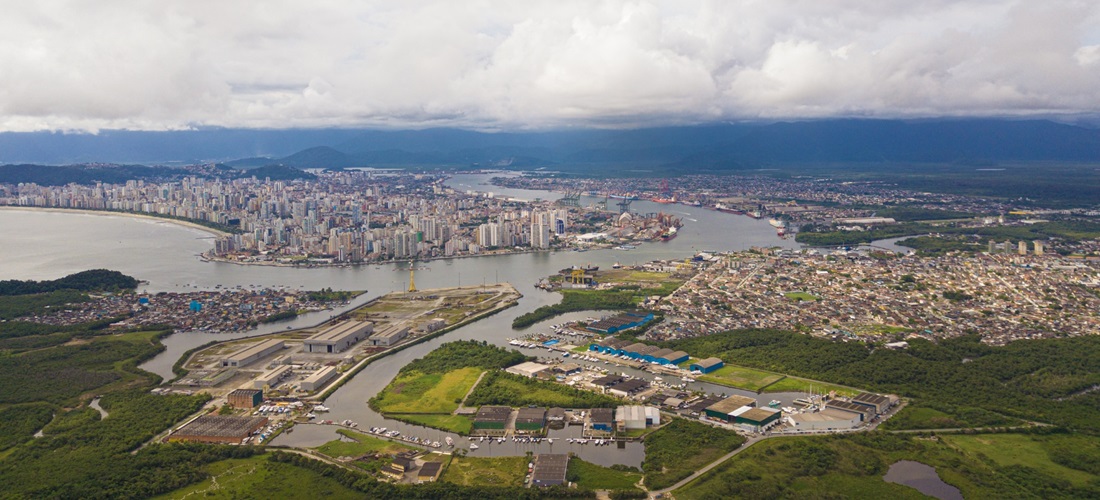
Brazil lawmakers, Santos mayor push for new port revenue transfers to cities
Oct, 02, 2025 Posted by Lucas LorimerWeek 202541
A proposal to create a new revenue stream for port municipalities from port income, included in Bill 733/2025, revising Brazil’s port framework, has gained support from lawmakers on the lower house’s special commission and the mayor of Santos, Rogério Santos (Republicanos). The issue was highlighted on Tuesday (30) during a meeting with the commission at Santos City Hall.
Articles 92 to 97 of the bill address port-city relations. Article 97 establishes that port municipalities would receive 1% of the port authority’s annual gross revenue from tariffs, along with 5% of concession or lease fees paid by winning bidders. If a port spans more than one city, the funds would be divided proportionally based on cargo volumes handled over the past 12 months. Payments would be made directly by the port authority to the municipalities.
Federal deputy Paulo Alexandre Barbosa (PSDB) argued that city governments are entitled to compensation for the impacts of port activity. Mayor Rogério Santos voiced support for additional revenue from port tariffs, saying the funds would be earmarked for local social and logistics investments. “These resources should offset the impacts of port activity, such as beach loss, marine pollution, and mobility problems. It is essential to balance the port’s economic importance with residents’ quality of life,” he said.
Arthur Maia (União-BA), the commission’s rapporteur, called the revenue-sharing “fair,” noting that “port activity brings benefits but also burdens for cities like Santos and Guarujá. You can’t build a good port-city relationship without transferring money.”
But the president of the Santos Port Authority (APS), Anderson Pomini, opposed the measure, citing Santos’s Complementary Law 793/2013, which requires port companies to carry out neighborhood impact studies. He said that the provision alone has raised more than R$500 million for the city. Pomini argued that similar local laws would be a better model for other municipalities tied to the port.
Industry opposition
Port terminal associations criticized the plan during a public hearing in Brasília last week. Jesualdo Silva, president of the Brazilian Association of Port Terminals (ABTP), said existing legal tools are sufficient to balance urban development with port activity. Murillo Barbosa, head of the Private Port Terminals Association (ATP), said applying a blanket policy to all terminals is misguided.
Caio Morel, executive director of the Brazilian Association of Container Terminals (Abratec), noted that the sector already pays service taxes (ISS) and argued the issue should not be included in the bill. Sérgio Aquino, president of the National Federation of Port Operations (Fenop), stated that companies already pay tariffs and taxes, warning that additional revenue transfers could discourage investment in port assets.
Source: A Tribuna
-
Automotive
Jul, 14, 2022
0
Brazilian motorcycle exports drop 4.4% YTD with increases expected ahead
-
Ports and Terminals
Feb, 26, 2024
0
Brazil’s Paranagua port resumes operations after berths shut by fire
-
Sugar and Ethanol
Jan, 26, 2023
0
Brazilian exports to Arab countries hit all-time record
-
Shipping
Mar, 10, 2022
0
Maersk and MSC are caught up in the STS10 auction dispute in the Port of Santos