

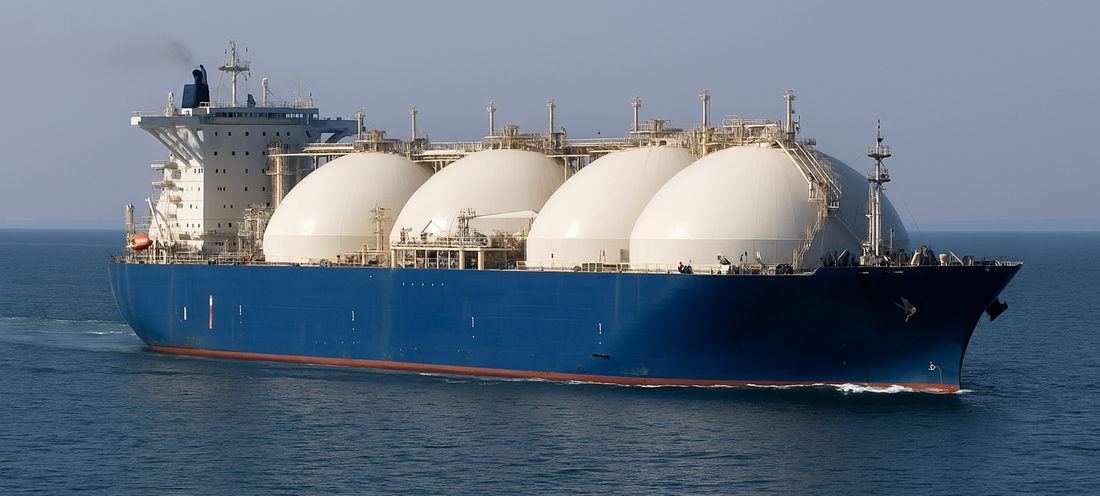
LNG demand as marine fuel set to double by 2030, industry says
Oct, 03, 2025 Posted by Lucas LorimerWeek 202541
Demand for liquefied natural gas (LNG) as a marine fuel is expected to double by at least 2030, according to industry executives. The driver is an abundant supply and tightening emissions regulations, which have been boosting orders for ships capable of running on this fuel.
Export projects in the United States and Qatar are expected to generate an oversupply of LNG through 2030, which will lower prices and increase its competitiveness against conventional, more polluting fuel oil.
LNG is outperforming other fuels in the shipping sector’s decarbonization process—which accounts for around 3% of global emissions—because supply and infrastructure hurdles cloud the prospects for cleaner alternatives such as methanol and ammonia.
“Owners will ultimately choose the fuel that offers the lowest cost,” said Tuomas Maljanen, associate director of LNG and new energies at shipping corridor Fearnleys.
“LNG is excellent because the infrastructure already exists. It’s easily available… and maybe later, hopefully, it will also be quite cheap,” he added.
Singapore, the world’s leading bunkering hub, led global LNG bunkering activity in the third quarter, followed by China and the Netherlands, according to consultancy Rystad Energy. The country plans to issue additional licenses for fuel supply.
Global LNG bunkering volumes could exceed 4 million tonnes by the end of 2025 and double by 2030, said Jo Friedmann, senior vice president of supply chain research at Rystad Energy.
French major TotalEnergies projects that global demand for LNG and bio-LNG as a marine fuel will soar to 15 million tonnes by 2030.
Currently, about 781 dual-fuel ships can use LNG, according to data from classification society DNV.
“Based on the current orderbook, the number of vessels will be 1,417 by 2030, but we expect it to rise as new orders are confirmed,” said Kristian Hammer, AFI product manager and senior consultant at DNV.
Immediate reduction
LNG bunkering cuts fuel oil emissions by 19% on a “well-to-wake” basis (from extraction to end use), according to Mitsui O.S.K. Lines, which owns the world’s second-largest fleet. The company operates 15 LNG dual-fuel vessels and has another 42 on order.
“Until zero- or near-zero-emission fuels are widely available, LNG remains a realistic option to decarbonize shipping in terms of availability, cost-effectiveness, and safety,” the company said.
Maersk, which until last year was focused exclusively on green methanol as an alternative fuel, has ordered 20 LNG dual-fuel container ships for delivery between 2028 and 2030.
TotalEnergies expects LNG to surpass other alternative marine fuels, such as methanol and ammonia, after 2030. “Production of renewable methanol and ammonia is still in an early stage, with limited bunkering infrastructure and a lack of economic competitiveness versus conventional fuels—factors that must be overcome before large-scale adoption,” the company highlighted.
Regulations
Europe’s FuelEU standard, which came into effect this year, caps the carbon intensity of ship fuels used at its ports and is expected to drive greater adoption of LNG bunkering.
This month, a committee of the International Maritime Organization (IMO) will vote on a rule drafted in April that imposes emissions tariffs on non-compliant ships and rewards vessels that use cleaner fuels, starting in 2028.
However, the United States rejected the deal, and a group of major shipping companies is demanding changes.
“Until IMO regulations come into force, LNG bunkering activity remains highly sensitive to LNG fuel prices, especially for vessels operating on routes outside the European Union,” said Friedmann of Rystad.
LNG prices as a marine fuel averaged $247 per metric tonne above marine fuel oil during the first nine months of this year, according to S&P Global data. However, the expected LNG oversupply by the end of the decade is widely seen as putting downward pressure on prices.
AI-generated image
Source: Portal Portuario
-
Ports and Terminals
Feb, 08, 2022
0
Imbituba has its best January performance in history
-
Grains
Jun, 02, 2022
0
Maize: line-up points to 1,162M tonnes in June
-
Meat
Sep, 30, 2021
0
China’s meat industry suffers from high feed cost due to energy crisis
-
Trade Regulations
Jul, 23, 2025
0
Brazil Tells EU It Will Not Reopen Mercosur Trade Deal