


Brazil requires 60% local content for vessels under tax benefit program
Oct, 06, 2025 Posted by Lucas LorimerWeek 202541
The National Energy Policy Council (CNPE) approved on Wednesday (October 1) two resolutions setting a minimum of 60% local content for companies seeking the benefit of accelerated depreciation when acquiring new vessels. The benefit is provided under Law 14.871/2024.
Accelerated depreciation is a public policy tool tied to the purchase of machinery and equipment. When a company acquires a capital good, its value can be deducted from Corporate Income Tax (IRPJ) and Social Contribution on Net Profit (CSLL). Normally, this deduction is gradual and can take up to 20 years. With accelerated depreciation, in the case of vessels, the deduction is made in two years, stimulating the renewal of machinery and equipment in Brazil’s industrial base, increasing productivity and energy efficiency.
For the program to take effect, a presidential decree is still required. The benefit will apply to acquisitions made between the publication of the decree and December 31, 2026, provided that local content requirements are met.
“The regulation of local content, one of the industrial policy instruments of Nova Indústria Brasil (NIB), acts as a counterpart to accessing this policy that stimulates fleet renewal, strengthening the country’s production chain,” said Uallace Moreira, Secretary of Industrial Development, Innovation, Commerce, and Services at the Ministry of Development, Industry, Commerce, and Services (MDIC).
The new rules apply to large oil tankers exceeding 15,000 deadweight tonnes, coastal gas carriers, and offshore support vessels.
Local content requirements
According to the CNPE’s decision, offshore support vessels must meet a minimum of 60% local content, as well as 50% in at least two of the three investment groups: engineering, machinery, equipment, and materials; and construction and assembly.
The text provides exceptions for innovative vessels, such as those with plug-in hybrid propulsion or equivalent sustainable technologies. In these cases, the minimum global content index will be 50%, with at least 40% in each of the three investment groups.
For large oil tankers intended for transporting oil and derivatives, as well as for gas carriers, the minimum global local content index was set at 50%, with investment group subdivisions to be specified.
As part of the Nova Indústria Brasil program, local content will be measured by the share of goods produced and services provided in Brazil relative to the total value of the vessel’s construction.
Monitoring
The National Agency for Petroleum, Natural Gas, and Biofuels (ANP) will be responsible for measuring and overseeing compliance with these requirements, ensuring transparency and predictability for the sector. Results will be reported to the MDIC.
In the shipbuilding sector, Brazil currently has a well-structured industrial system, with 19 large shipyards located along the coast and on the Amazon River, capable of meeting most of the national demand for vessels.
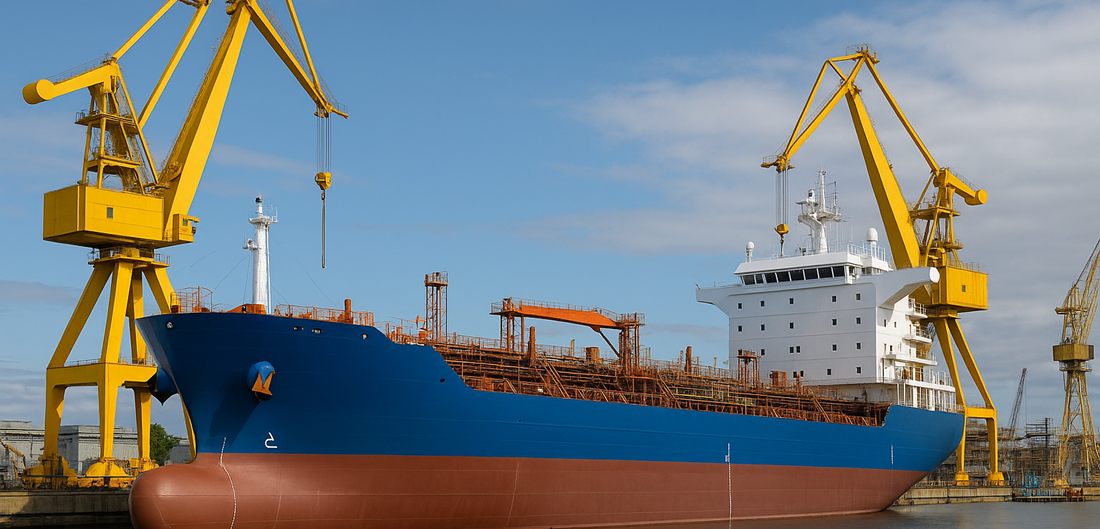
Image generated by Artificial Intelligence
Source: Informativo dos Portos
-
Ports and Terminals
Feb, 26, 2019
0
Santos dockers decide whether to strike
-
Meat
Jun, 12, 2026
0
Vietnam clears two more Brazilian beef plants for exports
-
Other Cargo
Nov, 16, 2021
0
CCGL concludes Brazil’s first dairy export to China
-
Ports and Terminals
Dec, 27, 2019
0
Port of Pecem triples amount of wind blades moved in 2019