


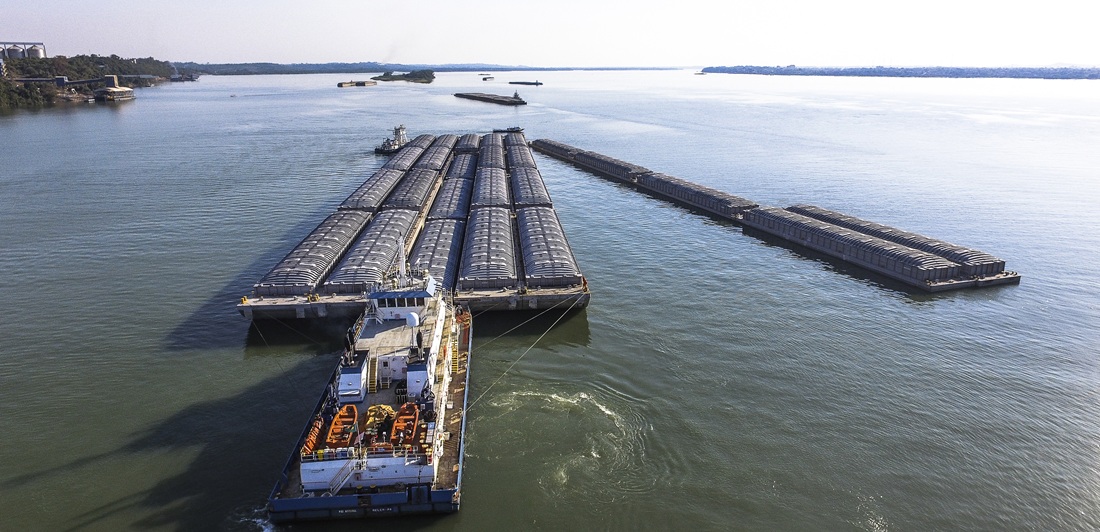
Port sector launches COP30 manifesto in defense of inland navigation
Nov, 20, 2025 Posted by Lucas LorimerWeek 202548
Five entities representing Brazil’s port and waterway sector launched a manifesto at COP30 — the 30th United Nations Climate Change Conference — defending inland navigation as a “cleaner, more efficient and more inclusive transport mode”. Released on Monday evening (11/17), the document, titled “Letter to the World – COP30: The Sustainable Strength of Inland Waters”, highlights that the country, with one of the largest river networks on the planet, is crossed by “true natural highways” (Amazon, Tocantins, Madeira, Tapajós, São Francisco, Paraná, Paraguay, among others), which connect regions, boost economies and respect the environment.
The Letter was jointly developed by ADECOM (Agência de Desenvolvimento Sustentável das Hidrovias e dos Corredores de Exportação), ABANI (Associação Brasileira para o Desenvolvimento da Navegação Interior), AMPORT (Associação dos Terminais Portuários e Estações de Transbordo de Cargas da Bacia Amazônica), ATP (Associação de Terminais Portuários Privados), and FENOP (Federação Nacional das Operações Portuárias). According to the document, inland navigation is more than a logistics mode: it is a strategic asset for sustainable development.
The entities stress that a river convoy carries the equivalent of hundreds of trucks, with much lower energy consumption and drastically reduced emissions. This translates “into logistics gains, competitiveness for agribusiness and industry, and a decisive contribution to decarbonizing the transport sector”.
“The port and inland navigation sector is also investing in cutting-edge technologies and new decarbonization projects, including the use of renewable energy in terminals, green fuels, more sustainable vessels, and essential dredging to ensure efficiency, safety, and lower environmental impact in navigation. With this, we reaffirm our commitment to emission reduction, energy transition, and a future for the new generations based on the sustainable development of the country and aligned with global requirements,” says Murillo Barbosa, president of ATP.
Below is the full text of the “Letter to the World – COP30”, signed by the presidents of the five entities: Adalberto Tokarski (ADECOM), José Rebelo III (ABANI), Flávio Acatauassú (AMPORT), Murillo Barbosa (ATP), and Sérgio Aquino (FENOP).
LETTER TO THE WORLD – COP30
The Sustainable Strength of Inland Waters
Belém do Pará, 2025
To the world gathered at COP30,
Brazil, land of majestic rivers and abundant hydrographic basins, presents to the international community a concrete and inspiring proposal for ecological transition: inland navigation as a symbol of cleaner, more efficient and more inclusive transportation.
With one of the largest river networks on the planet, Brazil is crossed by true natural highways — Amazonas, Tocantins, Madeira, Tapajós, São Francisco, Paraná, Paraguai and many others — which connect regions, boost economies and respect the environment. Inland navigation is more than a logistics mode: it is a strategic asset for sustainable development.
A river convoy carries the equivalent of hundreds of trucks, with much lower energy consumption and drastically reduced emissions. This results in logistics gains, competitiveness for agribusiness and industry, and a decisive contribution to decarbonizing the transport sector.
In addition to its environmental efficiency, inland navigation plays a transformative social role: it connects communities, generates jobs, strengthens productive chains and guarantees sovereignty over inland waterways — especially in the Amazon, where the rivers are the main link of mobility and citizenship.
But the future demands action. To unlock the full potential of waterway transport, it is essential to invest in resilient and safe infrastructure, signaling, sustainable dredging, connectivity and integration with rail and road modes. In passenger transport, it is urgent to expand port infrastructure and renew the fleet with more sustainable vessels.
Although still representing a modest share of the transport matrix, the waterway mode has been growing consistently, especially in agribusiness chains. Brazil has advanced with public policies that encourage the concession of waterway services, promoting a more efficient structure to expand the infrastructure needed for safe, predictable and environmentally responsible navigation in various river stretches.
At COP30, we reaffirm our commitment to valuing inland navigation as a strategic pillar of global decarbonization. May the rivers be seen not only as waterways, but as pathways to the future — where development and nature flow in harmony.
Between 2025 and 2035, Brazil is betting on a vigorous inland navigation, focusing on environmental sustainability, energy transition and innovation. We will promote the use of biofuels (HVO, biodiesel, ethanol, among others), the introduction of hybrid and electric vessels and progress toward climate neutrality, in line with the UN’s 2030 Agenda and the Paris Agreement.
Valuing inland navigation means recognizing that the future of Brazilian logistics also runs through the rivers. It means moving cargo, people and progress with intelligence, environmental responsibility and long-term vision.
Brazil navigates toward the future — and invites the world to embark on this mode toward cleaner, more efficient and more sustainable transport.
Signed:
Adalberto Tokarski – President of ADECOM
José Rebelo III – President of ABANI
Flávio Acatauassú – President of AMPORT
Murillo Barbosa – President of ATP
Sérgio Aquino – President of FENOP
Source: ATP
-
Ports and Terminals
Dec, 17, 2025
0
Federal Government to hold first block of port auctions of 2026 in February
-
Dec, 09, 2021
0
Covid-19: Anvisa approves sanitary measures for cargo ships
-
Coffee
Aug, 24, 2022
0
Coffee: August shipments reach 1,472 million bags mark
-
Other Logistics
Aug, 30, 2019
0
Ferroeste reaches last year’s revenue in eight months