


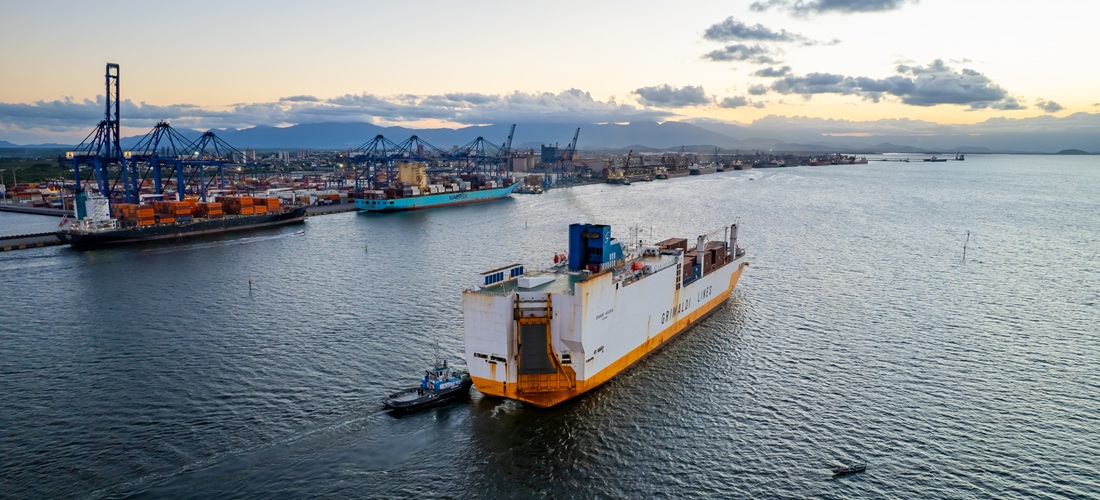
TCP increases operational draft, allowing ships to load up to 400 additional TEUs
Nov, 24, 2025 Posted by Lucas LorimerWeek 202548
TCP, the company that operates the Paranaguá Container Terminal, now operates with a draft of up to 13.30 meters, an expansion that allows the transport of approximately 400 additional TEUs of full containers per vessel. The update — formalized by Portos do Paraná through Ordinance No. 224/2025 and approved by the Brazilian Navy and the Pilotage Authority — is supported by simulation studies contracted by TCP, conducted in partnership with the University of São Paulo (USP), following the completion of the latest rock removal campaign promoted by Portos do Paraná.
The new draft limits were defined according to vessel size and divided into two operational conditions: zero tide and positive tide. For ships up to 300 meters long (LOA), the draft at zero tide increases from 12.80 to 13.00 meters, reaching up to 13.30 meters with 30 centimeters of positive tide.
Ships between 336 and 366 meters maintain the limit of 12.80 meters at zero tide but now operate with 13.10 meters with 30 centimeters of positive tide and with the maximum draft of 13.30 meters when the tide reaches 50 centimeters — levels higher than those of terminals in Santa Catarina, which operate with drafts between 11.00 m and 12.20 m depending on vessel size.
“In practice, the greater the authorized draft, the more cargo the ship is able to transport per voyage, generating a direct efficiency gain for shipping lines, importers and exporters without increasing operational costs,” explains Rafael Stein, Institutional and Legal Superintendent of TCP. “For this reason, this expansion represents more than an operational achievement: it is the validation of meticulous nautical engineering work that allows TCP to expand its transport capacity with total safety.”
TCP has been operating 366-meter ships since January 2024, when it received the MSC Natasha XIII, the first container ship of this size to berth at a Brazilian terminal. Vessels of the same dimension have been calling Paranaguá since then, but were not yet using their full capacity due to depth restrictions. With the new draft authorized by Portos do Paraná, these ships are expected to call the terminal regularly and depart more heavily loaded, with better use of ballast, cargo and tide windows.
The approval of these new parameters is supported by technical studies carried out at the Maritime Maneuver Simulation and Training Center of the Polytechnic School of USP, which used advanced mathematical modeling and high-precision simulators to test berthing and unberthing scenarios under various wind, current and tide conditions, including vessels up to 368 meters in LOA and 51 meters in beam. The simulations involved technical teams from TCP, Portos do Paraná, the Brazilian Navy and the Pilots’ Union, ensuring technical rigor and safety in defining the new operational limits.
As part of the improvements implemented, the studies also indicated the need to install an additional sensor on the tide gauges used to monitor tide conditions, an investment made in partnership between TCP and Paranaguá Pilots, benefiting the entire port sector. This measure reinforces the reliability of the information provided to pilots, ensuring greater precision in defining berthing windows and increasing navigation safety. For Julio Verner, President of the Pilots’ Union, “The study and recent investments were fundamental to expand the operational draft safely. This evolution ensures ideal conditions for operations with large vessels, reduces risks in complex maneuvers and consolidates Paranaguá as a port prepared to meet the demands of the new generation of ships. It is progress that combines technology, planning and safety.”
See below the history of long-haul container handling via the Port of Paranaguá. The chart was prepared using DataLiner data and excludes transshipment, cabotage and other internal movements:
Long-haul Container Handling at the Port of Paranaguá | Jan 2022 to Sep 2025 | TEU
Source: DataLiner (Click here to request a demo)
Structural investments ensured the advances
Since 2024, the operational draft of the access channel increased from 12.10 to 12.80 meters at zero tide after the removal of approximately 20 thousand cubic meters of rock at Pedras Palanganas. The fragmented material was donated to coastal municipalities for public works. The entire process was carried out with preventive and mitigation measures and periodic monitoring of fauna, flora and water quality.
Gabriel Perdonsini Vieira, Operations Director at Portos do Paraná, reinforces the strategic impact of these investments: “One of the major differentiators we had this year was the increase in our operational draft. We now have 13.3 m for the export and import of solid bulk cargo and now the increase to 13.3 m in the container segment. This is a major differentiator for our port, as it brings more competitiveness and directly influences the excellent handling results. We are increasing the operational draft to load and receive more cargo and berth larger ships, making our complex increasingly attractive and competitive.”
The draft expansion also comes at a moment of structural transformation of the access channel. In October, the concession auction for the channel was held, which foresees increasing the depth to 15.5 meters in the first five years of the contract, as well as modernizing nautical signaling, carrying out new dredging campaigns, promoting environmental actions and improving waterway infrastructure. The estimated investment for the Port of Paranaguá is R$ 1.23 billion, accompanied by a 12.63% reduction in the Inframar fee paid by vessels, a benefit dependent on meeting the targets established in the contract.
“With the future expansion of the channel to 15.5 meters, Paranaguá will position itself among the main deep-water ports in South America. The current authorization already generates immediate gains and is a decisive step toward receiving the new generation of container ships that is expected to dominate global routes in the coming years,” Stein adds.
TCP closed the first half of 2025 with 744,650 TEUs handled, remaining the largest container terminal in Southern Brazil and the third largest in the country, according to the Antaq Waterway Statistics. The draft expansion strengthens its position as a strategic hub for foreign trade and consolidates its readiness to operate large vessels with even greater efficiency.
Source: TCP
-
Coffee
Mar, 10, 2023
0
Brazil coffee exports down 35% as farmers hold on to remaining stocks
-
Oct, 04, 2022
0
Argentina: revenue from grain exports up 140% from a month ago
-
Shipping
Nov, 17, 2025
0
New Svitzer Copacabana tug strengthens LNG operations in Brazil
-
Trade Regulations
Feb, 20, 2020
0
Brazil registers trade balance deficit in January for first time since 2016