


Soybean Exporters predict calmer 2026 After US–China Trade Truce
Dec, 12, 2025 Posted by Lucas LorimerWeek 202550
Geopolitical tensions and commercial uncertainties marked the year 2025, but despite this, Brazilian exporters believe that 2026 will begin with a more favourable international outlook. The truce in the tariff war between China and the United States and the increased competitiveness of Brazilian products should ensure a year of good opportunities and a more stable environment, representatives of the sector say.
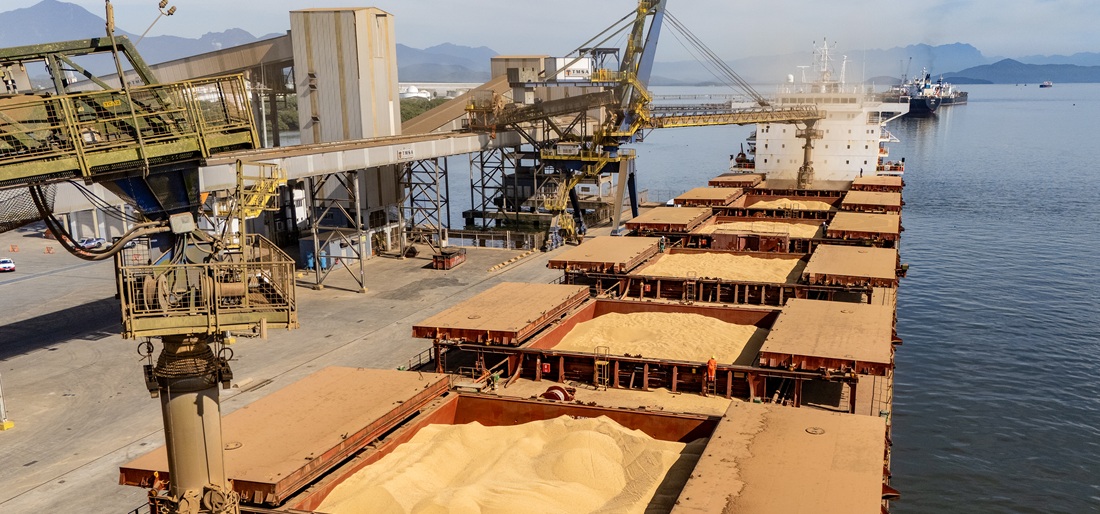
Soybean shipments, the main export item of Brazil’s agribusiness, are expected to grow and reach 112 million tonnes, an increase that will reflect higher production, according to the National Association of Grain Exporters (Anec). The entity estimates that exports will total 108 million tonnes in 2025. From January to November, according to Comex Stat, the foreign trade statistics system of the Ministry of Development, Industry, Trade and Services, the country exported 104.7 million tonnes.
In the geopolitical landscape, Anec believes the situation is beginning to return to normal after a period of tension from the trade war between the US and China, which temporarily benefited Brazilian soybean sales to the Chinese market. Within the association, the guideline is “to watch what China does, not what it says”, according to its leadership.
“The agreement [between the US and China] foresaw shipments of 12 million tonnes of American soybeans to China by the end of the year. That will not materialise. And the volume of 25 million tonnes per year over the next three years, also stipulated in the agreement, is entirely within the normal range of what the United States typically exports to China, while Chinese consumption continues to grow,” summarises Jean Carlo Budziak, head of market intelligence at Anec.
If this agreement is not broken, the entity’s view is that the market will “return to normal”. Even so, Budziak says supplying Chinese demand may be challenging, which would benefit Brazilian soybeans.
From January to November 2025, China was the destination for 80% of Brazilian soybean exports; last year, its share for the same period was 78%. In October this year, Brazil shipped 6 million tonnes to China, accounting for 94% of that month’s total shipments.
For Chinese importers, Brazilian soybeans are more competitively priced than American soybeans. “China will continue buying Brazilian soybeans, no doubt. We have already begun contracting Brazilian soybeans for the new crop,” says Lin Tan, director of the Chinese trading company Hopefull.
The executive believes that, over time, Brazilian soybeans will dominate the Chinese market. “China may buy some soybeans from the US and Argentina for stockpiling. But most of the time, they will prefer Brazilian soybeans to supply crushing industries,” says Lin Tan.
Regarding the supposed agreement to buy US soybeans, the executive says the Chinese side has never confirmed this information. “And if we are talking about China buying 12.5 million tonnes this year and then 25 million over the next three years, that is really nothing. Before the trade war, China was buying more than that,” he notes.
Asked whether China will continue buying US soybeans, Lin Tan says it is difficult to predict. “When you buy soybeans from the US, prices are very high, almost 100 cents per bushel above Brazil. So Brazil remains competitive. We, as a private company, will not buy because we do not want to pay such a high price,” he says.
He also notes that the US crushing industry has increased its capacity and will be able to process more soybeans than before the COVID-19 pandemic. For him, this gives Brazil an even larger international market.
Trade agreements
The geopolitical tensions of 2025 hindered business decisions and forecasts, but the year ended with a slightly less turbulent scenario. There are solutions underway for both the US tariff package on Brazil and the US–China trade conflict.
Larissa Wachholz, partner at Vallya Participações, says Brazil feared an agreement similar to the one signed between China and the US during Donald Trump’s first term, in which China was obliged to buy a fixed amount of soybeans from the US. At the time, this arrangement was detrimental to Brazil.
“But the scenario has changed a lot since then. First: China experienced a breakdown of trust in its relationship with the US. It was prepared for a moment when it could no longer depend as heavily on the US as before. Second: China increased its consumption of grains for animal feed,” she explains. On this point, she mentions the African swine fever outbreak between 2018 and 2019, which caused China to rethink animal feeding strategies.
This movement benefited Brazil, while US shipments changed little compared with historical levels, something between 20 million and 30 million tonnes per year. According to Wachholz, with China deciding to build large reserves as a protection strategy, 2025 ended up being an outlier.
The agreement between the US and China allowed exports to be “reset” to the same levels as before the disruption. “That is: at the end of 2025, we returned to a sense of normality. Yes, there is a purchase commitment from China, but within the historical levels it has already followed. Nothing that directly harms Brazil,” she argues.
The truce the two powers agreed to in November, valid for one year, ensures some stability in the international environment for 2026. “The agreement will be fulfilled — and my point is that it is not harmful to Brazil. In practice, it simply returns the China–US relationship to the levels of late 2024,” she adds, noting that beyond soybeans, the Chinese market has the potential to consume “virtually everything Brazil is capable of selling.”
Source: Globo Rural
-
Meat
May, 20, 2024
0
Brazil paves the way for new market in chicken meat exports
-
Oil and Gas
Aug, 17, 2022
0
Industrial port project geared to the offshore market to launch in Brazil’s Rio Grande do Norte
-
Datamar EN
Dec, 06, 2019
0
Container handling in Brazil grows 3% from January to October 2019
-
Meat
Sep, 10, 2020
0
PORK AND CHICKEN EXPORTS GROW 89% IN AUGUST