


Rio de Janeiro Port to receive R$948 million private investment to expand container terminal
Dec, 12, 2025 Posted by Lucas LorimerWeek 202550
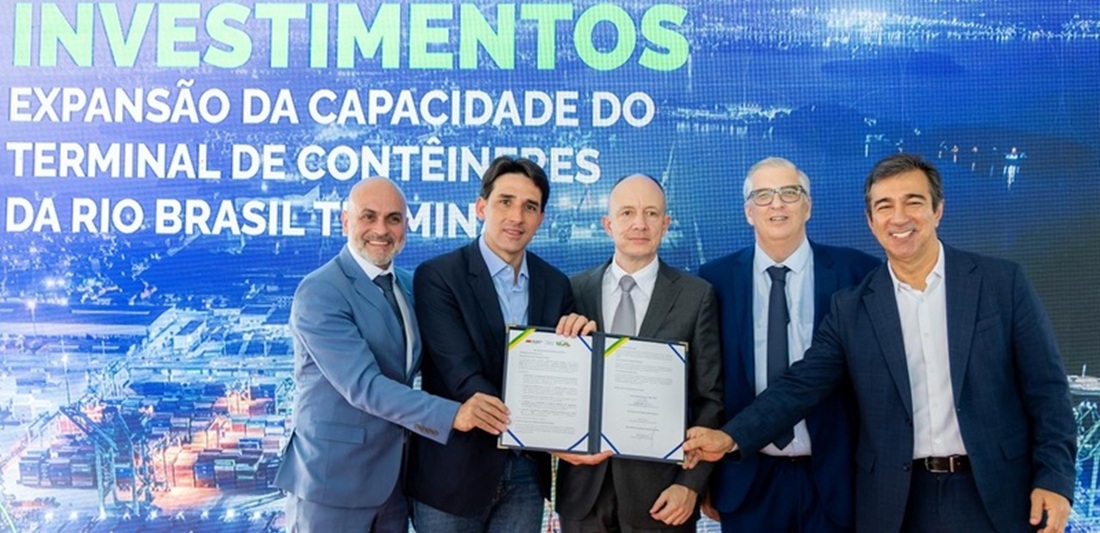
Brazil’s Minister of Ports and Airports (MPor), Silvio Costa Filho, announced on Friday morning (12), at the Port of Rio de Janeiro, a new R$948 million private investment for the expansion and modernization of Rio Brasil Terminal, operated by ICTSI at the Port of Rio de Janeiro (RJ). The project will be carried out between 2025 and 2029. It will increase the terminal’s operational capacity by 70.5%, rising from 440,000 TEU/year to 750,000 TEU/year, consolidating Rio de Janeiro as a strategic logistics hub for the Southeast and Center-West regions.
During the announcement, the minister emphasized that the expansion is decisive for the port’s growth and for strengthening foreign trade. “It is an investment of almost R$1 billion that will be fundamental for expanding our operations here at the port, from 440,000 to 750,000 TEU and, in the future, perhaps reaching 1.2 million,” he said. According to the minister, the measure also directly affects jobs and income. “I always say: the biggest social program in Brazil is employment and income,” he added, highlighting the potential for job creation with the terminal’s expansion.
Costa Filho also highlighted the Port of Rio de Janeiro’s performance in 2025, noting that the investment policy is part of a strategy to increase the competitiveness of the national port system. “Until November 30, the Port of Rio grew 14% in cargo handling. This is important because, when we align the port with the Federal Government, the state government, and municipalities, we strengthen the country’s production chain and logistics,” he said.
Below is a historical overview of long-haul container movement at the Port of Rio since January 2022. The chart was prepared with DataLiner data and excludes cabotage, transshipment, and other internal movements:
Long-Haul Cargo Movement via Port of Rio | Jan 2022 to Oct 2025 | TEU
Source: DataLiner (Click here to request a demo)
Expansion, equipment, and technology
The investment plan combines infrastructure works and the acquisition of state-of-the-art equipment, including measures to automate and increase operational efficiency. Planned initiatives include the unification and expansion of storage yards, the rearrangement of buildings to optimize internal flows, the modernization of utility and electrical systems, and the purchase of new equipment for container handling.
The project also includes implementing advanced access control, monitoring, and cargo management systems, with adaptations to meet recent regulatory requirements, particularly those of the Federal Revenue Service. It also incorporates environmental sustainability measures aligned with the ICTSI group’s global commitments to responsible operations and decarbonization.
For the minister, initiatives like this increase competitiveness and provide predictability to the sector. “What we want is to give security to businesses, reduce bureaucracy, and improve the business environment, working alongside regulatory agencies and oversight bodies,” he said.
A new phase of growth
Roberto Lopes, CEO of Rio Brasil Terminal, noted that the concessionaire marked six years of operation on the same date and highlighted the company’s strategy of continuous improvement. “Today we complete six years as part of the ICTSI Group. Since then, we have been able to invest heavily in the Port of Rio, always focused on delivering the best service possible, driven by a passion for serving and the pursuit of being 1% better every day,” he said.
According to Lopes, the expansion complements other initiatives aimed at strengthening logistics in the state and increasing connectivity with other regions. “This effort adds to our investments in the Rio–Minas and Rio–Suzano logistics corridors, with an emphasis on rail transport. This expansion will not only increase Rio Brasil Terminal’s capacity but will also help ease congestion in other ports by better distributing port demand across the country,” he stated.
He also emphasized that the investment represents “an internal and external transformation” to enhance deliveries for foreign trade and reinforce Rio de Janeiro’s logistic role.
Larger vessels, more efficiency, and predictability
With the expansion, the terminal will be able to operate large vessels more efficiently along the full berth, including New Panamax and Post-Panamax ships up to 366 meters long, with capacities exceeding 13,000 TEU. The schedule foresees the arrival of the first new cranes starting in mid-2026, prepared to handle even larger ships, in line with the global trend of increasing vessel size along the east coast of South America.
Costa Filho highlighted that Brazil’s port sector is experiencing strong growth and investment. “The Brazilian port sector is undergoing the largest volume of concessions in history. And this is essential to place the country on the development path,” he said.
Lopes added that the project is essential for maintaining the Port of Rio’s competitiveness as demand increases. “This investment is essential for Rio to increase its efficiency and maintain competitiveness while absorbing part of the demand currently concentrated in other ports. It is a project that benefits not only the terminal but the entire economy of Brazil’s Southeast and Center-West regions,” he stated.
With full implementation of the investments, the terminal is expected to operate at around 75% utilization between 2029 and 2030, providing more predictability to the logistics chain, with smoother operations, controlled wait times, reduced costs, and greater resilience to bottlenecks at other ports. Projections indicate that without these interventions, the terminal would reach saturation between 2027 and 2028.
Global presence and long-term commitment
ICTSI is the world’s largest independent port operator, with operations in 33 terminals across 19 countries. Anders Kjeldsen, ICTSI’s Vice President for the Americas, reinforced the company’s commitment to Brazil. “In Brazil, we are focused on bringing the highest international standards of operational efficiency and technological development to our operations. This project demonstrates our long-term commitment to enhancing Brazil’s logistical competitiveness,” he concluded.
-
Automotive
Jan, 03, 2019
0
Brazil’s auto industry shows signs of recovery, auto sales up 13.6%
-
Ports and Terminals
Jun, 10, 2025
0
Ibama Requests Revisions to Environmental Impact Study for Arroio do Sal Port
-
Ports and Terminals
Jun, 03, 2025
0
Imbituba Port in Southern Brazil Gains Competitiveness Through Investments and Infrastructure Projects
-
Shipping
Jun, 17, 2024
0
Containers lost at sea at record low levels