

Surge in Exports to China Offsets U.S. Tariff Impact
Dec, 19, 2025 Posted by Sylvia SchandertWeek 202551
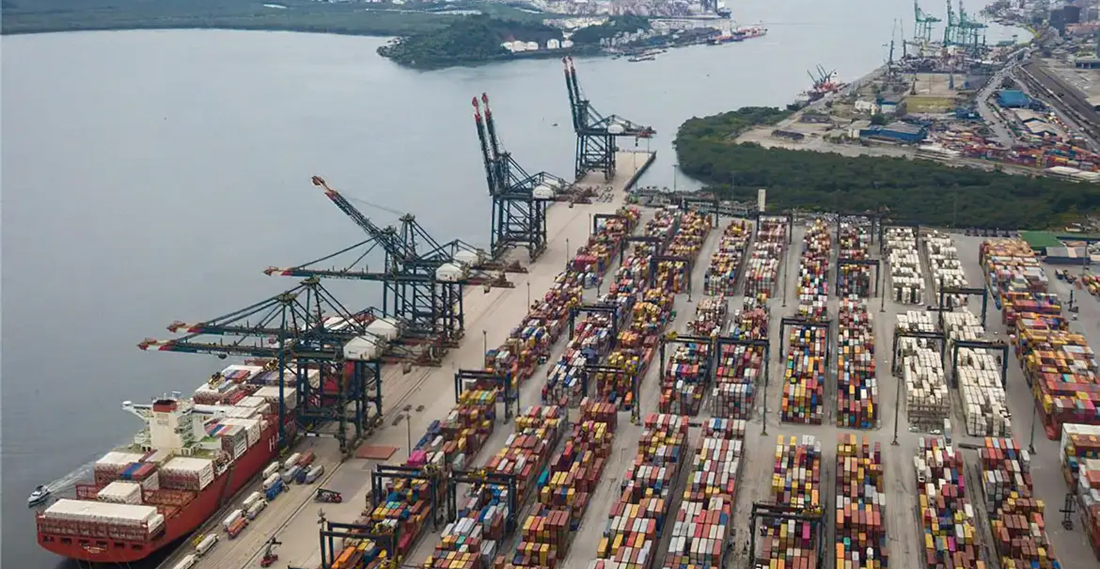
The advance of Brazilian exports to China offset the decline caused by the U.S. tariff hike, which began in August with surcharges of up to 50% on Brazilian sales to the United States.
From August to November, the value of exports to China rose 28.6% compared with the same period in 2024, while shipments to the United States fell 25.1%.
A similar pattern is seen in export volumes. Shipments to Chinese ports and airports increased by 30%, whereas exports to the United States dropped 23.5%.
What differentiates the behavior of values and volumes is the price of the exported products.
The data are part of the Foreign Trade Indicator (Icomex), released on Thursday (18) by the Brazilian Institute of Economics (Ibre) at Fundação Getulio Vargas (FGV).
The study analyzes data from the Foreign Trade Secretariat of the Ministry of Development, Industry, Trade and Services (MDIC).
See below a historical overview of Brazilian container exports to China starting in January 2022. The chart was prepared using DataLiner data:
Brazilian Container Exports to China | Jan 2022 to Oct 2025 | TEU
Source: DataLiner (Click here to request a demo)
China is Brazil’s main trading partner, ahead of the United States. According to Icomex, China’s share, which absorbs around 30% of Brazilian exports, helped offset the decline in sales to the United States.
“[U.S. President Donald] Trump overestimated the United States’ ability to inflict broad damage on Brazilian exports,” the report states.
Affected sectors
The sectors that recorded the sharpest declines in exports to the United States between August and November were:
- Non-metallic mineral extraction: –72.9%
- Beverage manufacturing: –65.7%
- Tobacco products manufacturing: –65.7%
- Metallic mineral extraction: –65.3%
- Forestry production: –60.2%
- Manufacturing of metal products, except machinery and equipment: –51.2%
- Wood products manufacturing: –49.4%
Annual performance
FGV’s research notes that export volumes to the United States increased consecutively from April to July when compared with the same months in 2024. However, after the tariff hike took effect, four consecutive months of contraction followed.
Change in export volume to the United States in 2025, compared with the same month in 2024:
April: +13.3%
May: +9.0%
June: +8.5%
July: +6.7%
August: –12.7%
September: –16.6%
October: –35.3%
November: –28.0%
Exports to China, meanwhile, jumped after the tariffs came into force:
- April: +6.4%
- May: +8.1%
- June: +10.3%
- July: –0.3%
- August: +32.7%
- September: +15.2%
- October: +32.7%
- November: +42.8%
Ibre/FGV associate researcher Lia Valls points out that one of the factors behind the surge in exports to China was soybean shipments, which were concentrated in the second half of the year.
“When exports to the United States started to fall, exports to China began to rise more strongly, and this had an impact on the country’s overall exports,” she told Agência Brasil.
In the cumulative total through November, Brazil’s total exports increased 4.3% compared with the same 11 months of 2024.
Argentina
Icomex also shows the performance of exports to Brazil’s third-largest trading partner, Argentina. From August to November, shipments to the country increased 5% in value and 7.8% in volume compared with the same period last year.
Lia Valls notes that this increase is not decisive in offsetting the effects of the tariff hikes.
“Argentina’s share in Brazil’s export basket is very small. Argentina is heavily focused on automobile exports, and Brazil hardly exports automobiles to the United States,” she explains.
Understanding the tariff hike
The tariff hike imposed by U.S. President Donald Trump came into effect in August 2025. By raising tariffs on imported products, the U.S. government argues that it aims to protect the American economy, encouraging domestic production instead of imports.
In Brazil’s case, which faced some of the highest rates, Trump also claimed the measure was retaliation for Brazil’s treatment of former president Jair Bolsonaro, whom Trump argued was being persecuted before being convicted by Brazil’s Supreme Federal Court (STF) in September 2025 for attempted coup d’état.
Since then, the Brazilian and U.S. governments have been negotiating ways to restore the trade partnership, including direct talks between Trump and President Luiz Inácio Lula da Silva.
On the 20th, Trump removed an additional 40% tariff on 269 products, 249 of them from the agribusiness sector, such as meat and coffee.
“The effects of this removal will only become visible from December and January onward,” Icomex notes.
Vice President and Minister of Development, Industry, Trade and Services Geraldo Alckmin estimates that 22% of exports to the United States remain subject to surcharges.
Source: Agência Brasil
-
Nov, 07, 2024
0
Unprecedented study reveals extent of racial disparity in Brazilian foreign trade
-
Environment and Sustainability
Nov, 28, 2024
0
Maersk could use 15-20% alternative fuels for its fleet in 2030
-
Ports and Terminals
Aug, 19, 2020
0
ANTAQ authorizes MFX to operate private use terminal in Salvador
-
Other Cargo
Dec, 30, 2025
0
Brazil raises import tax on solar panels and electric vehicles to up to 35% by 2026