


Asia gains ground in Brazil’s trade amid Trump policy shift
Feb, 02, 2026 Posted by Sylvia SchandertWeek 202606
The trade and foreign policy of U.S. President Donald Trump has fueled a strategic push by China and other Asian nations into new markets, deepening their dominance in Brazilian imports during the post-pandemic period. This shift has left other regions, including Brazil’s South American neighbors, with shrinking trade shares.
Economists say the shift has strengthened the complementarity of trade relations between Brazil and Asian countries. The question now is how these ties will hold up amid current geopolitical shifts.
Asian countries accounted for 38.9% of Brazil’s imports in 2025, up from 33.6% in 2019. This 5.3-percentage-point jump came as other regions lost ground.
The European Union’s fell by 0.9 point. The Middle East, Africa, and Oceania each slipped 0.1 point, and North America dropped by 3.3 points. South America’s share declined by 1.8 points, including a 1.3-point drop for the Mercosur bloc. The only region gaining share besides Asia was Central America and the Caribbean, up from 0.4% to 0.7%.
Overall, Brazil’s imports grew 50.8% between 2019 and 2025, while imports from Asia surged 74.4%. China led the pack with a 96.9% jump, reaching $70.93 billion in 2025.
See below a historical overview of Brazilian imports from China starting in January 2022. The chart was prepared using DataLiner data:
Brazilian containerized imports from China | Jan 2022 to Nov 2025 | TEU
Source: DataLiner (Click here to request a demo)
India came in second among Asian suppliers, with a smaller total of $8.35 billion but a steep 84.1% increase. India surpassed South Korea and Japan, which held the second and third positions in 2019. Imports from these two countries rose by just 5% and 27.7%, respectively, based on data from Brazil’s Foreign Trade Secretariat (Secex) under the Ministry of Development, Industry, Trade, and Services (MDIC).
On the export side, changes in regional share were smaller and more evenly spread. Asia took in 43.1% of Brazilian exports in 2025, a 0.9-point increase from 2019. The share of exports to Africa rose by 1 point and to the European Union by 0.7 point. Mercosur gained 0.7 point as shipments to Argentina rebounded, but South America as a whole slipped by 0.3 point. The Middle East saw a similar decline, while exports to North America, affected by U.S. tariff hikes, fell by 2.1 points.
Future uncertainties
Uncertainty clouds the future of these trade patterns. A long-awaited trade agreement between the European Union and Mercosur was signed on January 17, but just four days later, the European Parliament decided to send it for legal review, a process that could take two years. Meanwhile, the EU signed a separate trade deal with India in late January.
Ligia Maura Costa, a professor at the São Paulo School of Business Administration of the Getulio Vargas Foundation (FGV EAESP), said the new India deal could further reduce the EU’s political will to push through the Mercosur agreement, especially given internal resistance from the agricultural sector.
Economists are also watching what some call the “Donroe Doctrine”—Trump’s adaptation of the Monroe Doctrine that places the Americas at the center of U.S. security policy. This, along with the American tariff hikes, may further reshape trade dynamics.
“The impact of the Donroe Doctrine depends on how the rest of the world responds,” said André Valério, economist at Banco Inter. “Trump essentially wants a new world order based on spheres of influence: South America as the U.S.’s backyard, Asia as China’s, Europe with Russia, and so on. We’ve already seen efforts from the EU to fight back, like the case of Greenland where EU countries sought a unified tariff against the U.S.”
José Augusto de Castro, head of Brazil’s Foreign Trade Association (AEB), said Trump’s trade policies are fueling global protectionism. He noted that China and Mexico have already imposed tariffs affecting Brazilian goods, and more countries may follow suit. Brazil, he added, remains exposed to shifts in U.S.-China relations.
Last year, China increased its purchases of Brazilian soybeans, but the U.S. and China could strike new deals that benefit American producers, hurting Brazil’s exports. “Brazil needs a foreign trade strategy,” Castro said. “Right now, the world is taking action, and Brazil is just reacting.”
Valério noted that in 2025, faced with the U.S. tariff wave, Brazilian exporters sought new markets and partnerships. “We saw that in the second half of last year, but there’s a risk that Brazil will become a target for Trump,” he said.
He believes Brazil’s best path forward is to diversify and pursue new trade agreements to strengthen its global integration. “What’s becoming clear is that the U.S. is no longer a first-call ally.” He added that China is emerging as a more stable and economically powerful trade partner.
Rise in Asian durable goods
In 2025, Brazil saw an unusual increase in imports of durable consumer goods from Asia, such as household appliances and small electronics, said Livio Ribeiro, partner at BRCG and researcher at the FGV Brazilian Institute of Economics (FGV Ibre). This trend includes Chinese electric vehicles, whose imports began in 2024 and are expected to continue.
“In response to Trump’s trade war, China and Asia as a whole started actively seeking to diversify markets,” Ribeiro said. Despite falling exports to the U.S., China ended 2025 with overall export growth and a record trade surplus. Chinese government data show a 5.4% increase in total exports in 2025, even as exports to the U.S. fell 19.9%.
“China managed to offset lost U.S. sales with gains elsewhere. It’s important to note that the composition of exports varies. What they sell to the U.S. isn’t always marketable elsewhere, and vice versa,” he said. “But beyond that, Brazil and Asia, especially China, are increasingly complementary in their trade profiles.”
Ribeiro said this process has been underway for nearly a decade, and it is natural that Asia—and China in particular—is becoming the dominant trade partner for Brazil. He also noted that China sits atop the value chain for many products that Brazil now buys from across Asia.
Valério added that China’s growing footprint in Brazil reflects an investment surge in recent years. After Brazil’s interest rates dropped sharply in 2020 during the pandemic, infrastructure investments boomed and the capital markets matured.
That led to a recovery in Brazil’s gross fixed capital formation to about 17%–18% of GDP, levels that historically generate import demand. “China is the world’s industrial core. So much of this investment translated into imports from China and the broader Asian region,” he said.
Johanna Guevara Mendez, an international trade consultant, said Brazil’s imports from China have diversified quickly since the pandemic, when China became a supplier of vaccines as well.
On the export side, Chinese investment in Brazil’s agribusiness—especially soybeans—also plays a role. In 2025, 79% of Brazil’s soybean exports went to China, according to Secex.
Ribeiro of BRCG pointed out a curious new trend: recent Chinese investments in Brazil sometimes include plans to use the country as an export platform, particularly for durable goods like vehicles. “We may see Brazil become a base for Chinese exports to Latin America and other regions in the southern hemisphere, possibly even Africa,” he said.
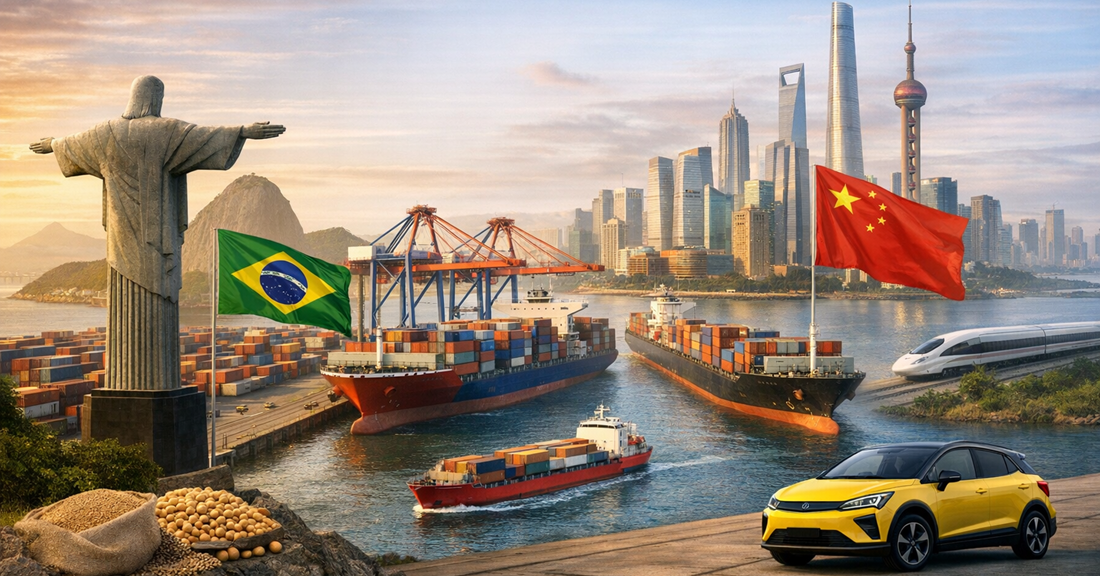
* Image generated by artificial intelligence
Source: Valor International
-
Ports and Terminals
Jan, 03, 2023
0
Paraná state expects BRL 1.2 mln for two port areas in Paranagua
-
Ports and Terminals
Nov, 14, 2023
0
Port of Itaguaí: Police Busts “Permanent Structure” For Drug Trafficking
-
Ports and Terminals
Feb, 11, 2025
0
São Francisco do Sul Port Administration Seeks Urgent Solutions for BR-280 Highway Bottleneck
-
Ports and Terminals
Sep, 04, 2023
0
New IEP Port to be inaugurated in Brazil’s Santa Catarina