

Port of Paranagua runs maneuver simulations ahead of infrastructure expansion
Feb, 06, 2026 Posted by Gabriel MalheirosWeek 202606
The Paranagua Port community has taken part in ship maneuver simulations to assess the feasibility of planned expansions, including the enlargement of the existing public liquid bulk pier (PPGL), the development of a new pier at the Liquids Terminal (PAR50), and construction of a new F-shaped pier structure for loading vegetable dry bulk.
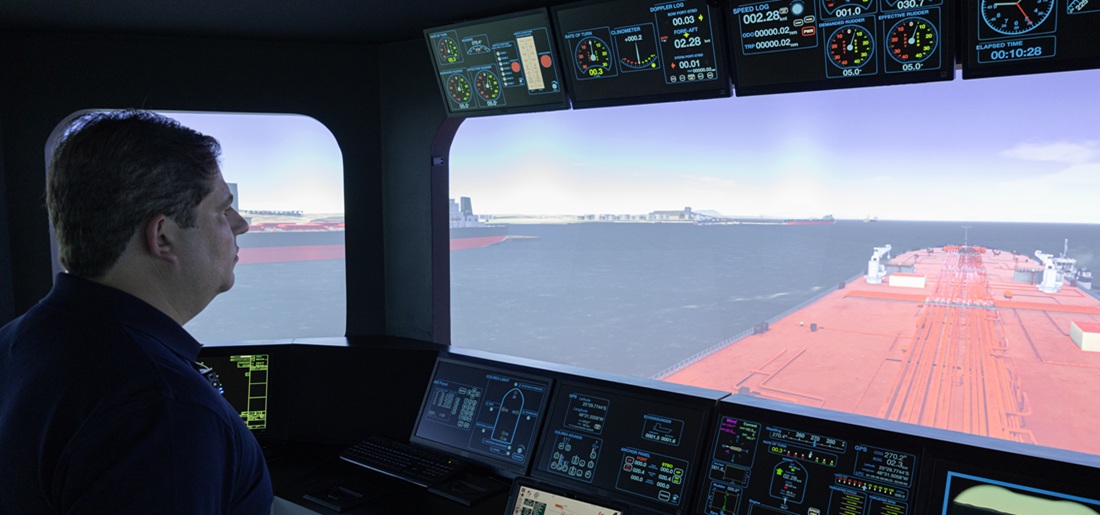
At the Numerical Towing Tank of the University of São Paulo (TPN-USP), pilots, tugboat masters and representatives from the local port authority and the Port Captaincy spent the past week analyzing, in a digital environment, scenarios involving berthing, unberthing and vessel movements under the future port layouts.
“The simulations focused on the expansion of the PPGL and the influence of the other structures under study. On the first day, we assessed how the implementation of the first phase of the F-shaped pier, planned for the western quay, would affect maneuvers at the PPGL. On the second day, we analyzed operations with the full F-shaped pier and the L-shaped pier at PAR50, also considering the expansion of the turning basin,” said Julia Bruch, coordinator for signaling, buoyage and monitoring at Portos do Paraná.
According to Bruch, the test scenarios were built using data collected in Paranaguá Bay, including tides, currents and wind gusts. Based on these inputs, the simulator performs calculations and projects, in real time, different maneuvering conditions for vessels.
“It is as if we had the pilot on board, guiding the ship’s master. The scenarios include both light and fully loaded vessels, current drafts and projections for future draft increases, allowing us to identify operational risks and assess how to mitigate them,” she said.
In Brazil, a pilot is a professional with in-depth knowledge of the local navigation area, from the channel entrance to the berth alongside the quay. The pilot is responsible for advising the ship’s master on precise navigation points and ensuring that all maneuvers are carried out with maximum safety.
According to Bruch, the USP technical team will now prepare a report consolidating the results. “The researchers will analyze all the data generated during the simulations, including the performance of pilots and tugboats, and will present technical recommendations for each scenario, taking into account factors such as tidal tables and current intensity,” she said.
Source: Porto de Paranaguá
-
Ports and Terminals
Oct, 28, 2019
0
Federal Police raises security level in Port of Santos
-
Economy
Sep, 04, 2025
0
New month of DataLiner data: Brazilian exports decline; industry drives imports
-
Ports and Terminals
Sep, 03, 2021
0
Bemisa Group formalizes interest in concluding the Suape branch of Transnordestina railway
-
Trade Regulations
Nov, 22, 2021
0
Brazil warns EU about discriminatory carbon tax plan