


Maritime shipping lane security gains global relevance, underscores Brazil’s strategic role
Mar, 24, 2026 Posted by Gabriel MalheirosWeek 202613
Maritime shipping lane security is drawing greater global attention amid rising tensions along strategic sea routes, including the recent increase in threats in the Strait of Hormuz in the Middle East. These ocean corridors connect markets and enable about 80% of global trade, sustaining flows of energy, food and other inputs essential to the world economy.
In that context, Brazil’s role in maritime shipping lane security is becoming more prominent, especially through the Brazilian Navy’s efforts to protect those routes and their support points on national territory, with special emphasis on the Port of Santos, Brazil’s main gateway to international seaborne trade. As the country’s largest port complex, Santos connects Brazil to more than 600 destinations and handles cargo linked to more than 200 countries, making it critical infrastructure whose security is directly tied to national sovereignty and development.
In 2025, 29.6% of all Brazilian foreign trade passed through the Port of Santos, which also posted a record for total cargo throughput at 186.4 million tonnes, up 3.6% from 2024. The port recorded 5,708 vessel calls during the year, a 2.7% increase from the previous year, according to the Santos Port Authority. Growth was driven mainly by containerized cargo, which surpassed 5.9 million TEUs. The main cargoes handled in 2025 were soybeans, at 44.9 million tonnes, sugar at 24.1 million tonnes, corn at 15.2 million tonnes, pulp at 9.8 million tonnes and fertilizer at 8.3 million tonnes, reinforcing the port’s role in supporting Brazil’s agricultural export chain.
Given its scale, the harbor master for Sao Paulo, Navy Captain Leandro Gomes Mendes, classifies the port complex as critical national infrastructure, meaning that any disruption could have “broad, immediate and cascading” effects on the economy and society, affecting essential areas such as foreign trade, international relations, the environment and public safety.
“The Port of Santos is not merely a transit corridor. It is critical infrastructure underpinning foreign trade, the trade balance, energy security and the agricultural export chain. For that reason, a blockage would not simply mean logistical delays. It would mean higher costs, supply risks, loss of external competitiveness, cargo deterioration, congestion across inland supply chains and heavier pressure on alternative ports without equivalent infrastructure,” he said.
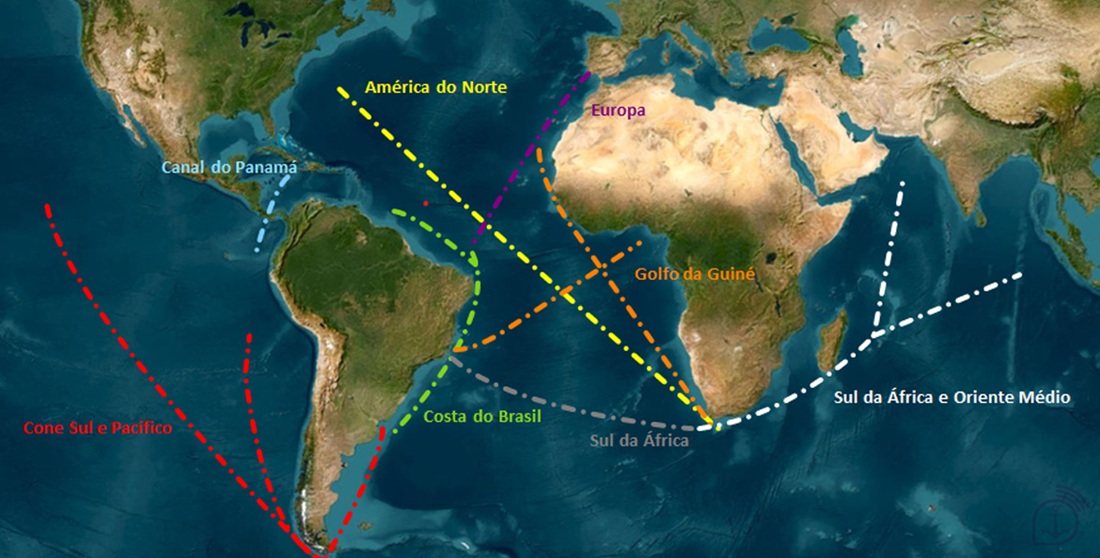
From the Port of Santos, Brazil is connected to a broad network of maritime routes integrated into the world’s main trade corridors. Strategic destinations include Asia, Europe, North America, the Middle East and Africa. The Asian axis stands out because of demand for Brazilian agricultural commodities. Europe maintains a traditional flow of agricultural products and containerized cargo. North America concentrates trade in industrial goods, technology, fuels and production inputs, while the South American and Caribbean regional corridor serves expanded coastal shipping and cargo redistribution. Routes to Africa and the Middle East are also gaining relevance for food, protein, bulk cargo and derivative exports.
Ensuring maritime shipping lane security, according to the harbor master, requires more than protecting physical facilities. The Brazilian Navy’s role involves continuous surveillance, inspection and intervention capability, intensive use of technology, personnel readiness and interagency governance, meaning coordination among different institutions.
“In a highly complex environment, protecting the port means knowing, almost in real time, who is coming in, who is leaving, under what conditions they are sailing, what cargo they are carrying, what risk they pose and what effect an anomaly may have on the system as a whole,” he said. He added that a systemic view is necessary because Santos is a port with a high density of maneuvers. “It is that combination of assets, surveillance, technology, personnel and governance that makes it possible to ensure the operational continuity of a port whose interruption would affect Brazil’s economy, security and defense.”
Maritime shipping lane security and the highways of the sea
Naval War College geopolitics professor and reserve Navy Captain Leonardo Mattos said maritime shipping lanes can be understood, in simple terms, as the “highways of the sea,” routes traveled by vessels that connect countries and sustain global trade.
“For many centuries, maritime trade has been extremely important for nations, even more so in recent decades with so-called globalization and the intense trade exchanges among countries,” he said.
Today, about 80% of all international trade is conducted by sea. In Brazil’s case, that dependence is even greater, with about 95% of foreign trade moving by sea. These routes connect the country to the world’s main markets. According to Mattos, Brazil’s main maritime shipping lane links the Port of Santos to Asia, rounding southern Africa by the Cape of Good Hope. Other strategic sea routes head toward Europe, the United States and South American countries, forming a network essential for the flow of commodities out of Brazil and the entry of key inputs into the national economy.
Mattos also stressed that these “highways” include sensitive points known as chokepoints, areas of concentrated traffic where any disruption can trigger global effects. Examples include the Strait of Hormuz, the Suez Canal, the Strait of Gibraltar and the Strait of Malacca. “Geography matters in any geopolitical analysis,” he said, explaining that blockages or attacks in these regions can affect everything from energy supply to the prices of food and inputs around the world.
How Brazil approaches maritime shipping lane security
The monitoring and protection of routes used for the transport of goods and inputs by sea, known as maritime shipping lanes, are carried out by the Brazilian Navy within the scope of its legal duties in Brazilian jurisdictional waters and in accordance with the international agreements and regulations to which Brazil is a signatory.
Rear Admiral Luciano Calixto de Almeida Junior, commander of maritime operations and Blue Amazon protection, said this work is carried out through operations aimed at maritime area control and the protection of maritime traffic of interest, with the goal of ensuring freedom of navigation and preventing or deterring threats to maritime traffic in Brazilian jurisdictional waters or other maritime areas of interest.
“To protect maritime shipping lanes in times of crisis or conflict, the Brazilian Navy may conduct naval warfare operations and actions such as maritime interdiction, attack, mining, mine countermeasures, anti-submarine operations, submarine actions, among others,” he said.
These activities, actions and operations are carried out with naval, air-naval and marine corps assets, including unmanned systems, often in coordination or cooperation with other state institutions, contributing to maritime security, protection of critical infrastructure and maintenance of good order at sea along the country’s main maritime routes.
“The protection of maritime shipping lanes also relies on mechanisms of international cooperation and information exchange, which are essential for tracking global maritime flows. In that regard, the Brazilian Navy maintains coordination with international maritime monitoring centers and partner navies, in addition to receiving and sharing information through cooperation networks and diplomatic-military channels,” the rear admiral said.
Surveillance and monitoring of maritime activity in priority areas along shipping routes are supported by Brazil’s Blue Amazon Management System, which integrates radar and signal surveillance systems with data-processing and intelligence-analysis capabilities. “This system is absolutely essential to maritime security in Brazilian jurisdictional waters, but it needs a hybrid funding model with permanent cash flow so its implementation can continue in a sustainable way,” Calixto said.
He also said that in an international environment marked by rising instability, growing competition among powers and the increasing strategic value of maritime spaces, the ability to maintain a modern fleet ready for deployment becomes central to maritime shipping lane security and to defending national interests. In his view, naval power is one of the main tools for guaranteeing freedom of navigation and preserving sovereignty over maritime areas of interest.
“The presence of an updated and well-prepared naval force strengthens the capacity for surveillance and control over maritime spaces of interest to the country, especially in the Blue Amazon. This vast area contains strategic natural resources, important navigation routes, submarine communications cables and offshore energy facilities, including the pre-salt fields. Protecting these assets requires forces capable of acting continuously and effectively, both in monitoring and in responding to incidents or threats,” he said.
Beyond the operational dimension, the rear admiral also stressed the navy’s deterrent role. “The existence of a modern and operationally ready fleet sends a clear message of capability and determination in defending national interests,” he said, adding that such a presence helps discourage hostile actions or attempts to exploit vulnerabilities. In his assessment, the effects of that capability go beyond the military sphere. “Maintaining an updated naval force strengthens economic security, strategic autonomy and Brazil’s standing on the international stage,” he said.
Sovereignty begins at sea
Episodes involving attacks on merchant ships and disruptions to traffic in the Strait of Hormuz, one of the world’s most strategic maritime passages, demonstrate the need for countries highly dependent on maritime trade, such as Brazil, to have adequate naval capabilities to protect their own sea routes. More than 95% of Brazil’s oil and gas production is concentrated in its maritime jurisdictional area, now estimated at about 5.7 million square kilometers and known as the Blue Amazon.
According to Rear Admiral Sandro Baptista Monteiro, deputy chief of strategy at the Navy General Staff, instability along globally relevant sea routes shows how hostile actions can generate immediate impacts on international trade, energy and global logistics chains. In his view, the response to that environment requires maintaining a balanced naval force that is permanently ready.
“Ensuring the security of maritime shipping lanes requires the Brazilian Navy to have a balanced set of capabilities in monitoring, presence, deterrence and rapid response,” he said.
From that perspective, he said surface ships with a high degree of readiness, such as frigates and other escort vessels, are essential to protect maritime traffic, conduct naval presence operations and respond rapidly to threats at sea. These assets operate alongside patrol vessels, which expand surveillance and inspection across vast areas and contribute to the protection of infrastructure such as ports, maritime terminals and oil and gas platforms.
Submarine capability also plays a central role in that system. “Conventional submarines and, in the future, a conventionally armed submarine with nuclear propulsion significantly expand the country’s deterrent power by strengthening sea denial capability and creating uncertainty for any actor seeking to threaten Brazilian maritime interests,” Monteiro said. Complementing that, naval aviation broadens the reach of maritime surveillance and control. “Fixed-wing aircraft, embarked helicopters and remotely piloted systems make it possible to identify contacts of interest at great distances, support anti-submarine warfare, conduct maritime reconnaissance and act in search-and-rescue missions,” he said.
Today, that capability translates into a naval force structured for combat and deterrence, with about 70 vessels, including frigates, corvettes, submarines and patrol vessels, capable of carrying out escort operations, sea denial and protection of strategic areas. According to data from the Naval Operations Command, the navy also operates about 50 aircraft and remotely piloted systems, in addition to a marine corps equipped with more than 100 armored vehicles, ensuring presence and response capability along the country’s main maritime routes of interest.
Although that structure represents a relevant base of capabilities, the current international environment and the scale of Brazil’s maritime interests require these assets to be continuously strengthened, with investments that ensure adequate levels of readiness, modernization and deterrent power.
According to Monteiro, the effectiveness of these capabilities depends on ongoing investment in logistics, maintenance, secure communications, cyber warfare, electronic warfare and the defense of ports and maritime facilities, as well as interoperability with the other armed forces and the various state institutions involved in maritime security.
“In practice, that means continuing strategic programs of the Brazilian Navy, such as the Submarine Development Program, the Tamandare-class frigate program, the acquisition of patrol vessels and air-naval assets, as well as the full deployment of maritime monitoring systems and the associated logistics infrastructure,” he said.
Reserve Navy Captain Leonardo Mattos echoed that argument by stressing the need to increase Brazil’s defense budget. “The whole world is increasing its defense budgets. Brazil needs to wake up to what is happening in the world. The world is very unstable. We need a minimum capacity to protect our interests, defend our maritime shipping lanes and defend our Blue Amazon and its wealth,” the Naval War College professor said.
Source: Brazilian Navy News Agency
-
Ports and Terminals
Dec, 09, 2025
0
Paraguayan Beef Exports Through TCP Rise 67%
-
Grains
Jan, 26, 2023
0
Corn prices to remain high on Brazil’s export record
-
Ports and Terminals
Oct, 22, 2021
0
State of SP studies new highway from the plateau to the Port of Santos, SP
-
Ports and Terminals
Jun, 05, 2024
0
Navy corps leave Santos Port premises as 7-month operation draws to a close