

TCP, Brado announce rail expansion in Paranagua
Mar, 27, 2026 Posted by Gabriel MalheirosWeek 202613
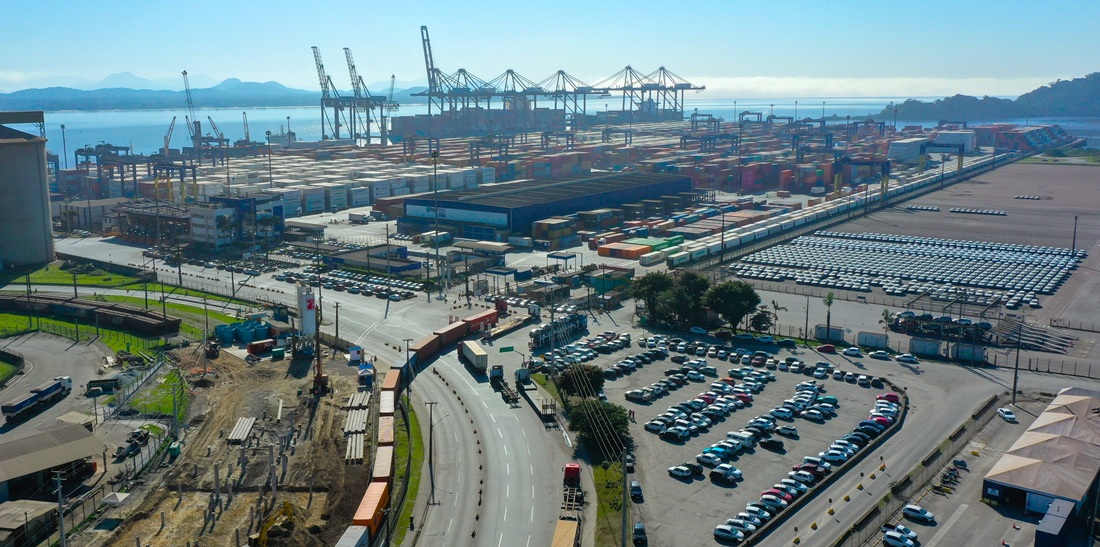
The Paranagua Container Terminal and Brado Logistica have announced an expansion of rail infrastructure in the terminal’s operating yard, the only one in southern Brazil with a direct connection between its operating area and a rail line. The initiative, to be implemented by Brado, includes the construction of a third rail track and a switching area, adding 757 meters of rail infrastructure. The expansion will be dedicated exclusively to the company’s operations and is expected to increase rail capacity by about 20%.
With the expansion, the terminal will be operationally capable of handling as many as 66,000 loaded containers per year by rail from 2027, compared with the current maximum capacity of 55,000. TCP currently operates with two lines: while one train arrives at the operating yard, another leaves the area, allowing the loading and unloading of 41 containers at a time. With the new line and switching area, two trains will be able to operate simultaneously while a third departs, potentially doubling the volume handled per siding call to as many as 82 units.
In 2024, of the 310,000 loaded export containers handled by TCP, about 52,000, equivalent to 17% of shipments, were transported by Brado. Rail has a strong share in the terminal’s refrigerated cargo flows: in 2025, about 55% of the volume moved by rail consisted of reefer containers, mainly animal protein for export originating in Cascavel and Cambe, the state’s main poultry agro-industrial hubs. The export market for paper and pulp from the Ortigueira region in Parana is also among the segments served.
Rail is becoming established as a strategic solution that strengthens cargo logistics. With lower risk of damage, greater security and more reliable transit times, rail transport in Brazil is part of the supply chain for a wide range of businesses, moving agricultural chemicals, industrial inputs, consumer goods and animal nutrition products, among other cargoes.
According to Giovanni Guidolim, TCP’s commercial, logistics and customer service manager, the expansion strengthens strategic services within the terminal’s logistics portfolio.
“Rail offers predictability, reliability and competitive logistics costs, factors that are essential for export chains such as paper and pulp and frozen meats. Because TCP is the only terminal in southern Brazil with a direct connection between the bonded area and the rail spur, containers can be transferred directly between the wagons and the yard, without the need for intermediate truck transport. That reduces logistics steps, increases operating efficiency and makes the service strategic and efficient for exporters,” he said.
For Vinicius Cordeiro, executive manager of Brado’s commercial and new business area, the expansion is directly tied to the company’s strategy of increasing rail’s share in its customers’ logistics mix.
“This expansion represents an important advance for the Parana corridor, especially at a time when the market is demanding more predictability, scale and logistics efficiency. By structuring a dedicated operation at the terminal, we are creating real growth conditions for our customers, especially in the region’s agribusiness sector. In addition, the expansion enables more efficient and sustainable logistics, allowing the diversification of new products and new partners with greater capacity, competitiveness, higher reliability and lower environmental impact. It is a move that strengthens our customers’ efficiency and expands rail’s role in the logistics matrix,” he said.
He added that the Paranagua expansion also supports a sector of major importance to Brazil.
“Parana has a strong animal protein industry, leading the country in chicken production with nearly 35% of the market, in addition to ranking second in pork, which requires efficient logistics solutions. At Brado, chicken accounts for 24% of the company’s transport volumes, and it is precisely to keep pace with that cargo flow that we are moving ahead with the terminal infrastructure expansion, creating conditions to expand rail use and make this operation even more strategic,” he said.
Investments expand logistics capacity and strengthen rail operations
The rail expansion is part of a broader set of investments made by TCP to strengthen its logistics infrastructure. Over the past five years, the company has invested about 500 million reais in operational improvements and terminal capacity expansion.
To meet growth in rail throughput, the area now operates with three RTG cranes, one more than before. These pieces of equipment underwent electrification, with electric busbars installed along the rail area, an initiative that reduced carbon dioxide emissions by about 771 tonnes per year in the operation of the three units.
TCP also invested in the deployment of new terminal tractors to optimize rail operations and in the reconfiguration of the terminal gate, allowing access to the third line and smoother cargo flows.
In 2023, TCP also inaugurated a 13.8-kV power substation to support both equipment electrification and the expansion of the terminal’s reefer area, now the largest in South America, with 5,268 plugs.
Brado, in turn, invested in new rails and three sets of switches for TCP’s expansion in 2026. These devices allow a train to move from one line to another, with a focus on traffic routing and switching operations. The company also acquired other components to consolidate the structure, including base plates, anchor bolts, welds and fastening clips.
For Washington Renan Bohnn, TCP’s logistics operations manager, the investments made in recent years are aimed at preparing the terminal for sustained growth.
“These investments strengthen TCP’s logistics infrastructure and allow rail operations to evolve with greater efficiency and predictability. By expanding terminal capacity and better integrating transport modes, we are able to offer more competitive solutions to our clients and contribute directly to the efficiency of Brazil’s foreign trade logistics chain,” he said.
-
Grains
Dec, 12, 2022
0
Soybeans: China buys 52.464 million tonnes from Brazil in 2022
-
Other Logistics
Oct, 04, 2021
0
Rumo opens train filling station in Araraquara (SP)
-
Ports and Terminals
Apr, 05, 2019
0
BTP receives four new RTG cranes from China’s ZPMC
-
Ports and Terminals
Mar, 03, 2023
0
Portos RS inks protocol of intentions with Port of Aveiro during Intermodal