

Brado and Alcoa launch multimodal rail operation transporting aluminum from Maranhão to São Paulo
Apr, 14, 2026 Posted by Sylvia SchandertWeek 202618
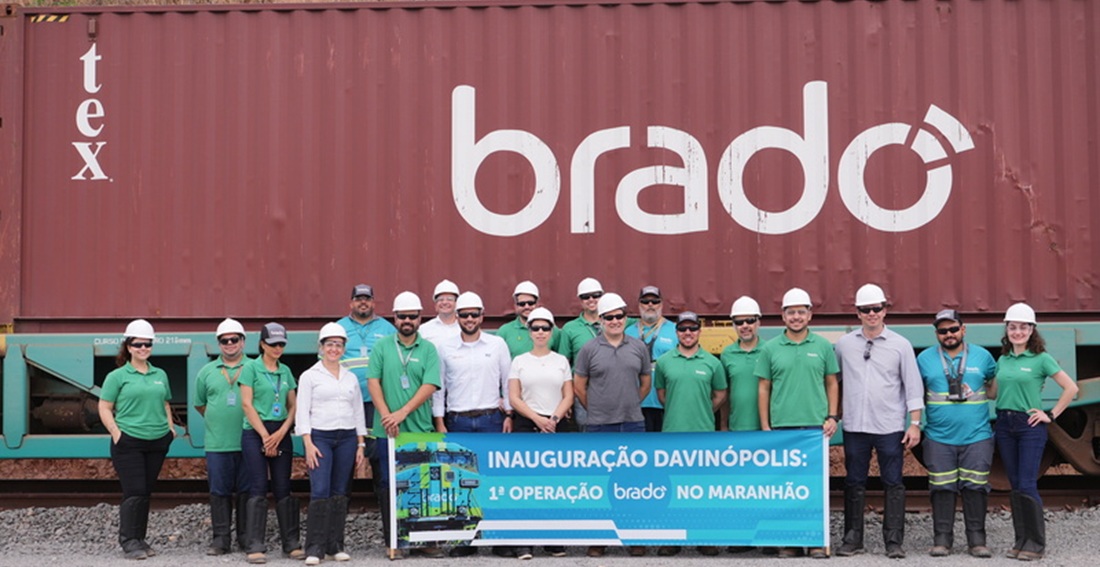
Brado Logística and Alcoa are implementing a new multimodal operation to transport aluminum ingots produced by Alcoa at Alumar—a consortium managed by the company in Maranhão—to customers in the state of São Paulo. The project integrates road and rail modes, with the North-South Railway as its main axis, connecting Davinópolis (MA) to Sumaré (SP) over more than 2,700 kilometers, forming the country’s longest continuous rail operation for regular industrial supply.
The initiative expands the use of rail for higher value-added industrial cargo and establishes a multimodal corridor with greater operational predictability, lower carbon intensity, and system-wide efficiency gains. The route was launched in July 2025 and has since completed 13 trips, moving 884 containers and 22,500 tonnes of cargo. The operation has helped validate key logistics parameters and efficiencies ahead of the formalization of the contract now announced.
“Operations like this show how multimodality is key to unlocking competitiveness in Brazil. By integrating rail and road transport, we can deliver more efficient, secure, and sustainable logistics, aligned with industrial demands and the need for predictable, low-impact solutions,” said Luciano Johnsson, CEO of Brado.
Beyond adding another transport mode, the project demonstrates the feasibility of establishing regular rail corridors for complex industrial supply chains, which are traditionally sensitive to delays, security issues, supply disruptions, and tariff volatility.
“This logistics model represents a structural advancement in how aluminum is transported over long distances in Brazil. It enables lower emissions, strict safety standards, and greater efficiency across the value chain, while strengthening the resilience and competitiveness of our business,” said Mateus Tiraboschi, Alcoa’s Global Vice President of Procurement and Transportation.
Industrial competitiveness and logistics agenda
The operational design combines the capacity and predictability of rail over long distances with the flexibility of road transport in first- and last-mile segments. The ingots, with an average weight of 1.1 tonnes per unit, require strict standards for packaging, traceability, and security, as well as careful planning for container allocation and terminal operations.
The logistics flow originates in São Luís (MA), moves to Davinópolis (MA), follows the North-South Railway to Sumaré (SP), and from there supplies industrial customers in São Paulo and Minas Gerais. The model aims to mitigate operational risks, reduce delivery time variability, and strengthen supply chain resilience—factors that are increasingly critical in industrial investment decisions.
Environmental performance is a central element of the project. In addition to operational gains, the partnership advances more sustainable cargo transport solutions in Brazil. In the second half of 2025 alone, the use of rail on Alcoa’s route reduced more than 5,000 tonnes of CO₂ compared to road transport. The estimate considers transported volume, distance, and mode-specific emission factors, reflecting a significant environmental benefit.
Source: Brado
-
Ports and Terminals
Jul, 12, 2021
0
CODEBA signs dredging contract at the Port of Ilhéus
-
Fish
Apr, 03, 2019
0
Argentina authorizes early opening of northern squid sector
-
Other Cargo
Dec, 22, 2025
0
Brazilian honey exports fall in volume, but revenue rises on international market appreciation
-
Grains
Jan, 21, 2025
0
Decline in Chinese Soybean Purchases Slows Brazilian Sales, but Exchange Rate Supports Growth