


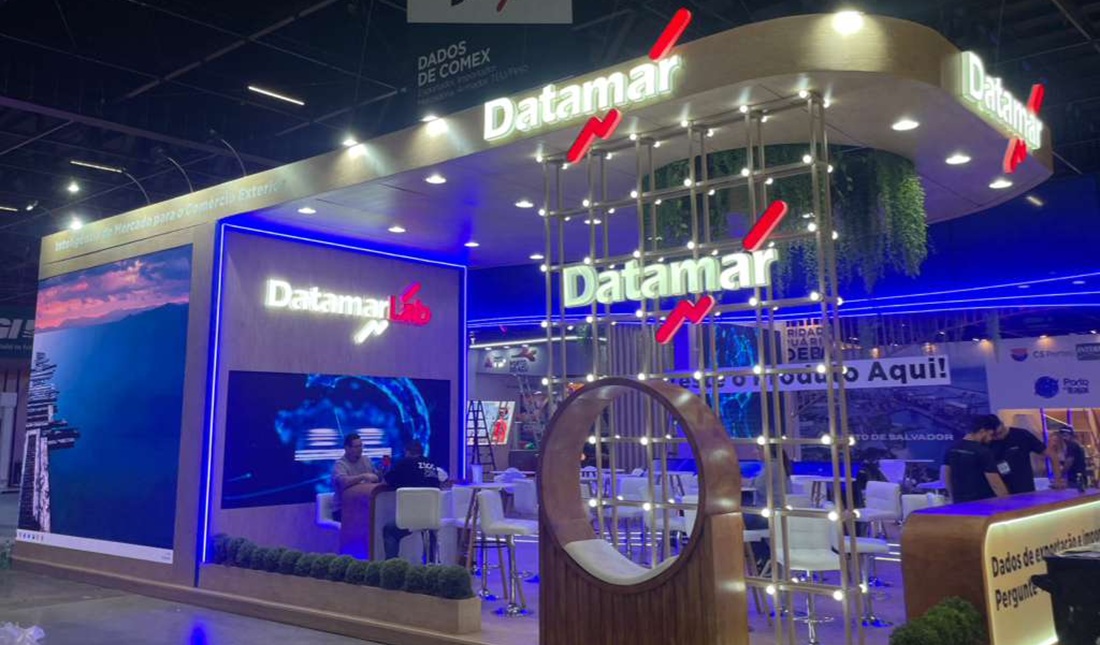
Datamar wraps up Intermodal 2026 with innovation, DatamarLab, and testimonials that reinforce its market impact
Apr, 17, 2026 Posted by Sylvia SchandertWeek 202618
At the close of Intermodal South America 2026, Datamar reinforced its positioning as a company driven by innovation and the generation of strategic intelligence for foreign trade. Its participation in the event consolidated DatamarLab as one of the main engines of this transformation, highlighting the value of integrating data, science, and applied technology.
More than simply presenting solutions, the company’s presence was marked by knowledge exchange, dialogue with the market, and the strengthening of new connections with clients, partners, and industry specialists. The high level of engagement over the three-day event underscored the growing relevance of data intelligence in an increasingly dynamic and challenging logistics environment.
Testimonials from clients and partners throughout the event highlighted the impact of Datamar’s solutions on day-to-day operations. According to Wilson Bispo, Foreign Trade Manager at Costa Foods, his company operates with a strongly data-driven culture, in which decisions and strategic direction are guided by reliable information. In this context, Datamar’s solutions support more assertive decision-making in directing cargo in the international market, both in export operations and in validating import data. “Data guides our choices,” he said.
Jeferson Gilgen, Market Intelligence and Pricing Coordinator at Porto Itapoá, described Datamar as a long-standing strategic partner, with a relationship spanning 11 years. According to him, data is essential for guiding the commercial team’s actions and supporting the company’s strategic decisions. “We work with data that truly makes a difference as market intelligence. Staying up to date is essential. It’s a fantastic tool that helps us a lot in our daily operations,” he said.
Aécio Santos Moraes, Commercial Intelligence and Data Specialist at ZIM Integrated Shipping Services, emphasized that Datamar’s solutions are fundamental in turning data into strategic decisions in maritime transport. According to him, access to information enables a more precise understanding of market behavior, from identifying where customers are directing their cargo to analyzing competitors’ movements and supporting decisions on new routes and services. “With a broader and more structured view, we can plan our operations better and make decisions with greater confidence,” he said.
Vitor Maia, Chief Data Officer at Craft, said that relying only on superficial market information is not enough to drive results in Brazil. In his view, access to structured and reliable data is essential to connect importers and exporters, generate new business opportunities, and bring more dynamism to the market. “Without data on what is really happening, the market does not move. Information is what drives commercial and strategic action,” he said.
Alexandre Oberti, Market Intelligence Analyst at Portonave, reinforced that terminal decision-making is heavily data-driven. According to him, Datamar’s tools provide the credibility needed to trust the numbers fully, enabling consistent market monitoring, lead generation, and opportunity identification. “It’s a long-term partnership that we intend to maintain and strengthen,” he said.
The initiative’s scientific perspective was also reinforced by Walter Teixeira, Chief Scientist at DatamarLab. He noted that the shipping industry, with nearly 600 years of history, has always been closely linked to science, but that the current environment, marked by the massive generation of new data, requires an even more structured approach. “The sector increasingly needs science to deal with this volume of information,” he said. In this context, DatamarLab operates by combining expertise in data processing with artificial intelligence to strengthen decision-making in maritime transport.
Walter Teixeira also highlighted the challenges of the decarbonization agenda in shipping, noting that the issue is still often approached solely from a sustainability perspective, without a proper understanding of its economic potential. According to him, different players across the value chain have been trying individually to adapt processes and infrastructure, often without robust methodologies that would allow, for example, the generation and monetization of carbon credits.
He also noted that a large share of the artificial intelligence solutions adopted in the market is based on general-purpose models from big tech companies, without sufficient customization to the specific needs of companies’ operations. “Decarbonization is still not among the immediate priorities because many do not see its economic benefits. They do not understand that decarbonization is business,” he said.
In this context, he emphasized that although communication around sustainability initiatives has improved, integration among the different links of the value chain remains limited when it comes to generating synergies in decarbonization projects, restricting broader gains for both the sector as a whole and individual companies.
The company’s participation also concluded with remarks from Datamar CIO Marcos Silva, who described the event as an opportunity to consolidate lessons learned and practice active listening. “These were important days for getting even closer to clients and partners, deepening conversations, and identifying new opportunities,” he said.
Silva also highlighted the positive reception of DatamarLab, reinforcing its positioning as a scientifically rigorous laboratory focused on solving real market problems. “It’s about less promise and more delivery,” he said. With more than 30 years of experience, Datamar continues to build today the foundations for what will matter in the years ahead. “Innovation is continuous, and it comes from listening to the market and evolving alongside it.”
Datamar concludes its participation at Intermodal with positive results and broader perspectives, maintaining its commitment to continuously improving its solutions and contributing to more efficient, sustainable, and data-driven decision-making in South American foreign trade. As Silva noted, although the event has ended, the connections and conversations initiated during the fair continue.
-
Ports and Terminals
Jul, 26, 2023
0
National Waterway Transport Agency publishes public call for the port of Arroio do Sal
-
Trade Regulations
Jul, 19, 2023
0
Brazil announces increased import taxes on solid waste
-
Ports and Terminals
May, 26, 2025
0
Container Throughput Breaks Record for the Fourth Consecutive Month at the Port of Santos
-
Ports and Terminals
Jun, 09, 2020
0
Santos no longer obliged to renew Marimex contract thus allowing rail reverse-loop project to go ahead