


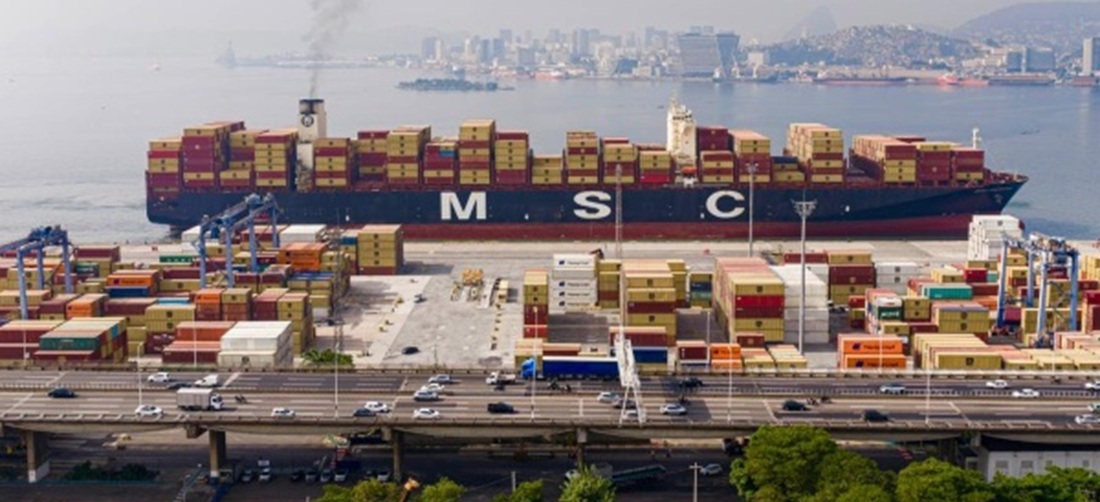
Port of Rio de Janeiro can now receive vessels of up to 366 meters after channel expansion
May, 26, 2026 Posted by Gabriel MalheirosWeek 202621
The Port of Rio de Janeiro has joined the group of Brazilian ports able to receive New Panamax vessels, among the largest ships in global commercial shipping. The milestone was reached after the completion of dredging and modernization works on the port’s access channel, carried out with investments from the federal government, through the New PAC infrastructure program, and from the PortosRio Port Authority. In all, R$163 million was invested in the project.
This month, the first vessel to call at the port under the new operating conditions was the container ship MSC Katrina, a 366-meter-long vessel with a beam of 48.4 meters and capacity to carry 14,131 TEUs. The Panama-flagged ship arrived from the Port of Suape, in Pernambuco, and later sailed to the Port of Santos, in São Paulo.
New operating conditions
For a port to receive larger vessels, infrastructure modernization works are required, especially dredging, draft expansion, improvements to nautical signaling and operational adjustments. At the Port of Rio de Janeiro, the access channel underwent dredging works supported by R$98 million raised through the New PAC and R$65 million from PortosRio.
With the works completed, the minimum depth of the access channel was increased from 15 meters to 16.2 meters, allowing an operating draft of 15.3 meters and adapting the infrastructure to receive New Panamax vessels.
National Ports Secretary Alex Ávila said the new operating capacity marks an important step forward for the Port of Rio de Janeiro and for Brazil’s port infrastructure.
“The arrival of larger vessels represents a new moment for the Port of Rio de Janeiro. This progress increases the terminal’s competitiveness, strengthens its position on international routes and demonstrates the importance of investments in the modernization of Brazilian port infrastructure,” he said.
The project also improves the port’s operational and logistics efficiency, enhances navigability and safety conditions, allows larger vessels to operate and reduces operational restrictions and logistics costs. It also increases operational predictability and strengthens the Port of Rio de Janeiro’s competitiveness in foreign trade.
Currently, in addition to the Port of Rio de Janeiro, only the ports of Santos, in São Paulo; Salvador, in Bahia; Itaguaí, in Rio de Janeiro; Paranaguá, in Paraná; and Pecém, in Ceará, have the operating capacity to receive vessels of up to 366 meters in length.
-
Aug, 25, 2020
0
Brazil´s apple juice exports rose 17% in first seven months of 2020
-
Ports and Terminals
Mar, 22, 2020
0
Porto Murtinho starts shipments of soybeans from the 2019/2020 harvest
-
DW 2019 EN
Mar, 11, 2019
0
DatamarWeek 12 March 2019
-
Shipping
Jul, 08, 2026
0
Seaspan and Maersk deepen retrofit push