


U.S. imposes 25% tariff on Brazilian goods
Jul, 16, 2026 Posted by Sylvia SchandertWeek 202629
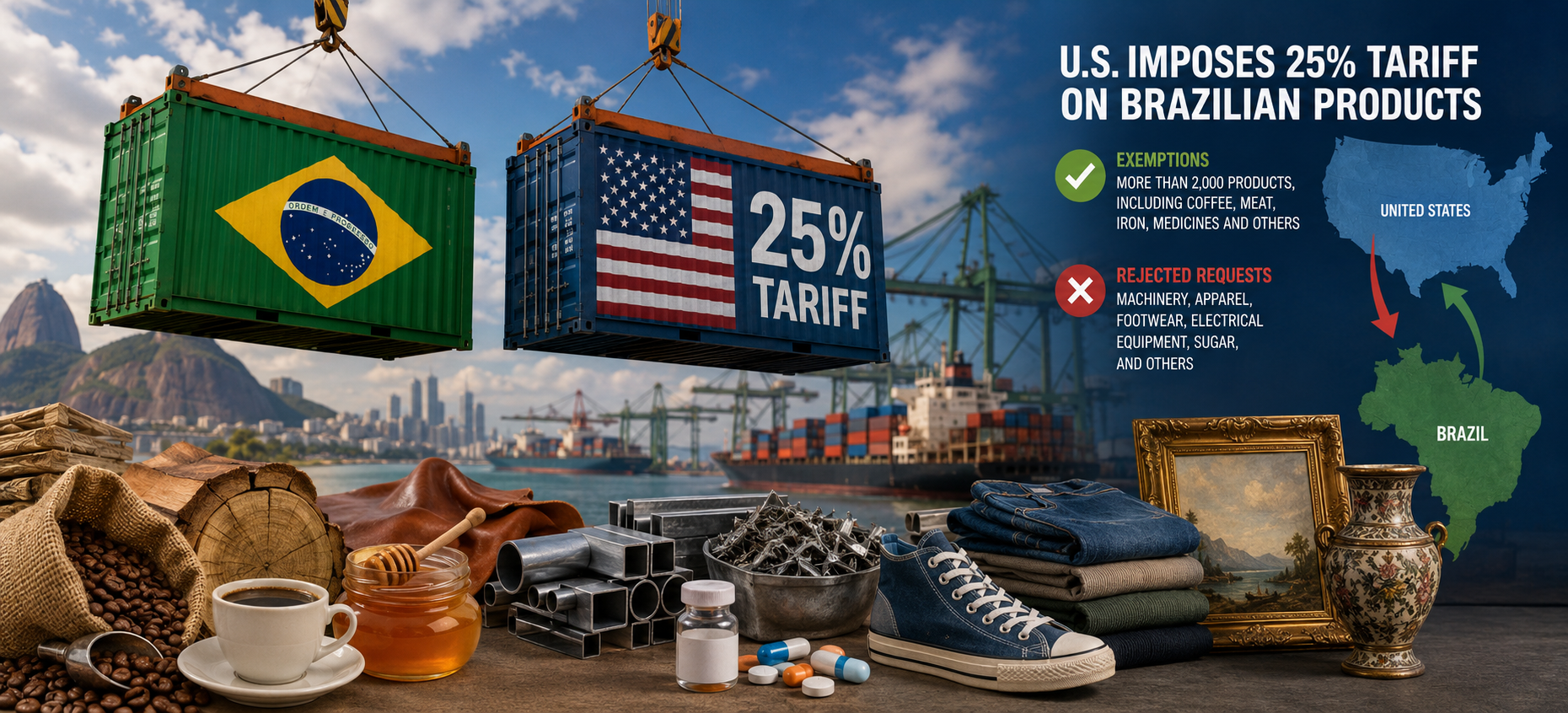
The U.S. government issued a resolution late Wednesday (15) imposing a 25% tariff on products exported by Brazil. The measure, adopted under Section 301 of the U.S. Trade Act, will take effect next Wednesday (22).
As Valor reported, although President Luiz Inácio Lula da Silva’s administration viewed a new sweeping tariff increase as virtually inevitable and sees ideological interference in the process led by the Office of the U.S. Trade Representative (USTR), it believes the United States may still expand the list of products exempt from the new 25% rate.
The Lula administration has sought to show the White House that it remains willing to negotiate.
Exemptions
The USTR measure exempts more than 2,000 items from the tariff. These will join products that were already excluded, including certain types of meat, coffee, fruit, iron and aircraft parts.
The newly exempted products include pig iron, unflavored instant coffee, organic honey, aluminum hydroxide, iron and steel scrap, certain seafood products, leather, some wood products, medicines and pharmaceutical inputs, as well as antiques, works of art and used clothing.
The USTR said the products are important inputs for U.S. industry, have limited domestic availability or are difficult to replace with supplies from other countries. The additional duty could therefore raise costs and disrupt U.S. supply chains.
In several cases, the agency argued that the United States depends on Brazilian supplies or that imposing the tariff would cause more damage to the U.S. economy than meaningful pressure on Brazil.
Rejected requests
Not all exemption requests were granted. The U.S. government rejected applications from sectors including agricultural and industrial machinery, apparel, footwear, electrical equipment, gardening tools, paper, organic sugar and a range of manufactured goods.
According to Datamar’s maritime cargo throughput data, footwear exports to the United States fell 25.7% in the first five months of the year compared with the same period a year earlier. That means only 466 TEUs were shipped to the North American market. See more details below:
Footwear Exports to the United States | Jan 2023 – May 2026 | TEUs
Source: DataLiner (click here to request a demo)
Although companies warned of higher costs and difficulties replacing Brazilian suppliers, the USTR concluded that the products could be sourced from other markets or that the economic consequences did not justify exempting them from the tariff.
The final resolution also toughened parts of the original proposal. The agency removed high-purity cellulose from the exemption list after receiving submissions alleging that Brazilian producers benefited from practices linked to illegal deforestation.
It also limited the exemption for certain chemicals to pharmaceutical applications, maintaining the tariff when the products are used for other industrial purposes.
Industry response
Brazilian industry groups expressed concern after the United States announced the new tariff.
The National Confederation of Industry (CNI) said in a statement that it was closely monitoring the 25% duty confirmed by the U.S. on Wednesday. The additional tariff worsens pressures already affecting Brazilian exports and creates greater uncertainty for companies in both countries, it said.
“The effects of higher U.S. tariffs are being felt increasingly across Brazilian industry: 20 of the country’s 27 states reduced their exports to the U.S. market in the first half. Following today’s announcement, the situation is likely to worsen, further eroding the competitiveness of Brazilian industry. We must spare no effort to reverse this trend and restore the relationship that Brazil and the United States have built,” CNI President Ricardo Alban said.
The tariffs adopted by the United States since 2025 are already affecting bilateral trade. Brazilian exports to the U.S. market fell 13%, equivalent to $2.6 billion.
The decline was partly driven by an 8.7% drop in industrial-goods shipments, particularly semi-manufactured iron and steel products, crude cast iron, chemical wood pulp made from non-coniferous materials, petroleum oils and semi-manufactured products made from other steel alloys.
Despite the decline, the United U.S. remained the leading destination for Brazilian manufacturing exports during the period.
The impact of tariffs in place since 2025 is also evident in state-level exports. In the first half of this year, 20 of Brazil’s 27 states and the Federal District (Brasília) posted lower sales to the U.S. than in the same period of 2025.
Competitive pressure
The Federation of Industries of the State of Minas Gerais (FIEMG) also said it viewed the U.S. government’s decision with deep concern.
The measure creates a significant disadvantage for Brazilian companies against suppliers from other countries competing for the same customers, FIEMG said. The ultimate impact will depend on the products covered, the tariff classification of each item and the treatment given to international competitors.
Possible consequences include the replacement of Brazilian suppliers, pressure to cut prices and margins, and the renegotiation of contracts, deadlines and commercial terms, the federation said.
“The 25% tariff significantly changes the conditions under which Brazilian products can access the U.S. market. It will be essential to provide clarity on the products affected, the timetable for implementing the measure and the treatment of existing contracts, reducing uncertainty for exporting companies,” said Verônica Winter, international business facilitation coordinator at FIEMG’s International Business Center.
FIEMG called for intensified negotiations between Brazil and the United States and clear rules covering signed contracts, cargo already in transit and the implementation of the measure, in order to prevent a prolonged loss of competitiveness for Brazilian industry.
(With Folhapress)
Source: Valor International
-
Automotive
Mar, 19, 2020
0
Lack of parts causes Scania to halt production at São Bernardo do Campo unit
-
Other Logistics
Aug, 02, 2022
0
VLI and Bunge partner to ensure multimodal sugar transportation
-
Grains
Feb, 24, 2023
0
Brazil’s Feb. soy exports seen lower at up to 8.3 mln T -Anec
-
Shipping
Apr, 27, 2023
0
MSC slows ships, adds Mobile to Latin America-Gulf Coast service