


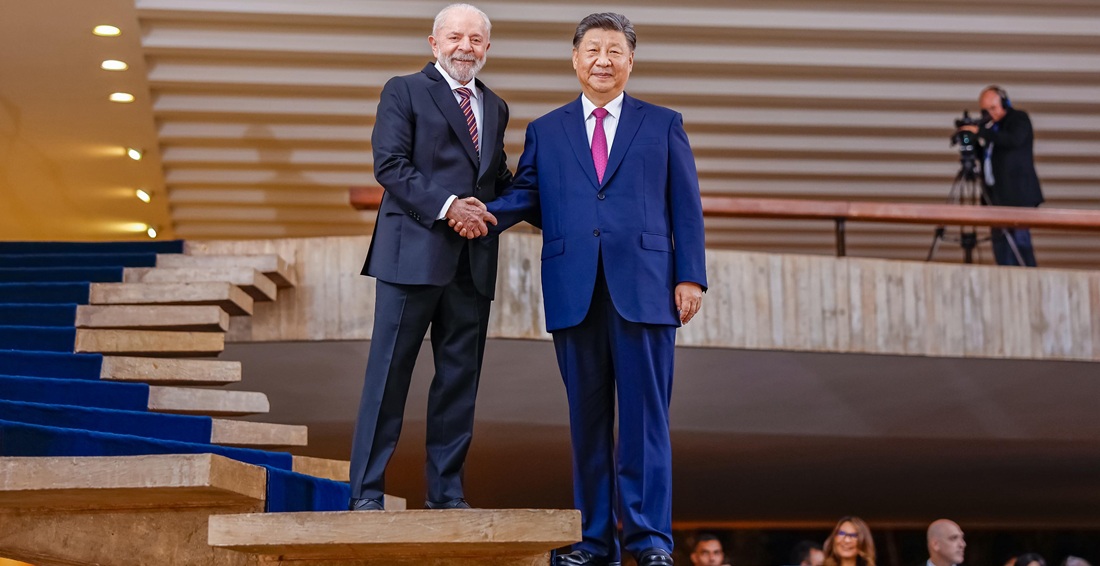
Lula and Xi call for faster talks on China-Mercosur trade deal
Jul, 27, 2026 Posted by Gabriel MalheirosWeek 202631
Brazilian President Luiz Inácio Lula da Silva and Chinese President Xi Jinping agreed on the need to accelerate preparations for trade negotiations between China and Mercosur during a telephone call on Sunday, July 26, Brazil’s presidential office said.
According to the statement from the Planalto Palace, the two leaders agreed that talks should begin more quickly and proceed with “the necessary flexibility.” China’s state media account of the conversation did not mention the proposed agreement with Mercosur, the South American trade bloc comprising Brazil, Argentina, Paraguay, Uruguay and Bolivia.
The call, initiated by the Brazilian side, lasted more than an hour.
It took place roughly four days after a new U.S. tariff measure affecting Brazil came into force, imposing an additional 25% duty on about 3,000 Brazilian products.
The Trump administration adopted the measure following a Section 301 investigation by the Office of the United States Trade Representative, or USTR, into trade practices it considered unfair.
Neither the Brazilian government’s statement nor the account published by Chinese state media said whether the new U.S. tariffs were discussed during the call.
Xi, however, said China supports Brazil “in safeguarding its sovereignty and independence, opposing external interference, and contributing to regional and global peace and stability.”
His remarks echoed the position taken by China’s Foreign Ministry after the tariffs were announced. At the time, ministry spokesperson Lin Jian said that “there are no winners in tariff wars, and they serve no one’s interests.”
“China is ready to work with Brazil and other countries to defend the multilateral trading system, with the World Trade Organization at its core, and to promote international fairness and justice,” Lin said.
Leaders discuss BRICS and strategic cooperation
Xi and Lula also discussed strengthening BRICS. According to Beijing, the Chinese leader said cooperation among members of the group could help “maintain the momentum of unity, achieve further results and write a new chapter of solidarity and self-reliance for the Global South.”
In outlining what makes 2026 a significant year for both countries, Xi cited the 105th anniversary of the founding of the Chinese Communist Party, the start of a new five-year planning cycle for China’s economy and Brazil’s decisive domestic political agenda. He did not explicitly mention Brazil’s presidential election in October.
Against that backdrop, Xi said he was willing to strengthen strategic coordination with Brazil at both the bilateral and multilateral levels. He added that Beijing places great importance on Brazil’s international standing and influence.
The Brazilian government’s statement provided more detail about the bilateral agenda.
According to the Planalto, Lula and Xi reiterated their intention to expand cooperation in strategic and high-technology fields, including artificial intelligence, satellites, critical-mineral processing and fertilizer trade.
Lula stressed that his government “remains committed to diversifying markets and trading partners,” the statement said, in a passage that appeared to connect the conversation with Brazil’s current trade dispute with Washington.
The two leaders also highlighted the performance of bilateral trade, the cultural initiatives being held in both countries in 2026—including the Brazil-China Cultural Year—and an agreement waiving visas for short stays. According to the Brazilian government, the visa measure should increase tourism flows and create new business opportunities.
Global conflicts and maritime trade routes
Lula and Xi also discussed the proliferation of conflicts worldwide and their effects on global food and energy security, as well as the resulting human and material losses.
On the Middle East, they agreed that restrictions on freedom of navigation through the Strait of Hormuz and the Bab el-Mandeb Strait were harming the global economy. They also expressed concern about the continuing humanitarian crisis in Gaza.
Regarding the war in Ukraine, the two leaders pointed to the Friends for Peace group, an initiative launched by Brazil and China, as a possible avenue for restarting negotiations.
They also criticized the United Nations Security Council’s inability to respond effectively to the crises and said the organization’s next secretary-general would face a particularly challenging international environment.
According to Chinese state media, Xi concluded by taking a broader view of the countries’ relationship. He said China and Brazil, as major members of the Global South, should stand firmly “on the right side of history” and on the side of human progress, while playing a larger constructive role in reforming the global governance system.
Source: Folha de São Paulo
-
Shipping
Jan, 24, 2024
0
FT: Red Sea reroutings to further disrupt car supply chains, warn shipping executives
-
Ports and Terminals
Jun, 20, 2025
0
Brazil’s São Francisco Port Unveils R$340 Million Infrastructure Plan, First PPP Dredging Project with Beach Replenishment
-
Economy
Apr, 07, 2026
0
Brazil’s Trade Balance Posts US$ 6.4 Billion Surplus in March
-
Ports and Terminals
Nov, 11, 2022
0
Chile’s largest port to enhance its equipment with 20 Konecranes lift trucks