

Fresh DataLiner figures show Brazilian trade strengthening in first half, with tariffs and beef restrictions looming
Aug, 04, 2026 Posted by Gabriel MalheirosWeek 202631
New Datamar figures on Brazil’s containerized trade show exports and imports both expanding in the first half of 2026.
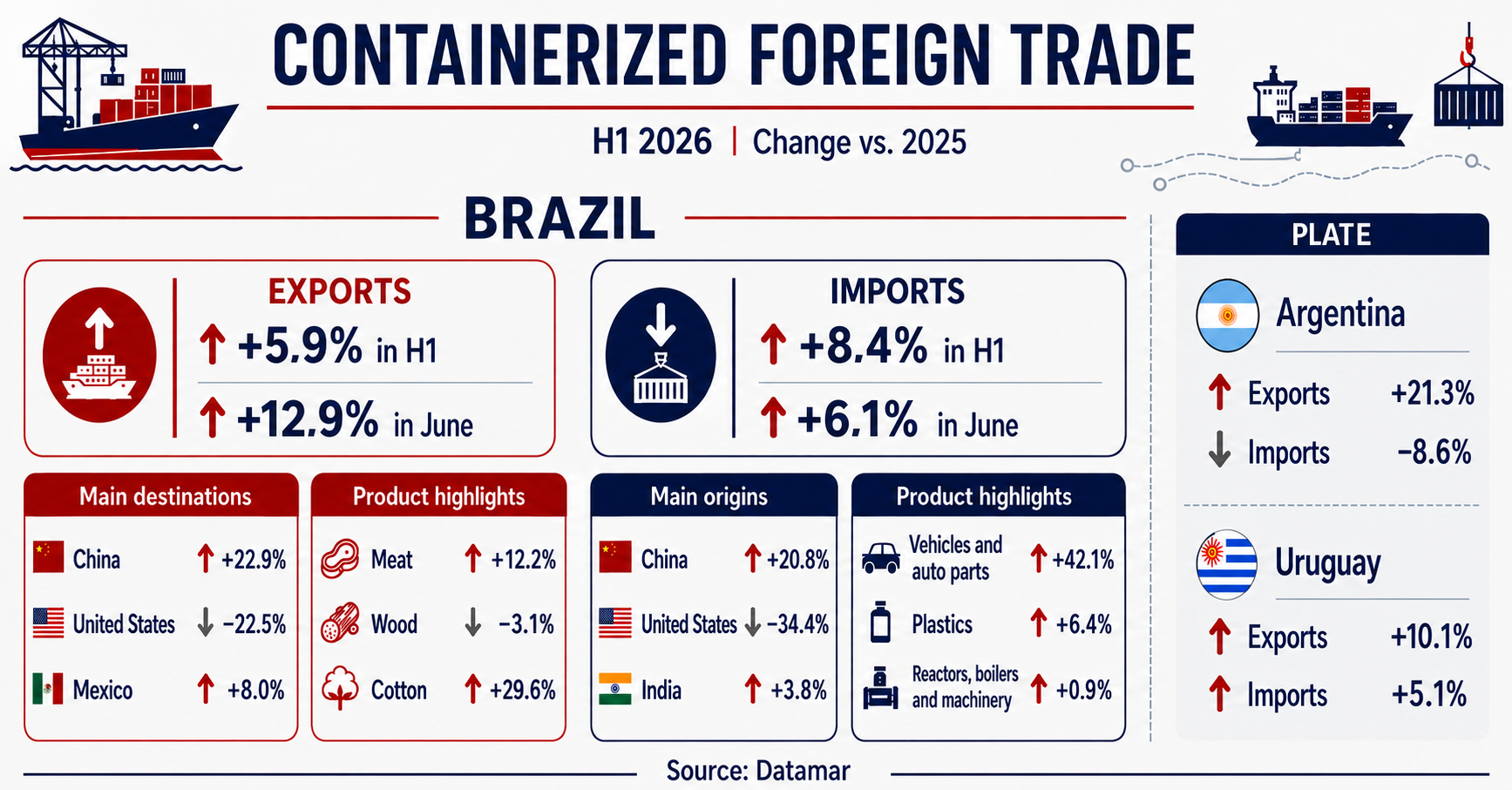
From January to June, Brazilian containerized exports rose 5.9% from the same period in 2025. Growth accelerated in June, with shipments up 12.9% year on year, suggesting stronger momentum toward the end of the half-year period.
The figures point to the resilience of Brazil’s foreign trade despite high interest rates, a gradual cooling of domestic activity and mounting uncertainty in global trade.
See below a comparison of Brazilian containerized exports in the first half of the past five years:
Brazilian Containerized Exports | Jan–Jun 2022 to Jan–Jun 2026 | TEUs
Source: DataLiner (click here to request a demo)
China expands its share of Brazilian exports
China remained the top destination for Brazilian containerized exports. In the first half of 2026, shipments to the Asian country were 22.9% higher than in the same period last year.
The increase reinforces the importance of Chinese demand for Brazilian goods, especially food, raw materials and agro-industrial products. China’s economy grew 4.7% in the first half of 2026, according to the National Bureau of Statistics, keeping the country as one of Brazil’s main sources of external demand despite a slowdown in the second quarter.
The United States, Brazil’s second-largest destination for containerized exports, received 22.5% less cargo. Shipments to Mexico rose 8%.
The decline in containerized exports to the United States contrasts with the gains recorded in flows to China and Mexico. It may reflect changes in the product mix, weaker demand for certain goods, a high comparison base and the redirection of shipments to other markets.
The new U.S. tariffs announced in July do not directly explain the decline between January and June, since they were introduced after the period analyzed. Even so, they add uncertainty to the second half and could speed up the reshuffling of Brazilian export flows.
Meat and cotton lead growth
Meat was Brazil’s leading containerized export category in the first half of 2026, with volumes up 12.2% from the same period in 2025.
Wood ranked second, although shipments fell 3.1%. Cotton exports, meanwhile, rose sharply, up 29.6%.
The performance of meat and cotton underscores the role of agribusiness and agro-industry in the growth of Brazil’s containerized trade. For meat exporters, access to refrigerated containers and regular shipping services is essential to reach distant markets. For cotton, rising production and export availability have helped Brazil capture a larger share of global demand.
Brazilian imports grow 8.4%
Imports also increased in the first half. Brazil received 8.4% more containerized cargo than in the same period in 2025. In June alone, imports were up 6.1% year on year.
The increase shows that the Brazilian economy continued to absorb foreign goods despite restrictive monetary conditions and signs of slower domestic growth.
Part of that movement reflects consumer demand, but imports also include machinery, equipment, parts and intermediate goods used by industry. In that sense, the rise in imports should not be read solely as stronger demand for finished goods. It may also point to investment, technological renewal and deeper integration into global production chains.
See below a comparison of Brazilian containerized imports in the first half of the past five years:
Brazilian Containerized Imports | Jan–Jun 2022 to Jan–Jun 2026 | TEUs
Source: DataLiner (click here to request a demo)
Chinese products gain ground in the Brazilian market
China was Brazil’s largest source of containerized imports in the first six months of 2026, with shipments up 20.8% from the same period last year.
The United States ranked second, but volumes from the country fell 34.4%. Imports from India rose 3.8%.
The growth in Chinese shipments reflects China’s expanding role in supply chains for vehicles, electrical equipment, machinery, components, chemicals and consumer goods. The country has intensified its export push amid high industrial capacity and relatively weak domestic demand.
For Brazilian companies, that trend can mean access to more competitive equipment and components. At the same time, it increases pressure on domestic industries that compete directly with imported goods.
Vehicles and auto parts drive imports
Vehicles and auto parts were Brazil’s top containerized import category in the first half of 2026, with volumes up 42.1% from the same period last year.
They were followed by plastics, up 6.4%, and reactors, boilers and machinery, up 0.9%.
The performance of vehicles and auto parts is closely tied to the rapid expansion of Chinese automakers in Brazil. Secex data show that Brazilian imports of Chinese vehicles reached $1.5 billion in the first quarter, up 552.5% from the same period in 2025. China accounted for 65.6% of the value of imported cars during that period.
Part of the increase may reflect early shipments and inventory building. As Chinese automakers expand local production, the import mix could change. Finished vehicles may gradually lose ground, while parts, batteries and components become more important.
Argentina increases exports and reduces imports
Argentina exported 21.3% more containers in the first half of 2026 than in the same period last year, while imports fell 8.6%.
The containerized trade figures follow the broader direction of Argentina’s foreign trade. According to the country’s statistics agency, Indec, goods exports rose 24.4% in the first half, while imports fell 3.9%. Argentina recorded a trade surplus of $13.9 billion over the period.
Export growth reflects a recovery in agricultural and agro-industrial supply, as well as stronger external competitiveness for Argentine products. The decline in imports, however, may also point to subdued domestic demand. As a result, the wider surplus should not be interpreted only as a sign of improved competitiveness; it also reflects Argentina’s weaker ability to absorb foreign goods.
Uruguay’s containerized trade outpaces total export growth
In Uruguay, containerized exports rose 10.1% in the first half, while imports increased 5.1%.
Containerized exports outperformed the country’s overall goods exports. According to Uruguay XXI, total Uruguayan exports grew by about 1% in the first half of 2026.
The gap suggests stronger momentum in goods typically shipped in containers, such as chilled meat, dairy products, processed foods and forest products. It may also reflect weaker performance among bulk commodities.
Outlook for the second half
The first-half figures point to a positive trend, but the outlook for the coming months will depend largely on three factors: new U.S. tariffs, the implementation of the European Union-Mercosur agreement and China’s restrictions on beef imports.
U.S. tariffs raise risks for shipments
In July, the United States announced two new measures under Section 301 of U.S. trade law, imposing surcharges of 25% and 12.5% on portions of Brazilian imports.
According to a survey by Brazil’s Ministry of Development, Industry, Trade and Services, the measures together affect 23.1% of Brazilian exports to the United States. A share equivalent to 16.5% of Brazil’s sales to the U.S. market now faces a combined tariff of 37.5%, while 52.7% of Brazilian exports remain free from sector-specific or Brazil-specific surcharges.
Because the measures were adopted in July, their effects should appear mainly in second-half data. Products more exposed to the new duties could face weaker competitiveness, contract renegotiations, early shipments, cancellations or redirection to other destinations.
The impact on containerized trade will depend on the exact mix of products affected. Sectors that rely heavily on the U.S. market and have fewer alternatives may be hit harder. At the same time, the 22.5% drop already recorded in containerized shipments to the United States makes this flow one of the main indicators to watch in the months ahead.
EU-Mercosur agreement opens opportunities, but effects will be gradual
Moving in the opposite direction of U.S. trade barriers, the European Union-Mercosur agreement offers South American exporters a path to diversify their markets.
The agreements were signed in January 2026, and the interim trade agreement began to be applied provisionally on May 1. According to the Council of the European Union, the EU will gradually eliminate tariffs on 92% of imports from Mercosur and grant preferential access to another 7.5% through tariff-rate quotas and other mechanisms.
The effects will not be immediate or uniform across sectors. Tariffs will be phased out over as long as 10 years, while sensitive agricultural products, including beef, will be subject to quotas and safeguards.
Still, the agreement could support containerized flows of meat, processed foods, wood, pulp, chemicals and manufactured goods. It could also boost traffic in the opposite direction, with more European machinery, pharmaceuticals, chemicals, auto parts, vehicles, wines and other products entering Mercosur.
For exporters in Brazil, Argentina and Uruguay, the agreement offers a chance to reduce dependence on a limited number of markets. That opportunity becomes more relevant as the United States raises trade barriers and China places limits on certain products.
Chinese quota could limit meat growth
The main risk for Brazilian beef exports is China’s new safeguard measure.
For 2026, China set a quota of about 1.1 million metric tons for Brazilian beef. Volumes above that limit are subject to an additional 55% tariff. The measure took effect in January and is expected to remain in place for three years, with annual quota adjustments.
In July, China reported that Brazil had already used 80% of its annual quota. If the current pace continues, the limit could be reached before the end of the year.
As the ceiling approaches, meatpackers and exporters may reduce or redistribute shipments, renegotiate prices and look for alternative destinations. The European Union, Mexico, the Middle East and Southeast Asia could become more important in that process, although not all of these markets can quickly absorb the volumes currently shipped to China.
This restriction helps explain why the EU-Mercosur agreement has taken on strategic importance. Even so, European quotas for agricultural products are not enough, on their own, to replace the Chinese market. Access to Europe also requires strict compliance with sanitary, environmental and traceability standards.
Growth trend points to greater diversification of flows
The second-half outlook is therefore one of continued high cargo flows, but with greater volatility across countries and product categories.
Brazilian imports may continue to be supported by vehicles, auto parts, machinery and Asian components, although high interest rates and a possible slowdown in consumption could moderate growth.
On the export side, performance will depend on how companies respond to three simultaneous developments: weaker competitiveness for some products in the United States, gradual opportunities created by the EU-Mercosur agreement and the need to diversify beef destinations as China’s quota tightens.
More than a change in total volume, the second half could bring a reorganization of trade routes. China, the European Union, Mexico and other emerging markets are likely to become more important in diversification strategies, while tariffs, quotas and regulatory requirements increasingly shape destination choices, shipment planning and demand for containerized services.
-
Other Logistics
Jun, 12, 2024
0
Brazil to allocate BRL 12 mi for maritime planning in Southeast
-
Grains
Feb, 23, 2023
0
Rice: imports from Brazil amount to 764.86k t in March/January
-
Grains
Apr, 07, 2026
0
Brazil expands exports to China with first DDGS and poultry meal shipments
-
Meat
Jun, 16, 2023
0
Brazilian beef shipments to China make up for lost ground