


Argentina: River transport of grains moves its largest cargo volume in five years
Aug, 24, 2026 Posted by Sylvia SchandertWeek 202635
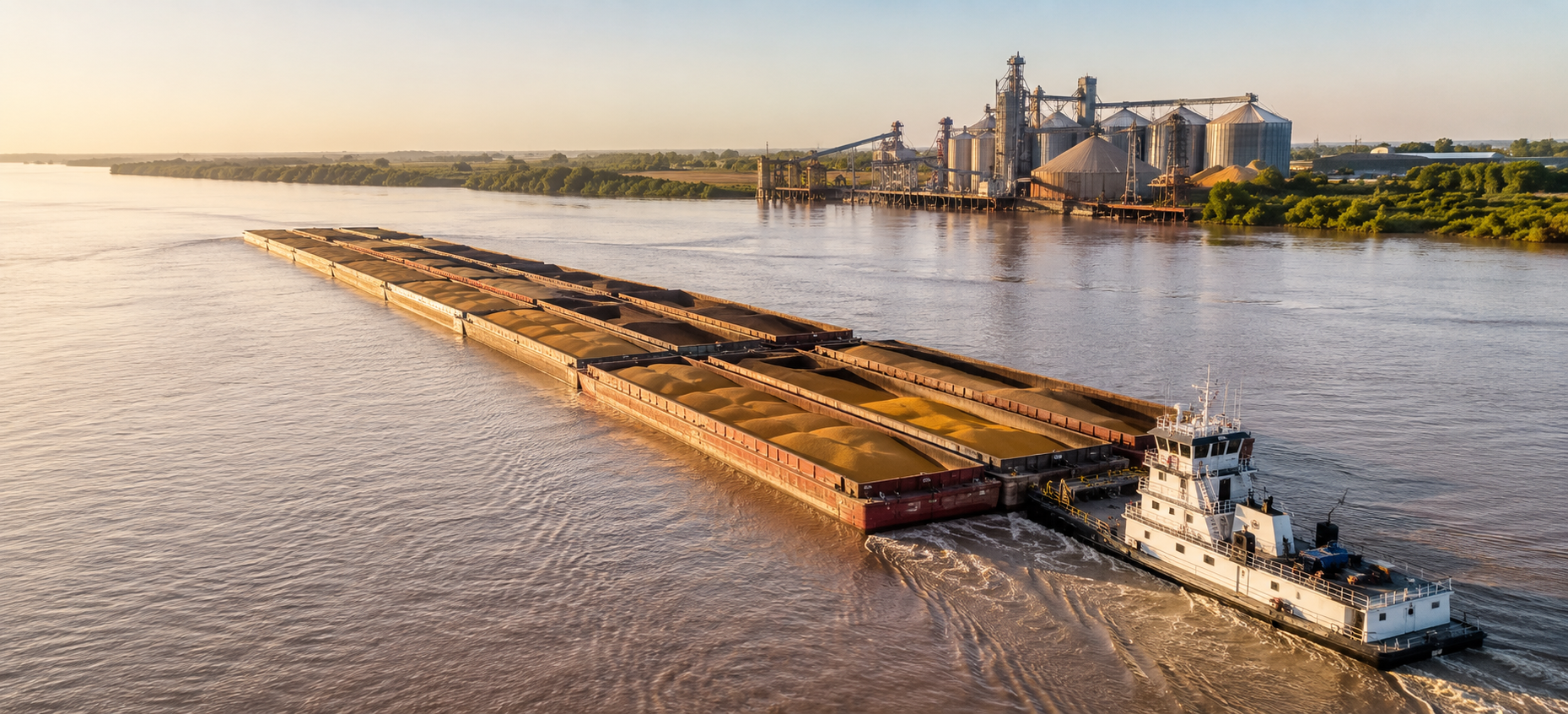
According to a report prepared by Ana Rubicondi , Bruno Ferrari , Emilce Terré , and Julio Calzada for the Rosario Board of Trade (BCR) , Argentine river transport of grain reached its highest volume in five years in 2025. This was achieved by transporting almost 806,000 tons of grain via the Paraguay-Paraná Waterway during that year.
According to official data, operations recorded last year were 18% higher than those recorded in 2024, also the highest number since 2020. “River transport of domestic cargo via the Paraguay-Paraná Waterway is relevant to the Argentine logistics network, particularly for connecting the regional economies of the riverbank with the domestic market,” the BCR stated.
“The 2025 data confirms this trend: grain cabotage recorded its best performance in five years, in a context where the total domestic cargo transported by road, including fuels and fertilizers, also showed a positive trend,” he added.
As a starting point, geographically the network of terminals that operated cabotage in the last three years on the main Paraguay-Paraná waterway (that is, that handle cargo whose origin and destination are located within the Argentine borders), extends from Barranqueras , in Chaco , to La Plata , in Buenos Aires , with a strong concentration of facilities in the Greater Rosario corridor and in the northeast of Buenos Aires .
“It is a network of bulk and fertilizer terminals, fuel plants, thermal power plants and public docks that channel both the outflow of goods to the domestic market and the inflow of goods to the core area,” the entity pointed out.
The movement of coastal goods on the Paraguay-Paraná Main Waterway closed 2025 with a total of 8,494,328 tonnes dispatched, representing a year-on-year growth of 5.8%.
The above was driven primarily by the increased transport of oil from the province of Buenos Aires, in addition to the sharp increase in shipments of grains and fuels originating from the terminals in Santa Fe.
Buenos Aires consolidated its position at the top of cargo dispatch by concentrating 86.4% of the Argentine total (7.36 million tonnes), a volume mostly explained by oil and derivatives that depart from the terminals in the southern suburbs of Buenos Aires towards the domestic market.
For its part, Entre Ríos ranked second with shipments composed exclusively of grains, while Santa Fe (4.8% of the total) more than doubled its 2024 volumes by registering 407,008 tonnes, thanks to the rebound of the energy sector.
Grain cabotage showed expansion for the second consecutive year, moving 805,805 tonnes, 17.8% more than in 2014 and 27.3% above the average of the last five years. This system—key to the sector’s competitiveness because it operates using barges at lower costs than trucks or trains—originates on the banks of the Paraná River and its main destination is the Greater Rosario agro-export complex.
Entre Ríos, the segment leader, accounted for 89% of the national volume with 718,301 tonnes (+19.8%). Cargill’s operations in Diamante (305,790 tonnes) stood out, as did the remarkable growth of the La Paz Agricultural Cooperative, which increased by 63% to reach 279,756 tonnes.
Santa Fe and its capital city port captured the remaining 11% by doubling their shipments (87,504 tonnes), concentrated almost entirely in the Port of Santa Fe. In contrast, Chaco did not register any grain shipments via this route in 2025, deepening the paralysis of the sector that it has suffered for years, despite having represented a third of the market in 2020.
In the first six months of the year, Argentina’s containerized cargo exports were shipped mainly to China, the United States, and Brazil, traditional destinations for the country’s exports. The chart below shows Argentina’s main containerized export cargoes:
Main Containerized Cargoes – Argentina | H1 2026 | TEUs
Source: DataLiner (click here to request a demo)
In the opposite direction of river traffic, fuel arrivals at the waterway’s receiving ports increased by 5.3% year-on-year, totaling 3.63 million tonnes. Eighty percent of these unloadings were concentrated in the province of Santa Fe (led by the Pan American Energy and YPF plants in San Lorenzo), while the YPF dock in Barranqueras (Chaco) experienced a significant recovery, increasing its revenue sevenfold (241,092 tonnes), thus consolidating its position as the energy supply hub for Northeast Argentina (NEA).
Fertilizer shipments—mostly from Bahía Blanca—experienced a general decline of 27.8%, ending the year with 501,992 tonnes. The drop affected all terminals along the corridor, although Profertil in Santa Fe (204,039 tonnes) and the Provincial Dock of San Nicolás in Buenos Aires (181,530 tonnes) remained the main unloading points for this agricultural input.
Source: Portal Portuario
-
Economy
May, 31, 2022
0
The agribusiness trade balance in São Paulo registered a surplus
-
Ports and Terminals
Mar, 22, 2020
0
Brazil`s infrastructure minister rules out closing logistics channels due to coronavirus
-
Meat
Jun, 10, 2024
0
Brazil’s chicken meat exports surge by 4.2% in May, defying revenue dip
-
Meat
Mar, 24, 2026
0
Rabbit farming gains ground in Parana, boosts rabbit meat exports