


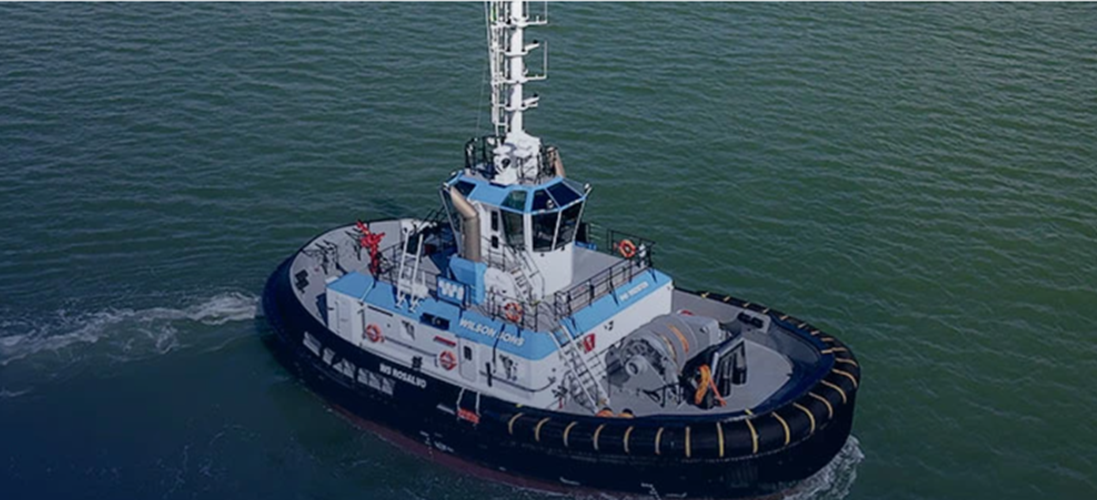
Wilson Sons plans to double tugboat output at Santos shipyard
Sep, 21, 2026 Posted by Gabriel MalheirosWeek 202639
Wilson Sons plans to double tugboat production at its shipyard on the left bank of the Port of Santos, in Guarujá, São Paulo state, by expanding into an adjacent area.
The 14,500-square-meter facility currently employs around 360 people, including roughly 300 in operational roles and another 60 in administrative positions. The site handles newbuilds, repairs and power upgrades for Wilson Sons’ own tugboat fleet.
Wilson Sons, a port and maritime logistics operator controlled by MSC since last year, operates 83 tugboats across Brazil. Seven are based at the Port of Santos, where the shipyard also serves as a berthing base.
“The shipyard is responsible for providing technical support to the fleet. We develop new projects, build and deliver them. Our production line is fully booked next year, the following year and through 2029 to meet internal demand. We still have 14 tugboats to deliver over that period, averaging four a year. We cannot open capacity to third parties, although we have done so in the past,” said Adalberto Luiz Renaux Souza, the company’s executive director.
The exception is an existing contract to maintain tugboats operated by mining company Vale.
Damen partnership supports vessel design
The tugboat projects stem from a long-standing partnership with Dutch shipbuilder Damen Shipyards Group.
“The major equipment is not manufactured in Brazil. Because they are larger shipyards and have greater purchasing power — they build 40 tugboats a year — we use that to our advantage,” Souza said.
“We buy the design, and they supply what we call the material package. We receive 3D drawings, piping material lists, steel specifications — essentially a package of technical information.”
Steel, one of the main raw materials used in tugboat construction, including for the hull, is purchased from a Brazilian mill.
“We buy the steel and send it to a partner in Santos, which receives it, blasts it to remove impurities and provide a smooth, uniform finish, paints it and cuts it. There is a cutting plan that produces the individual pieces,” Souza said.
Those components are then delivered to the shipyard for assembly.
“Building a boat is like assembling Lego. It is a set of pieces that we put together,” he said.
Electrical panels have been supplied for 30 years by Brazilian manufacturer WEG, based in Jaraguá do Sul, Santa Catarina.
Shipyard targets four tugboat deliveries in 2026
Wilson Sons has already delivered three tugboats this year after assembly and sea trials.
“We are ready to deliver the fourth, fifth and sixth. The fourth is already in my dry dock, while the fifth and sixth are in the workshops. I think we will end the year at our annual average of four vessels,” Souza said.
So far in 2026, the facility has carried out 13 dockings of vessels from the fleet for different types of work, often simultaneously. The shipyard has the only dry dock of its kind in São Paulo state.
Expansion could lift output to eight tugboats a year
The planned Wilson Sons shipyard expansion would use an area next to the existing facility and double annual production capacity, according to Souza.
“If I can build four tugboats a year at the current site, the new space will take that to eight over the same period. In other words, I will double capacity with the additional area,” he said.
“If our own company does not have enough demand, we will certainly serve third parties.”
The site is greenfield land that has never been developed, and Wilson Sons has already signed a lease agreement with the owner.
The company is beginning the environmental licensing process with São Paulo state environmental agency Cetesb. The project was presented to the agency at a meeting in late July.
Souza said he expects the process to be relatively straightforward and may not require a full Environmental Impact Study and Environmental Impact Report, known in Brazil as an EIA-Rima.
“The expectation is that an EIA-Rima will not be necessary. It should be something simpler, handled through the Santos office itself. We are filing our request for their review,” he said.
Souza expects an installation license could be available within six months.
“We want another workshop, more open yard space and a quay. Today we have 78 meters of quay and, if we extend it, we can add another 72 meters,” he said.
Skilled labor remains a challenge
Unlike Itajaí, in Santa Catarina, and Rio de Janeiro, Santos is not currently a major shipbuilding center. Souza therefore sees skilled labor as the shipyard’s biggest challenge.
To address the shortage, Wilson Sons hires workers with little or sometimes no previous experience and trains them with support from Senai, Brazil’s industrial training service.
“Today, from Monday to Friday, Senai is here inside the shipyard training our people and providing technical instruction so they can qualify as fitters, welders or boilermakers, for example,” Souza said.
“Because the diploma is issued by Senai, they are not being trained just to work here. They can work wherever they want.”
Lower-emission tugboats under study
Souza also said Wilson Sons has already studied options for lower-emission tugboats.
“It could be electric or ethanol-powered. Since we do not have methanol available here the way it is overseas, it would be ethanol. We already use biodiesel,” he said.
At the Port of Açu, in Rio de Janeiro state, Wilson Sons operates three tugboats using biodiesel and HVO, or hydrotreated vegetable oil, a renewable diesel fuel.
“We have had excellent technical results. Performance is the same, and emissions are lower,” Souza said.
Source: A Tribuna
-
Ports and Terminals
Feb, 16, 2021
0
Ceará EPZ cargo handling up 6.1% in January
-
Grains
Dec, 09, 2025
0
Government Reduces Export Duties for Argentina’s Grain Sector
-
Ports and Terminals
Jul, 05, 2019
0
Port of Itajaí: Dredger Backhoe Simson is in 24-hour action
-
Meat
Aug, 10, 2022
0
South Africa stops charging anti-dumping tariffs on Brazilian chicken