


Brazilian Poultry Import Restrictions Expected After Newcastle
Oct, 21, 2026 Posted by Sylvia SchandertWeek 202643
Most of Brazil’s trading partners are expected to restrict poultry imports only from the area affected by the Newcastle disease outbreak at a turkey farm near Nova Itaberaba, Santa Catarina, under bilateral animal health protocols signed with those countries.
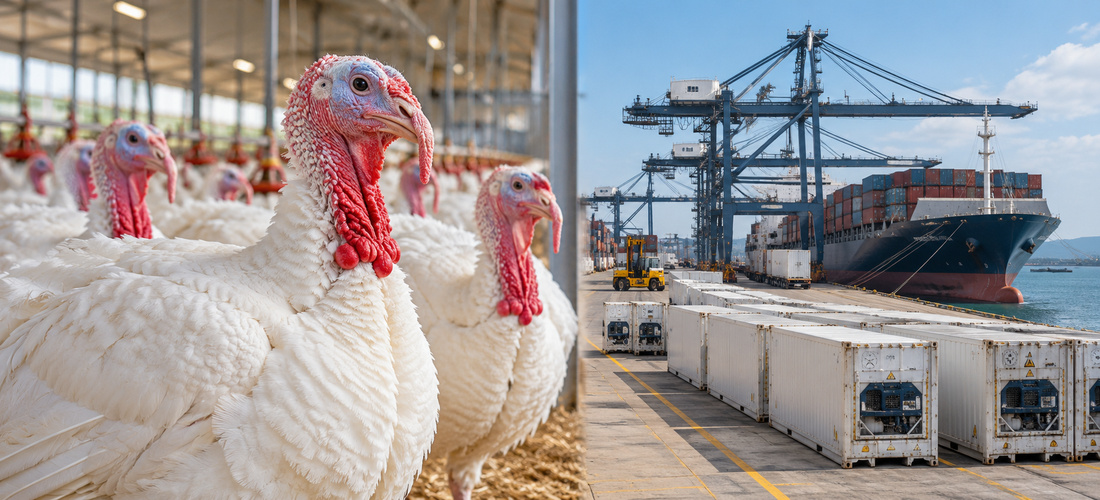
According to Embrapa, Brazil has been the world’s largest chicken meat exporter since 2021, while Paraná and Santa Catarina are the country’s leading states for international shipments. According to Datamar data, Brazil exported 265,544 TEUs of chicken meat between January and August. See more details on the shipments below:
Chicken Meat Exports | Jan 2024 – Aug 2026 | TEUs
Source: DataLiner – explore our trade data
Only the agreements with China, the largest buyer of Brazilian chicken meat, and Malaysia provide for nationwide restrictions. Even so, China decided to limit its ban to processing plants in Santa Catarina, a move Brazilian authorities considered a victory. Malaysia has yet to announce how it will apply the rules. Mexico suspended purchases from all of Brazil on Monday, October 19.
The information is contained in a circular issued late Monday night by the Department of Inspection of Animal Products (DIPOA), part of the Ministry of Agriculture’s Secretariat of Agricultural Defense.
The document instructs federal agricultural inspectors on certifying poultry products for export under the rules agreed with each trading partner. The circular reiterates that September 21 must be used as the reference date when applying restrictions. That was the day the first samples were collected from asymptomatic birds in Nova Itaberaba, leading to the investigation and confirmation of the outbreak.
“For the purposes of applying certification-related restrictions, the reference date of September 21, 2026, must be used, corresponding to the collection of the samples that resulted in confirmation of the outbreak, subject to the time-related criteria set out in each international sanitary certificate (CSI),” states the circular, obtained by the publication.
For international certificates “already issued covering products subject to sanitary restrictions arising from the occurrence of Newcastle disease,” the document says, “the requirements applicable to each importing country must be assessed, particularly regarding the dates of production, slaughter, raw material sourcing and certification.”
In the circular, the department asks inspectors to exercise greater scrutiny when reviewing animal health reports, particularly regarding on-farm poultry mortality, and when checking for clinical signs during ante-mortem and post-mortem inspections.
If these assessments raise suspicions of signs of avian neurological and respiratory syndromes (SRN), the state veterinary service must be called in to respond. The Ministry of Agriculture also asks inspectors to pay closer attention during post-mortem inspections, conducted after slaughter, to lesions characteristic of SRN.
“Birds sent to slaughter and processing plants accompanied by an Animal Transit Permit (GTA) are eligible for slaughter because, when SRN is suspected on a farm, their movement is prohibited. Ante-mortem inspection is responsible for verifying the birds’ health status on site, in accordance with the standardized inspection procedures in force,” the document states.
The circular lists the restrictions and certification conditions applicable under the bilateral protocols. It notes that importers may officially communicate specific restrictions or conditions for certifying poultry products, which had not occurred as of Monday night, October 19.
The Ministry of Agriculture is expected to publish the official list of countries that have applied specific measures, along with information on compliance with restrictions under the protocols, on Tuesday, October 20. Certification has followed these rules since Monday, October 19.
Under the signed agreements, nationwide bans apply to China and Malaysia, including Sabah, Malaysia’s second-largest state, located in the northern part of the island of Borneo.
Under the protocols, restrictions covering the state of Santa Catarina apply to Kazakhstan, Chile, Peru for processed products, Tajikistan, Ukraine, the European Union, the Eurasian Customs Union and Uzbekistan.
Bans covering a restricted area or an affected radius, which varies by protocol, apply to South Africa, Argentina, Algeria, Saudi Arabia, Azerbaijan, the Bahamas, Bolivia, Burkina Faso, Bosnia and Herzegovina, Canada, Chile for edible viscera, South Korea, Cuba, Egypt, El Salvador, the United Arab Emirates, Ecuador, the Philippines, Georgia, Hong Kong, India, Israel, Japan, Jordan, Kosovo, Lesotho, Morocco, Mexico, Myanmar, Namibia, New Caledonia, Oman, Pakistan, Peru for unprocessed meat and offal, whether frozen or chilled, French Polynesia, the United Kingdom, the Dominican Republic, Sri Lanka, Thailand, Tanzania, Taiwan, Timor-Leste, Turkey, the Eurasian Customs Union for egg products, the European Union for blood derivatives and byproducts used in animal feed manufacturing, Uruguay, Vanuatu and Vietnam.
Some countries apply restrictions to animals from the outbreak site. These include Bhutan, Iran and Mauritius.
The circular also lists countries that accept imports of certain poultry products provided they undergo heat treatment: South Africa, Argentina, the United Kingdom and Vietnam.
Source: Globo Rural
-
Ports and Terminals
Nov, 06, 2024
0
Brazil and China sign agreement establishing new route between river ports in Amapá
-
Ores
Jun, 25, 2024
0
Regulatory hurdles, slow licensing hamper Brazil’s mining potential
-
Coffee
Aug, 25, 2021
0
Exports of instant coffee negatively impacted by increase in domestic demand for robusta coffee
-
Ports and Terminals
Jun, 15, 2020
0
National Secretariat for Ports and Water Transport includes new procedure within ‘Port Without Paper’ system