


U.S. opposition to IMO marine fuel rules leaves Japan in limbo
Nov, 25, 2026 Posted by Sylvia SchandertWeek 202648
A disagreement between Europe and the United States over whether to give clean fuels such as ammonia priority over liquefied natural gas (LNG) is holding up a deal on international shipping standards. The impasse has left Japanese shipping companies and shipbuilders uncertain about how to proceed with their decarbonization plans.
A working group of the International Maritime Organization (IMO), a United Nations agency, is meeting in London this week to work out the details of the new regulations. If members reach a consensus, a vote could take place at a special session on December 4. A U.S. representative, however, expressed doubt that any measures would be formally adopted this year.
Ships that run on clean-burning fuels such as ammonia are expensive to develop and put into service. In April 2025, countries agreed on incentives to encourage the use of these fuels. Higher-emitting vessels would pay fees, with a share of the proceeds going to ships whose emissions fell below preset thresholds.
The United States opposed the idea and sought to win over oil-producing countries. Plans to formally adopt the measures in October 2025 were put on hold.
Washington argued that the proposal amounted to a carbon tax and that consumers would bear the cost of the penalties through higher freight rates and energy costs. It also argued that the measure would put LNG at a disadvantage. The United States is a major LNG producer.
With the IMO planning to tighten its standards over time to reach net-zero emissions around 2050, the central question is how much to relax the proposed rules. Although LNG produces about 25% less carbon dioxide when burned than the heavy fuel oil used by conventional ships, it lags well behind ammonia in terms of sustainability.
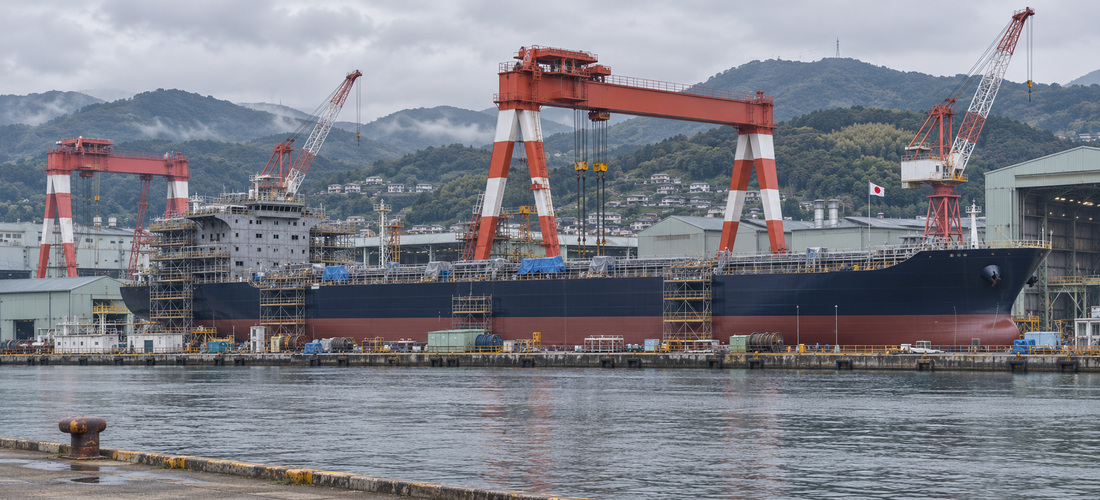
More flexible rules would likely force Japan to rethink its shipbuilding strategy. The Japanese government has focused on next-generation fuels as a way to compete with companies in China and South Korea, which currently dominate the market. Japanese shipping companies have followed the same strategy. “Japanese shipbuilders see securing orders for ships that run on next-generation fuels as a winning strategy for increasing their market share,” said a senior executive at a shipbuilding industry group. “If adoption of the IMO standards is delayed and the outlook becomes uncertain, they’ll have to rethink their strategy again.”
Faced with that uncertainty, Japanese shipping companies are looking beyond fuels for ways to cut emissions.
In April, Mitsui O.S.K. Lines unveiled an updated roadmap for reaching net-zero emissions by 2050. It expects about 30% of its emissions reductions to come from improvements in operational efficiency, up from 20% in the previous plan.
In 2022, the company set up a subsidiary in the Philippines to collect and analyze data from its ships in real time to improve operations. The company will also speed up the installation of energy-saving equipment, including wind-assisted propulsion systems.
NYK Line has partnered with a British company to test a program that analyzes operating data from selected vessels and advises crews on how to improve performance.
Source: Nikkei Asia, as published by Valor Econômico.
-
Fruit
Jan, 17, 2025
0
Orange juice exports set for another decline amid weak demand
-
Ports and Terminals
Mar, 20, 2026
0
New container yard at Port of Vitoria is ready but still cannot operate
-
Meat
Dec, 12, 2025
0
Uruguay Set to Post Record Meat Export Revenue in 2025
-
Shipping
Aug, 18, 2025
0
Public consultation resumes on essential clauses for long-term coastal shipping contracts