


Government agency study sees no reason to restrict participation in Santos port auction
May, 27, 2025 Posted by Denise VileraWeek 202522
In a new competition study, the technical department of Antaq (National Waterway Transportation Agency) stated it found no grounds to justify excluding shipping lines (transport companies, shipowners) from the auction for the concession of Tecon 10, the mega terminal at the Port of Santos.
However, the agency views favorably the entry of a new company into the bidding — one that does not yet operate in Santos.
As Folha has reported, there is a dispute over the auction rules: whether participation will be open to all interested parties or restricted.
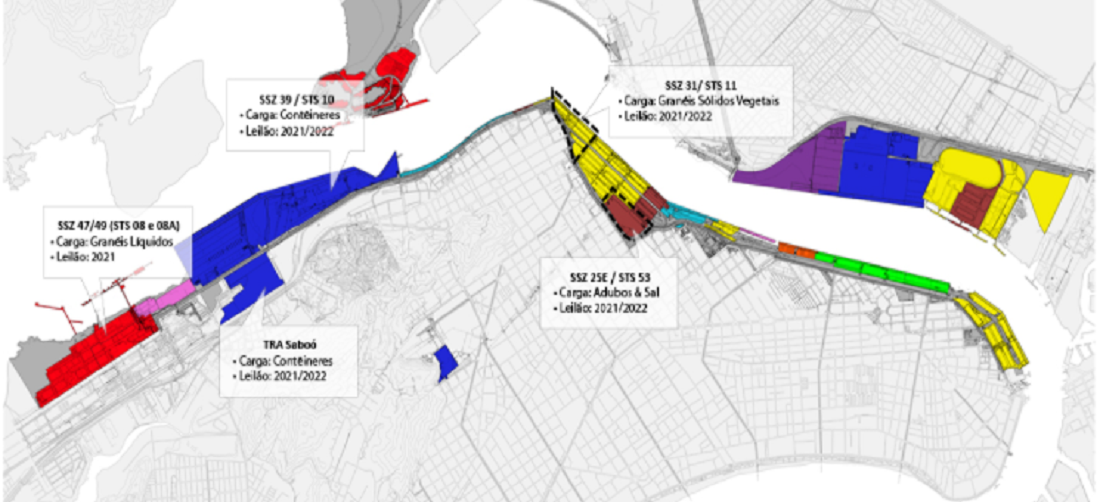
The terminal will be built in the Saboó region of Santos. It will cover 423,000 square meters along 1,300 meters of quay. Operations are expected to begin in 2027, and by 2034, the terminal is projected to handle 3.5 million TEUs (twenty-foot equivalent units, the standard for containers).
The project is expected to increase the port’s container throughput by 40% to 50%.
Below is a historical overview of container throughput at the Port of Santos. The chart was prepared using DataLiner data:
Container Throughput at the Port of Santos | Jan 2022 – Mar 2025 | TEUs
Source: DataLiner (click here to request a demo)
The concept of open participation has already been the subject of cases at CADE (Administrative Council for Economic Defense) and has faced political pressure at the Ministry of Ports and Airports. In an initial analysis, Antaq did not impose any restrictions. However, the agency decided to conduct another study following suggestions made during public hearings on the matter.
The technical report is not binding. It offers recommendations to the agency’s board on “economic, legal, institutional, and situational factors to be considered for establishing the guidelines of the bidding process,” according to the document.
Port operators have complained that shipping companies such as Maersk and MSC, which already operate a terminal in Santos, could cause harmful market concentration. The Antaq study addresses this concern, noting that BTP (a joint venture between Maersk and MSC), DP World, and Santos Brasil (recently acquired by CMA CGM) could exert competitive pressure on the market.
Still, the study argues that such concentration can be “effectively mitigated through existing regulatory and antitrust tools.”
Antaq is expected to send a recommendation to the Federal Court of Accounts (TCU) regarding the auction model. Folha has learned that if the Antaq board chooses to deviate from its technical findings, it will likely face pushback from shipping companies.
“Depending on what happens, there’s a strong likelihood of legal action. If it violates the Economic Freedom Law, someone may take steps in that direction,” said Claudio Loureiro de Souza, executive director of Centronave (Center for Transatlantic Navigation), which represents shipping lines.
“We need berths [in Santos] and deeper draft [channel depth]. Ships are waiting 50 hours — it’s a dramatic situation. Container operations should be: arrive, handle cargo, leave. Demand is very strong, and we can’t increase the number of ships because we can’t increase the number of berths,” he added.
Terminal operators inside and outside the port warn that there’s a risk of cargo concentration in the hands of a single company, undermining fair competition.
“The shipping line docks at its own terminal, regardless of the prices offered by other terminals. The shipping line is the one that contracts the terminal. It has the power to stifle competition,” said Angelino Caputo, president of ABTRA (Brazilian Association of Terminals and Customs Warehouses).
So-called verticalized terminals operate across all stages of transportation — they own the ships, the terminal, and handle the cargo.
Antaq’s technical report states that it “does not identify any technical or legal basis to prohibit the participation of shipping lines in the auction, provided that principles of equality, non-discriminatory access, and regulatory transparency are observed.”
Among the six scenarios analyzed by Antaq are those that, in the agency’s view, could harm competition at the port — such as a win by BTP, which could allow Maersk and MSC to control 60% of the market.
“There is always the possibility that the winning company sells another asset,” noted Centronave’s executive director.
This scenario is mentioned even by those in favor of restrictions: that if Maersk or MSC wins the Tecon 10 concession, it would sell its 50% stake in BTP to the other partner.
“The exit of one of BTP’s controllers would lead to a redistribution of container throughput capacity,” the competition study notes. It also considers that if Santos Brasil — currently the top container handler at the port — were to win the auction, it would lead to excessive concentration in a single company.
To a lesser extent, Antaq expresses a similar concern regarding a potential victory by DP World, another terminal already operating in Santos.
The agency reserves its highest praise for the possibility of a new, non-verticalized company entering and winning the auction. This aligns with widespread speculation among port operators in Santos — namely that JBS Terminais could win the concession, either on its own or in partnership with a shipping line such as Cosco, a subsidiary of China Ocean Shipping.
Source: Folha de S. Paulo
-
Ports and Terminals
Jan, 12, 2024
0
Port of Sudeste to Deploy RightShip’s Maritime Emissions Portal
-
Ports and Terminals
Aug, 15, 2024
0
PortosRio records 23% growth in cargo throughput in first half of 2024
-
Meat
Aug, 02, 2022
0
Brazil set to break another chicken meat export record in 2022
-
Meat
Aug, 13, 2025
0
Brazilian meat exporters urge sector-specific talks with U.S. to reverse beef tariffs