


Brazil-Mexico Trade Has Potential, but a Deal Is Challenging
Jul, 16, 2025 Posted by Sylvia SchandertWeek 202530
Strengthening trade cooperation between Brazil and Mexico could be an alternative for both countries to offset potential losses if the tariff hike announced by U.S. President Donald Trump is confirmed. Foreign trade experts interviewed by Valor Econômico believe a bilateral agreement between Brazil and Mexico could benefit Brazil’s agribusiness sector as well as industrial activities ranging from electronics to the chemical industry. However, they caution that such a solution is not short-term and cannot replace the United States.
Over the weekend, Trump announced 30% tariffs on Mexican products starting August 1. Brazil had already been hit with a 50% tariff, announced by the U.S. president the previous week, which would also take effect next month.
Mexico currently has two main economic cooperation agreements in effect with Brazil—ACE 53 and ACE 55, both signed in 2002. ACE 53 provides for the elimination or reduction of tariffs on 800 items (approximately 12% of bilateral trade) through reciprocal preferences. ACE 55 establishes free trade in automobiles, light commercial vehicles, trucks, buses, agricultural machinery, and auto parts.
“What is needed now—and Brazil has been trying for some time—is to expand these agreements with Mexico to include more sectors and products. That would greatly increase bilateral trade,” says Welber Barral, Brazil’s former foreign trade secretary and partner at consulting firm BMJ.
Mercosur members are limited in their ability to negotiate trade deals independently. However, through the Latin American Integration Association (ALADI), Brazil has signed the two ACE agreements with Mexico. Mercosur has also authorized Brazil to begin negotiations with Mexico to establish a free trade area.
In 2024, Brazilian exports to Mexico totaled USD 7.8 billion, while imports reached USD 5.8 billion, resulting in a USD 2 billion surplus for Brazil. However, this surplus fell by USD 1 billion compared to 2023, when it was USD 3 billion. Experts say these figures show there’s room for growth.
Below is a historical overview of Brazilian container exports to Mexico starting from January 2022. The chart was created using DataLiner data:
Brazilian Container Exports to Mexico – Jan 2022 to May 2025 – TEU
Source: DataLiner (Click here to request a demo)
Brazil and Mexico have been negotiating a free trade agreement for over two decades, facing resistance on both sides. Analysts believe Trump’s tariffs may provide additional incentive for an agreement, as could the political alignment between Brazilian President Luiz Inácio Lula da Silva and Mexico’s recently elected President, Claudia Sheinbaum.
Sandra Rios, director of the Center for Integration and Development Studies (Cindes), notes that such negotiations take time, regardless of political context. “It’s not a short-term solution. It’s more a sign that the country is seeking alternatives,” she says. Brazil’s Ministry of Development, Industry, Trade and Services (MDIC) and the Ministry of Foreign Affairs (MRE) declined to comment.
Rios agrees there’s potential to explore various value chains through a Brazil-Mexico free trade deal, but notes that Brazil would need to be open to importing Mexican goods.
She says negotiations have repeatedly stalled due to concerns, including fears among different Brazilian administrations about the negative impact on the domestic industry. This stems from Mexico’s participation in the United States-Mexico-Canada Agreement (USMCA), which replaced NAFTA in July 2020 during Trump’s first term.
“There was fear that Brazilian markets could receive goods from Mexico that didn’t meet rules of origin [which determine if a product qualifies as originating in a country], essentially allowing indirect imports of American goods,” she explains.
Mexico sees Brazil as a closed economy with numerous non-tariff barriers, according to Rios. “There’s a lack of trust between the two countries that has always hindered progress in such attempts.” Barral also points to the protectionist stance of Mexico’s agricultural sector, which fears competition from Brazilian products. “Brazil doesn’t want to expand the agreement without including agribusiness. And Mexico’s agricultural sector is highly protectionist.”
Frederico Lamego, head of International Relations at Brazil’s National Confederation of Industry (CNI), says trade between Brazil and Mexico is complementary and that asymmetries can be resolved through negotiation. “Trade agreements typically include tools like excluding sensitive products and long tariff phaseout periods—up to 10 years or more—offering predictability and adjustment time for industries,” he explains.
Lamego highlights that Brazil and Mexico represent 55% of Latin America’s GDP, 52% of its population, and 66% of its foreign trade. Still, economic integration between the two countries remains below potential. “In practice, trade barriers still restrict bilateral commerce.” He adds that there are 434 identified opportunities for Brazilian products in Mexico, 95.6% related to manufacturing; about 70% of goods traded between the two nations still lack preferential access.
Jorge Amâncio Oliveira, a professor at the University of São Paulo’s Institute of International Relations, argues that seeking new trade partners won’t yield quick results. There are also differences between the types of goods Brazil exports to Mexico and the U.S., which limit any immediate market replacement. “The products exported to the U.S. are not the same as those to Mexico—Embraer aircraft are one example,” he says. “And the volume of meat, soy, and other agricultural exports to the U.S. is on a different scale.”
Barral notes one advantage of an agreement: both are Latin America’s largest countries with similarly developed consumer markets. Still, Mexico is heavily reliant on the U.S. “Today, 80% of Mexico’s exports go to the U.S. Under tariff pressure, they’ll seek to diversify trade relations, and Brazil is a major candidate,” he concludes.
Source: Valor Econômico
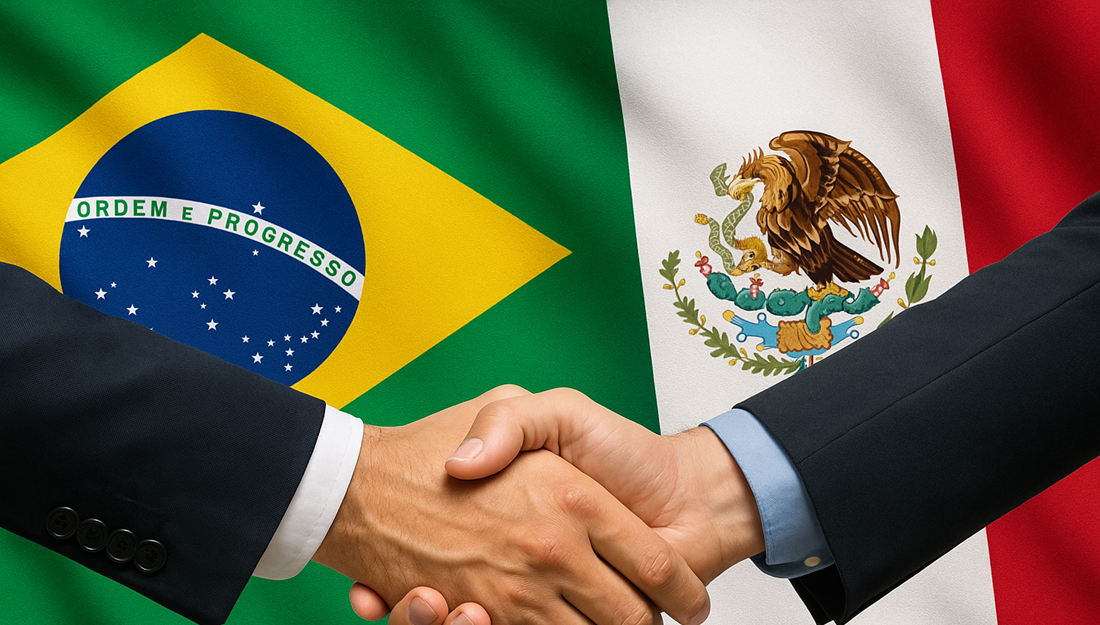
Image generated by artificial intelligence
-
Trade Regulations
Jun, 02, 2025
0
China Rejects U.S. Accusation of Violating Tariff Agreement
-
Economy
Aug, 19, 2025
0
Brazilian exports to Argentina surge over 50% amid economic rebound
-
Dec, 08, 2021
0
Chinese foreign trade breaks record
-
Trade Regulations
May, 30, 2025
0
Opening of Ten New Markets for Brazilian Agribusiness Exports