


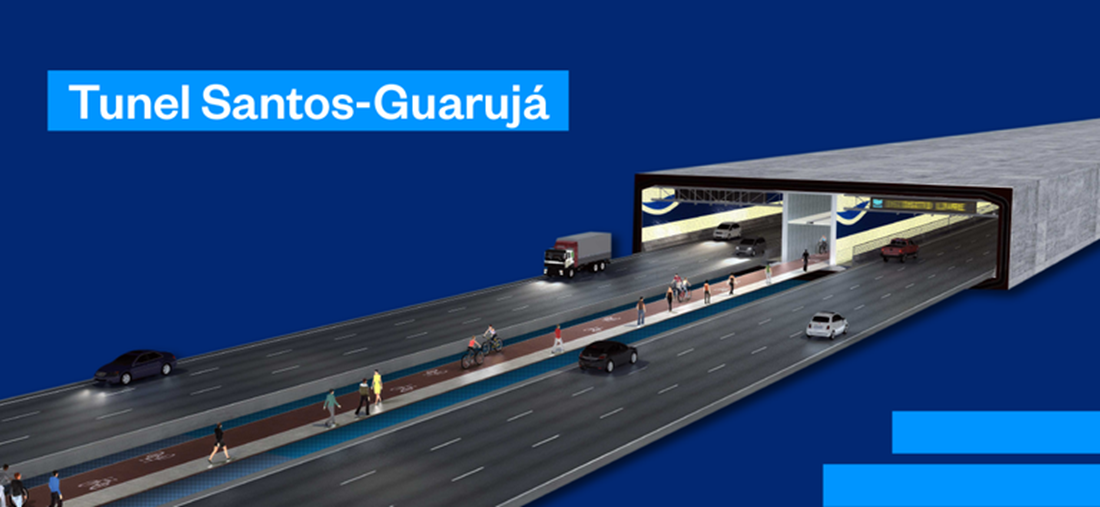
Santos–Guarujá tunnel project clears key environmental hurdle, cost exceeds R$ 6 billion
Aug, 08, 2025 Posted by Lucas LorimerWeek 202533
The State Environmental Council (Consema) approved on Thursday (7) the technical opinion of the São Paulo State Environmental Company (Cetesb) in favor of the Santos–Guarujá immersed tunnel project. With this approval, Cetesb may now issue the preliminary license (LP), the initial stage in the project’s environmental licensing process. The extraordinary meeting was held at the State Secretariat for the Environment, Infrastructure, and Logistics (SEMIL) in São Paulo.
Cetesb issued a favorable opinion on the project last month, following an analysis of the Environmental Impact Study and Report (EIA/Rima) prepared by the Economic Research Institute Foundation (Fipe) and submitted by the State Secretariat for Partnerships and Investments (SPI) the previous year.
The report concluded that the socio-environmental balance is positive, stating that the tunnel “is considered strategic for the Baixada Santista region, with direct effects on mobility, the economy, and quality of life.”
The tunnel will directly impact operations at the Port of Santos, the largest in Latin America. See below a history of container throughput at the Port of Santos starting from January 2022. The chart was prepared using DataLiner data:
Container Throughput via Port of Santos – Jan 2022 to Jun 2025 – TEU
Source: DataLiner (Click here to request a demo)
The project maintains the guidelines of the original plan (Dersa project), which received an LP in 2014, but incorporates updates such as the urban integration of tunnel access points in accordance with the master plans of Santos and Guarujá, as well as the inclusion of infrastructure for the Light Rail Vehicle (VLT).
Once the LP is issued, Cetesb will set a series of requirements for the next stage, the installation license (LI), which will authorize construction to begin.
Debates
One of the issues discussed during the Consema meeting was the creation of the Socio-Environmental Council, which is already planned in the project and will oversee the enterprise during both the installation and operational phases. The organization and membership of the council have yet to be defined.
Environmental impacts
The report indicated that measures such as erosion control, water quality monitoring, and proper dredging management will help prevent more severe damage. A reduction in ferry use is also expected to result in an 18,500-tonne reduction in annual carbon dioxide (CO₂) emissions and a 72-tonne reduction in carbon monoxide (CO) emissions.
The project will require the removal of approximately 10.5 hectares of vegetation (just over 100,000 square meters, or nearly 15 soccer fields), which will impact local fauna. However, the loss may be offset by investments in conservation units. Dredging in the channel could also temporarily impact aquatic life, but these effects are expected to be monitored and reversible.
The expropriation of 65 properties in the Macuco neighborhood of Santos was identified by technical staff as the project’s most sensitive point. However, the reduction in the number of affected families and the compensations offered—such as indemnities, resettlement, and social support—were viewed positively.
The tunnel
The tunnel will be 1.5 kilometers long, with 870 meters running beneath the estuary channel. It will have three lanes in each direction—two for passenger vehicles, buses, and trucks, and one dedicated to the VLT—plus a pedestrian and bicycle gallery.
The project is a joint effort between the federal and state governments. The estimated investment is R$6.8 billion, of which R$5.14 billion will be public funding.
The international tender for the sponsored concession, under the public-private partnership (PPP) model, will take place on September 5 at 4 p.m. at the São Paulo Stock Exchange (B3). The winner will be the bidder offering the greatest discount on the maximum annual public payment, set at R$438.4 million (based on the March 2025 date).
The future concessionaire will sign a 30-year contract for the construction, operation, and maintenance of the asset, with the potential to earn tariff revenue of R$2.34 billion starting from the sixth year of the concession (with a one-way toll of R$6.15).
Meeting
The Special Subcommittee on the Santos–Guarujá Tunnel Works, part of the Chamber of Deputies’ Transport and Infrastructure Committee, held a technical meeting on the fixed link on Thursday (7). Anderson Pomini, president of the Santos Port Authority (APS), attended. The tunnel’s legal documents were approved by the National Waterway Transport Agency (Antaq) at the end of last year. Antaq is responsible for monitoring possible impacts on port operations from the planning stage through to construction. The meeting also discussed the Tecon Santos 10 megaterminal at the Port of Santos.
Source: A Tribuna
-
Grains
Dec, 28, 2021
0
A record-breaking grain harvest is expected for 2021/2022
-
Other Cargo
Jul, 11, 2023
0
Paranaguá port expects 9 mt of fertilizer imports by the end of the year
-
Coffee
Jan, 16, 2020
0
Brazilian coffee crop in 2020 expected to be greater than previous season
-
Other Logistics
Jul, 10, 2019
0
A third bridge to link Paraguay and Brazil