


Two companies bid for Santos-Guarujá tunnel project
Sep, 03, 2025 Posted by Lucas LorimerWeek 202537
Two foreign companies with operations in Brazil have submitted proposals for the auction of the Santos-Guarujá immersed tunnel: the Portuguese construction firm Mota-Engil and the Spanish company Acciona. The auction is scheduled for Friday (5) at 4 p.m. at the São Paulo Stock Exchange (B3), where the envelopes will be opened.
The tunnel, the largest infrastructure project in the country and part of the Growth Acceleration Program (PAC), will be auctioned under a public-private partnership (PPP) model. Of the R$6.8 billion in expected investments, R$5.14 billion will be split evenly between the federal and state governments. The remaining amount will be financed by the future concessionaire.
The winning bidder will be the one offering the highest discount on the maximum annual public compensation, which is capped at R$438.4 million. The contract will last 30 years, during which the concessionaire will be responsible for the construction, operation, and maintenance of the asset.
Since 1996
Acciona entered Brazil in 1996 and built Terminal 2 at the Port of Açu in São João da Barra (RJ), among other projects. It currently leads the construction of São Paulo’s Metro Line 6-Orange. Internationally, the company “has designed and built over 800 km of underground works and executed some of the world’s most important tunnel projects, including the Follo Line railway tunnels in Norway, the Quito Metro in Ecuador, and the Western Harbour Tunnel in Sydney, which is currently under construction,” the company stated in a note.
Acciona also emphasized that it “continually analyzes infrastructure opportunities aligned with its business strategy and its aim to generate a positive impact on society.”
Arrived in 2009
Mota-Engil has been active in Brazil since 2009, initially entering the highway concessions sector. It currently operates in engineering and construction, as well as in the oil and gas sector through Empresa Construtora Brasil (ECB), and in environmental services via Suma Brasil, and in highway telemetry systems through Tracevia do Brasil.
The Chinese state-owned China Communications Construction Company (CCCC) holds a 30% stake in Mota-Engil and provides integrated services in the construction and operation of transport infrastructure.
Mota-Engil was contacted by the news outlet but had not responded by the time of publication. Requests for comment were also sent to the State Secretariat for Partnerships and Investments (SPI), the Ministry of Ports and Airports (MPor), and the Santos Port Authority (APS), but no responses were received.
Addendum ensures legal certainty
After Brazil’s Federal Court of Accounts (TCU) pointed out flaws in the tunnel’s project model, federal and state representatives met at the court last Wednesday in Brasília. As a result, an addendum to the cooperation agreement will be signed to ensure legal certainty and institutional alignment, without affecting the project timeline, according to the São Paulo state government.
On June 13 in Santos, Governor Tarcísio de Freitas (Republicanos) said the public notice had been revised, raising the project’s value by nearly R$1 billion. The adjustments incorporated feedback gathered during an international roadshow in Europe, which brought together global infrastructure operators.
Updates included a new contract base date of January 2025; revised costs for key items like concrete, dredging, and diaphragm walls; re-evaluation of average transport distance (set at 85 kilometers); updated traffic forecasts; revised risk allocation criteria; and interim solutions for the Outeirinhos quay and the Guarujá rail yard, which will ensure port and logistics operations continue during construction.
Additionally, an expropriation fund of R$544.3 million (as of March 2025) was established by the state to cover compensation and resettlement costs. An estimated 65 properties in the Macuco neighborhood of Santos will be expropriated.
Project details
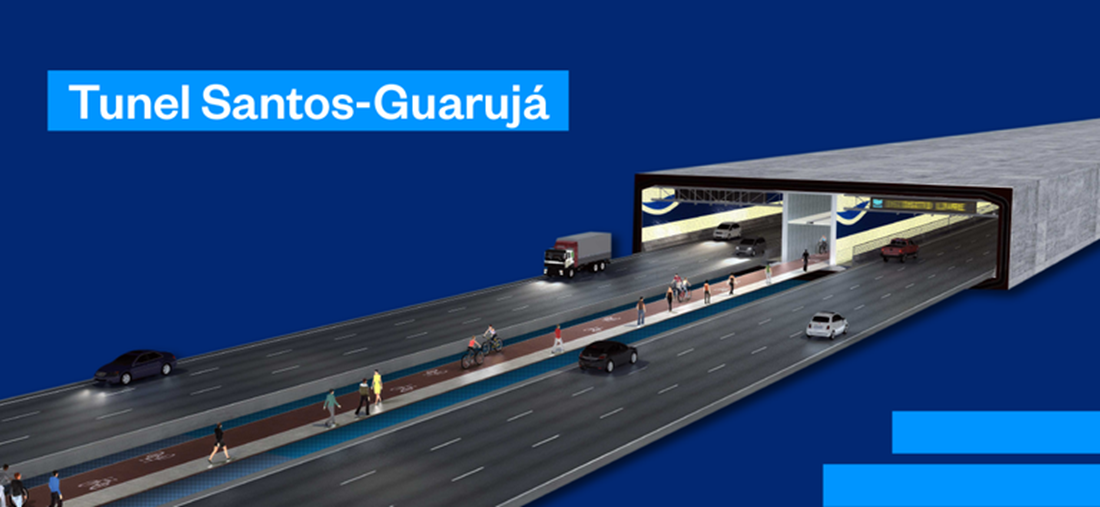
The tunnel will be 1.5 kilometers long, including 870 meters beneath the estuary channel, with three lanes in each direction: two for cars, buses, and trucks, and one exclusively for a Light Rail Vehicle (LRV), along with a pedestrian and cyclist gallery. Currently, the connection between Santos and Guarujá is made via ferries and small boats, which transport more than 21,000 vehicles, 7,700 cyclists, and 7,600 pedestrians daily.
The construction is expected to generate approximately 9,000 direct and indirect jobs.
Source: A Tribuna
-
Mar, 17, 2026
0
U.S. tariffs curb Brazil’s steel exports but country keeps market share
-
Ports and Terminals
Nov, 08, 2024
0
New Container Cranes Boost BTP’s Equipment Capacity by 25%
-
Grains
Oct, 07, 2019
0
Study shows Brazilian agriculture’s growth due to productivity
-
Ports and Terminals
Oct, 13, 2020
0
Port of Santos passes IBAMA inspection for dangerous cargo handling