


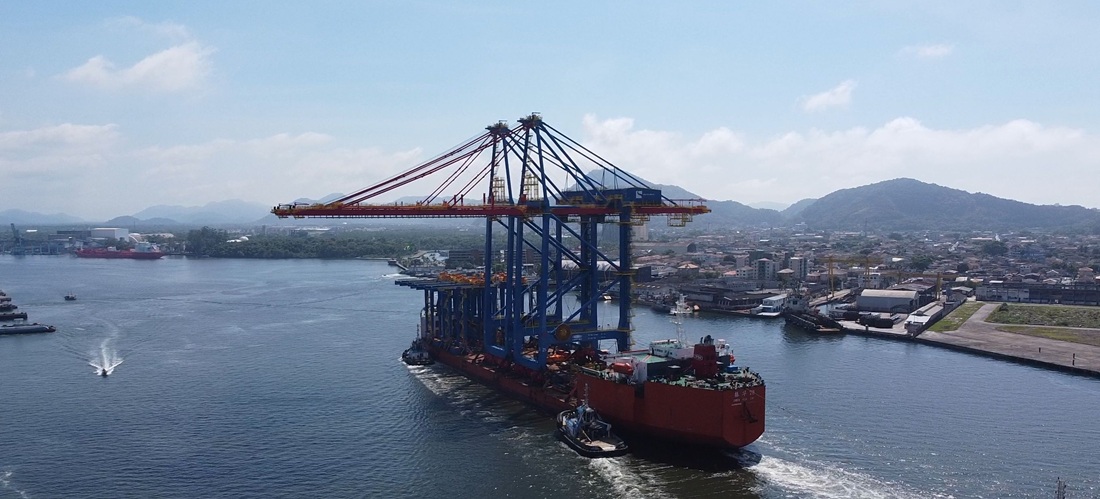
New remote-operated cranes arrive at Tecon Santos
Jan, 13, 2026 Posted by Gabriel MalheirosWeek 202603
Tecon Santos took delivery on Saturday (10) of two new ship-to-shore cranes and eight electric rubber-tired gantry (RTG) cranes acquired by Santos Brasil as part of a broader expansion and modernization program. Manufactured by China’s ZPMC, the equipment arrived at 10:35 a.m. aboard the vessel Zhen Hua 28 at Tecon Santos, located on the left bank of the Port of Santos, Latin America’s largest port complex.
The Zhen Hua 28 departed China on November 15 carrying the cranes fully assembled on deck. At Tecon Santos, the unloading operation is carried out via rails that connect the vessel directly to the quay.
Standard operation of the new cranes is expected to begin next month. Remote operation will be introduced gradually after the completion of testing, system configuration and staff training, a process that may take up to one year.
The ten cranes represent investments of around R$ 300 million. The new ship-to-shore cranes are equipped with the Truck Position System (TPS), which ensures precise truck positioning during loading and unloading activities.
Each ship-to-shore crane stands 50 meters tall from the quay to the boom and has a 70-meter outreach, with the capacity to handle simultaneously up to two fully loaded 20-foot containers, for a total lifting capacity of up to 100 tonnes.
In the yard, the eight new electric RTGs add to the eight units already in operation at Tecon Santos. The company also plans to acquire another 30 electric RTGs in the coming years, gradually replacing diesel-powered models.
Each electric RTG avoids the emission of around 20 tonnes of CO₂ per month. Once the fleet replacement is completed, monthly emissions reductions are expected to reach 713 tonnes, equivalent to a 97% cut in emissions from these machines at the terminal.
Tecon Santos’ expansion and modernization program began in 2019 and calls for investments of approximately R$ 3 billion through 2031, in updated values, of which about R$ 2 billion has already been deployed.
Source: Santos Brasil
-
Ports and Terminals
May, 08, 2024
0
ANTAQ Conducts Public Hearing for Lease of Port Terminal in Santana
-
Automotive
Apr, 08, 2025
0
Brazil Auto Exports Rise 40.6% in Q1, But U.S. Tariffs, Mexico Threaten Outlook
-
Economy
Aug, 20, 2025
0
Brazilian industry sees first export outlook drop since 2023 amid U.S. tariff hike
-
Shipping
Jun, 29, 2023
0
Wilson Sons celebrates over 500 maneuvers with sustainable tug