

Offal goes global: once-overlooked cuts become new export stars of Brazilian agribusiness
Feb, 10, 2026 Posted by Gabriel MalheirosWeek 202607
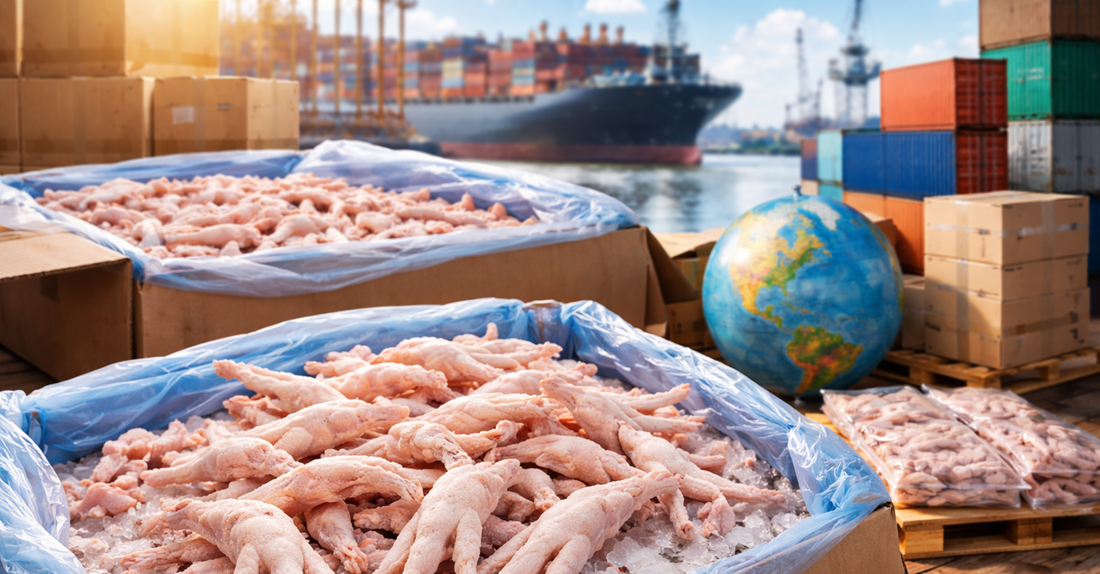
Who would have thought that products long dismissed by the market — such as chicken feet — would gain prominence and fetch premium prices abroad?
Alongside them, other cuts often labeled as exotic, including bovine penis, are finding new territories and consumers willing to explore unfamiliar flavors. Brazilian agribusiness is increasingly showing that added value does not always lie in the most famous or traditional cuts.
The trend has gained traction in recent years, revaluing products once treated as byproducts and now rebranded as delicacies. These items have become unexpected sources of income for producers, particularly in international markets.
Chicken Feet: From Waste to a Million-Dollar Business
Chicken feet, long neglected by large-scale production chains, have become one of the clearest examples of this transformation.
Once freely handed out by butcher shops in the 1980s and 1990s, they now face strong demand in markets such as China and South Africa.
The product has found both culinary and industrial niches that have lifted its market value. Brazil now exports millions of units, with the external demand even pushing up domestic prices, reaching as much as R$14 per kilogram in some local markets.
Beyond traditional cooking — where chicken feet are used in soups and broths, including dishes such as South Africa’s walkie-talkie, prepared with chicken heads — the product has entered the snack market. In China, chicken feet are sold ready-to-eat, even through vending machines.
Another destination is the pet food segment, including in Brazil, expanding applications and creating new opportunities for small and mid-sized producers.
In 2025 alone, Brazil earned $221 million from chicken feet exports to China, the main buyer of the product, according to the agriculture ministry. That represented a 9.5% increase from 2024.
Bovine Penis: Asia’s ‘White Gold’
Another surprising example is bovine penis. Once routinely discarded or sold cheaply as dog chews, it can now command prices of up to $6,000 per tonne in Asian markets, particularly in China and Hong Kong, where it is considered an aphrodisiac delicacy with cultural and culinary value.
The product readily absorbs seasonings and broths and can be consumed in several forms: fresh, boiled, stewed, dehydrated or even powdered. Dehydrated versions are the most common.
For Brazilian meatpackers, this reinforces the industry saying that “nothing goes to waste,” turning what was once discarded into an additional export revenue stream.
Brazil generated $231,752 from exports of fresh or chilled edible bovine offal, according to Agrostat, an export data platform run by the agriculture ministry. Shipments of fresh bovine penis alone total several tonnes each month.
Other Rising Byproducts
Other niche trends include so-called premium offal and viscera. In several international markets, products such as chicken hearts, beef tongue, casings and livers see strong demand, whether for traditional cuisine or specialized food processing.
Datamar data shows that Brazil exported 8,875 TEUs of animal entrails between January and December 2025. The following chart provides a month-to-month comparison of these shipments over the last four years.
Exports of Animal Entrails | Jan 2022 – Dec 2025 | TEUs
Source: DataLiner (click here to request a demo)
Fishmeal and fish oil, used both for human consumption and in feed and functional foods, have also posted growth, particularly in China, with increasingly robust and diversified export flows.
Beef omasum — a stomach cut — has also joined the list of rising stars. In Brazil’s domestic market, it remains a niche product tied to regional cuisine and processed foods. Internationally, however, it is considered a delicacy, especially in Asian markets, led by China, where it features in soups, stir-fries and traditional medicinal recipes.
External demand has lifted the product’s status within Brazil’s beef byproduct export mix, with prices well above those seen at home.
With sanitary negotiations advancing for products such as bovine fats and heparin in markets including Vietnam and Saudi Arabia, Brazil’s export diversification continues to expand — potentially bringing even lesser-known byproducts into the global spotlight.
The growing value of these once-overlooked items is part of a broader shift: Brazilian agribusiness is expanding both its export markets and product range, combining traditional commodities such as soybeans, coffee and meat with unconventional products that are now delivering tangible income for producers and meat processors alike.
Source: Agrofy
-
Economy
Jan, 03, 2024
0
Uruguay’s Exports Decline by 13% in 2023, Hit by Agricultural Challenges
-
Ports and Terminals
Dec, 08, 2020
0
Government and VLI seek to boost port activities in Sergipe
-
Trade Regulations
Feb, 27, 2025
0
India and Latin America tighten ties to diversify trade
-
Ports and Terminals
Apr, 03, 2023
0
Port of Manaus becomes first in Brazil to gain AQUA sustainability certificate