


El Niño revives fears of Amazon River shipping shutdown
Jul, 31, 2026 Posted by Sylvia SchandertWeek 202631
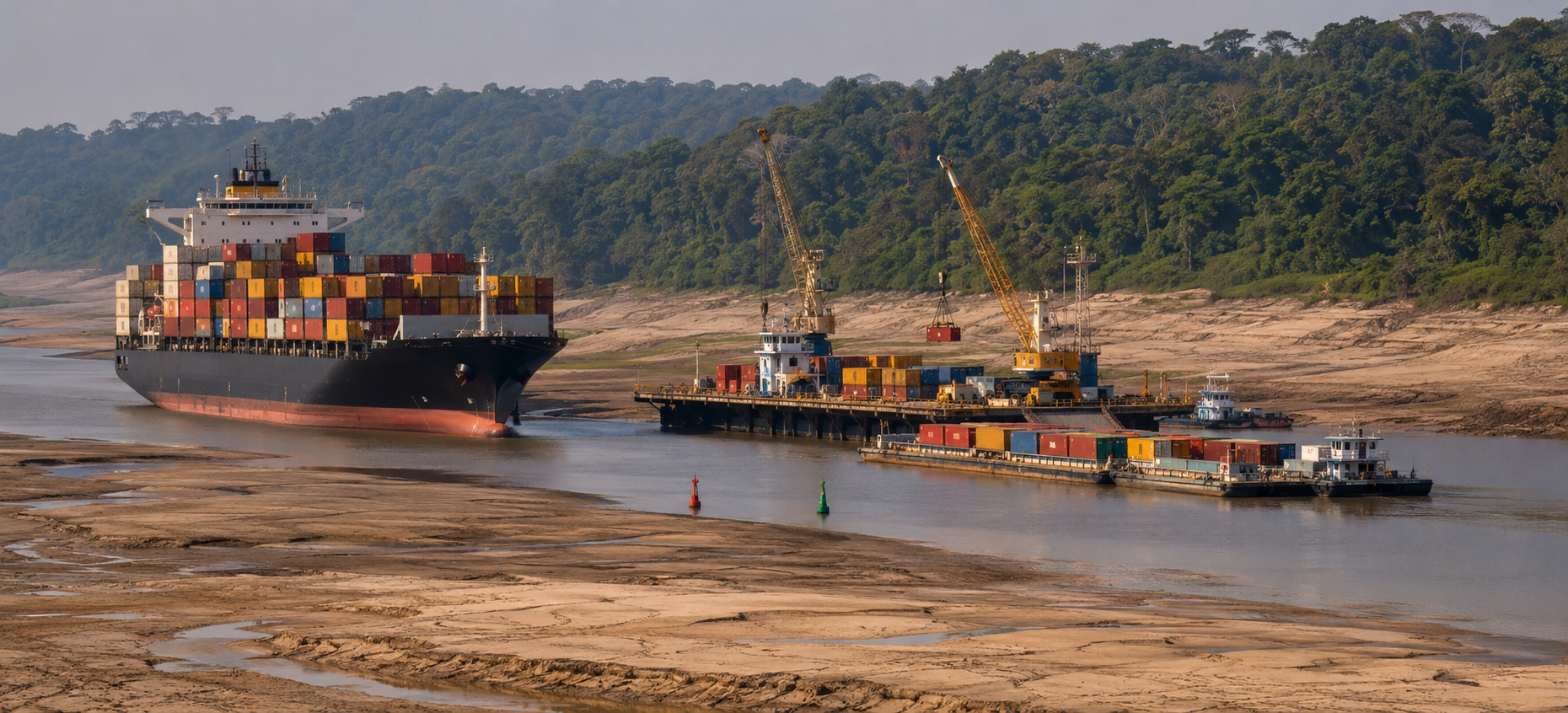
With a strong El Niño expected, manufacturers in northern Brazil are preparing for a severe drought late this year and in 2027. The increasingly frequent crisis is already raising concerns over cargo transportation along the Amazon River and fueling disputes between shipping companies and their customers.
“El Niño is expected to be severe. The question is how severe it will be and whether it will arrive in time to affect logistics this year,” said Augusto Rocha, a director at the Amazonas State Industry Center, known as Cieam. The most intense phase of the region’s dry season usually begins in the second half of September.
During the previous El Niño, in 2023 and 2024, northern Brazil experienced a historic drought that halted large-vessel traffic entirely for months, leading to additional costs and delays in shipments from the Manaus Free Trade Zone.
Rocha said one advantage this year is that river volumes remain near historical averages. Even in the event of a sharp decline, water levels would therefore be falling from a relatively high starting point.
“The most critical period will be between October and November, so it could still affect year-end retail sales, but that will depend on the intensity,” he said.
Even with river levels currently at reasonable levels, navigation is expected to be suspended, said Luis Resano, executive director of the Brazilian Association of Cabotage Shipowners (Abac).
The Amazonas Port Authority estimates that, during the most critical period of this year’s drought, the Amazon River’s allowable draft will be limited to 8 meters.
“At that level, navigation becomes operationally unviable,” Resano said.
Rocha considers the outlook for 2027 even more worrying than this year’s.
“With El Niño, the rivers are unlikely to fill very much, so water levels may fall more sharply next year. That makes the risk of a severe drought in 2027 very high,” he said.
Floating terminals
Companies have developed new solutions in recent years to cope with extreme droughts. Logistics operators have created temporary floating port terminals on the Amazon River that can operate during periods of low water.
The facilities are installed in Itacoatiara, Amazonas, where the river becomes shallower and vessels can no longer pass. Cargo is transferred from ships to barges, which then continue to Manaus.
The system was first deployed in 2024. It was not needed last year, and companies are now monitoring conditions to determine whether it will be required again.
“We have already filed authorization requests with the federal tax authorities and the Navy. We will probably have to take the terminal to Itacoatiara. Unfortunately, on our side, that is the only solution available today,” said Marcello Di Gregorio, chief executive of Super Terminais, one of the port operators that installed floating terminals in 2024.
That year, the alternative generated an additional cost of R$1.5 billion, based on Cieam estimates.
Despite the substantial expense, Di Gregorio noted that additional costs were similar in 2023, when cargo flows were disrupted and factories in Manaus had to halt operations. In 2024, by contrast, transportation continued throughout the dry season.
Surcharge disputes
The increasing frequency of extreme droughts has also triggered administrative and legal disputes between shipping companies and their customers over surcharges imposed to cover crisis-related expenses.
Shipowners charge the fees because lower river levels force vessels to carry lighter loads, increasing the cost per shipment.
The dispute intensified last year, when shipping companies announced surcharges even before the drought began and set them above the levels usually charged, said Bruno Pinheiro, president of the Amazonas Commercial Association, or Aca.
“The fees used to correspond to 10% of the amount charged per container. In 2025, they reached 50%. We are not challenging the existence of the charge, but its size. The calculation needs to be more transparent,” Pinheiro said.
Following a complaint filed by Aca with waterway transportation regulator Antaq, the agency ruled that companies could impose the fees only when the Negro River’s draft in Manaus fell below 17.7 meters.
Abac, which represents shipowners, has criticized the decision. Resano said Antaq’s analysis is flawed because it uses the water level in Manaus as a benchmark, even though shallower stretches farther downstream can prevent ships from reaching the city.
He also said the Port Authority, not Antaq, is responsible for setting the maximum allowable draft.
Antaq said there was “no final decision on the matter” and that it was acting “within the scope of its legal authority.”
In a statement, the agency said it had adopted measures since 2024 related to drought surcharges to “provide greater transparency regarding the criteria used for their application.” It added that the 2025 injunction was granted “in light of indications that charges were being imposed without technical justification.”
Despite the disagreement over the 2025 fees, Aca does not oppose the additional charge used to finance floating structures that keep cargo moving, Pinheiro said.
“The productive sector understood that, without the temporary terminal operation carried out in 2024, the city of Manaus would not have been supplied,” he said.
Permanent dredging
Beyond temporary measures, companies are calling for longer-term solutions, including regular dredging.
Pinheiro said the best approach would be to award a concession for the waterway, a proposal also supported by Abac.
“With these climate events, dredging will have to become permanent. The waterway should be concessioned so that the operator is paid based on results. Even with a tariff, the worst outcome is being unable to navigate,” Resano said.
The Ministry of Ports and Airports said studies are underway for concessions covering the Madeira, Tapajós and Tocantins river waterways.
The government is also studying a concession for the so-called Green Waterway, covering approximately 1,640 kilometers between Manaus and Barra Norte. A public consultation is expected to open in the first half of 2027.
“Concessions for waterway services are among the alternatives being considered to improve service provision along strategic stretches of the Amazon waterway system,” the ministry said.
Source: Valor International
-
Steel and Aluminium
Nov, 07, 2023
0
Gerdau Steel President Urges Action as c Surge in Brazil
-
Ports and Terminals
Oct, 27, 2021
0
Container handling at Santos grows by double digit figures
-
Ports and Terminals
Jun, 25, 2024
0
Drop in Brazil’s Port of Natal activities worries state productive sector
-
Ports and Terminals
Sep, 15, 2023
0
Paranagua and Antonina announce 6% year-to-date increase in throughput