

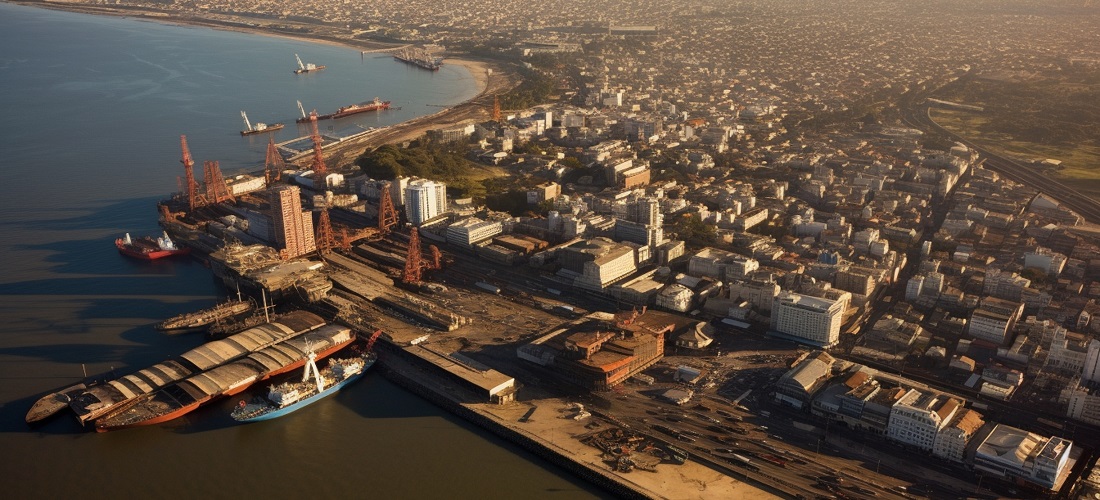
Cuenca del Plata and SUPRA Sign Five-Year Agreement at Port of Montevideo
Oct, 08, 2026 Posted by Gabriel MalheirosWeek 202641
Terminal Cuenca del Plata (TCP S.A. / Nelsury S.A.) and the Single Union of Port Workers and Related Trades (SUPRA) signed a five-year collective bargaining agreement on Wednesday, Oct. 7, at the National Labor Directorate (DINATRA) of Uruguay’s Ministry of Labor and Social Security (MTSS). The agreement establishes a series of labor improvements and commitments governing operations at the Port of Montevideo’s specialized container terminal.
The agreement provides for improved working conditions, a progressive system of guaranteed shifts and a labor peace clause. The MTSS and the Ministry of Transport and Public Works (MTOP) also lifted the minimum-service requirements imposed during the labor dispute.
The signing was attended by Labor and Social Security Minister Juan Castillo, Deputy Minister Hugo Barretto Ghione and National Labor Director Marcela Barrios.
The agreement will remain in force from Oct. 1, 2026, through Sept. 30, 2031, bringing to a close an extended negotiation process in which the MTSS intervened to help bring the parties closer together. On Sept. 30, TCP and SUPRA had agreed at DINATRA on the basic terms of the collective bargaining agreement, based on a compromise proposal presented by the ministry.
Following the signing, Castillo highlighted the work carried out by the company, employees and DINATRA officials throughout the negotiations.
“Ultimately, it ends with an agreement between the parties,” he said, emphasizing in particular that the agreement incorporates demands raised by workers, including an increase in guaranteed shifts and other improvements in rights and benefits.
“It seems to us that, despite the work involved and thanks to the dedication of all the parties, because without flexibility this agreement would not have been signed, we now have an agreement, and that is the most important thing,” the minister said.
Montevideo Container Terminal Labor Agreement Expands Worker Benefits
Among the main provisions of the Montevideo container terminal labor agreement is a progressive increase in guaranteed shifts, subject to compliance with collective and individual targets and the conditions established in the agreement.
Starting in October 2026, workers previously guaranteed 13 or 15 shifts will move to 17, while those previously guaranteed 18 shifts will move to 19. Beginning Jan. 1, 2027, workers previously guaranteed 20 shifts will receive 21.
The agreement also establishes a one-time net payment of 38,750 Uruguayan pesos, to be paid within the first 15 days of October, as well as several increases and compensation measures linked to specific job categories and duties.
These include increases for stevedores and forklift operators in Logistics, new conditions for instructors working with empty containers and trainee tally clerks, equalization of the hourly pay of Maintenance & Repair (M&R) inspectors with that of tally clerks, and the addition of an 8% payment to the base salary of M&R equipment operators.
The agreement also provides for an additional net payment of 20,000 pesos toward vacation pay for leave taken between 2027 and 2031, a 10% increase in meal vouchers for operational employees receiving the Port Activity Continuity Bonus, and improvements related to Sunday pay, maintenance and certain operational duties.
The company will also cover the first three days of medically certified leave not covered by Uruguay’s Social Security Bank (BPS), on up to two occasions per contractual year, subject to the conditions established in the agreement.
Agreement Sets Rules for Operational Continuity and Labor Disputes
The agreement establishes conditions aimed at ensuring continuity of operations on Sundays and public holidays, sets minimum staffing requirements and provides for operational crews during union assemblies to ensure cargo loading, unloading and terminal services continue.
It also consolidates the four-shift system of six hours each for crane operations and establishes a proportional system for calling operators to work.
The agreement also includes a labor peace clause for its duration. In the event of future disputes, the parties must first use the negotiation mechanisms established in the agreement, including DINATRA intervention, before taking measures that could affect the terminal’s normal operations.
Asked about the provision, Castillo said labor peace “is something that has to be built every day,” adding that the agreement establishes procedures and deadlines allowing the parties to return to the MTSS in the event of disagreements and seek a negotiated solution.
The agreement also creates a technical committee on technology that will meet monthly under the MTSS to assess the impact of new technologies on occupational health, guaranteed shifts, jobs and training requirements.
It also establishes mechanisms requiring the company to notify the union in advance before implementing technologies used to monitor employees, such as GPS systems, cameras or algorithms.
Castillo linked this provision to one of the challenges currently facing the world of work: the rapid introduction of new technologies and the changes they are bringing to labor relations.
“The world is moving in that direction,” the minister said when asked about reductions in working hours. He noted that scientific and technological advances, including artificial intelligence, are transforming the way work is organized. In that context, he stressed the importance of bringing these issues onto the agenda through a process involving workers, employers, labor unions, business associations and academia.
Minimum-Service Requirements Lifted After Agreement
With the signing of the collective bargaining agreement, the MTSS and the Ministry of Transport and Public Works lifted the resolution that had temporarily established minimum essential services to preserve safety and operational continuity at the Port of Montevideo’s Specialized Container Terminal during the labor dispute. The measure had been adopted on Sept. 14.
Castillo confirmed that the resolution lifting the minimum-service requirements was signed the same day, in the presence of representatives of the company and the union.
“As we announced and said at the time, this was a measure intended to ensure that, without affecting workers’ freedom of association or legitimate right to strike, the movement of products and exchange of goods could continue while minimizing the impact on both rights,” he said.
Once an agreement had been reached, Castillo added, the measure “no longer has any reason to remain in place.”
Source: Uruguay Ministry of Labor and Social Security (MTSS)
-
Apr, 29, 2025
0
Amazonas Handles US$ 1.42 Billion in Exports and Imports in March 2025
-
Ports and Terminals
Feb, 22, 2019
0
Brazil’s Login sign contract to operate at Tecplata
-
Other Cargo
Jun, 23, 2025
0
Brazil’s Date Imports Near USD 10 Million
-
Trade Regulations
Jun, 03, 2020
0
CNI identifies 17 new barriers to Brazilian exports between March and May