

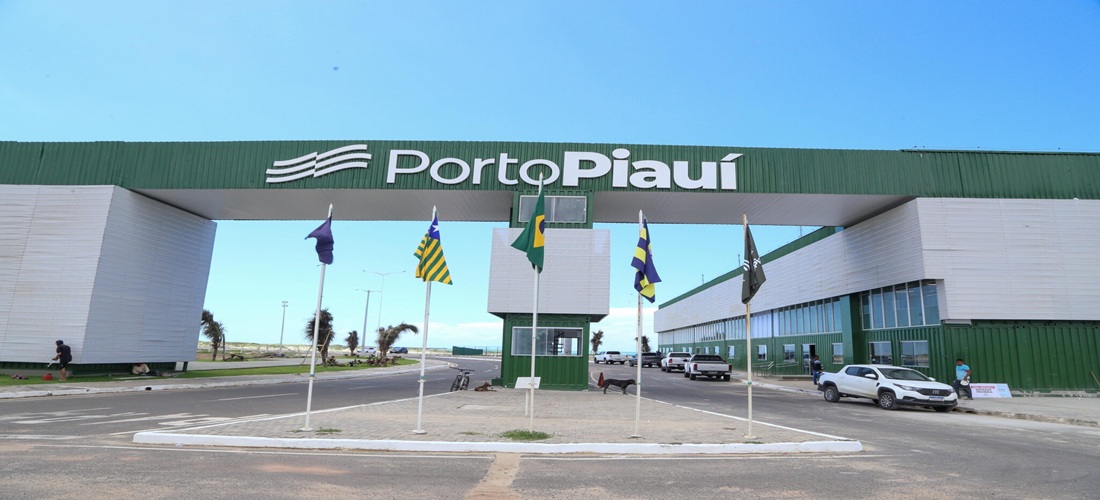
Porto Piauí Targets Grain Export Route to Portugal, Advances Clean Energy Plans
Oct, 16, 2026 Posted by Gabriel MalheirosWeek 202642
Porto Piauí is looking to expand its international trade connections and aims to establish a grain export route to Portugal, with its first shipment to the Port of Aveiro targeted for 2027. Negotiations involve products such as soybeans, corn and dried distillers grains (DDG) and could open a new export route to Europe. Discussions with Portuguese partners also include studies on implementing a renewable shore power system for vessels berthed at the Luís Correia Private Use Terminal.
Both initiatives were discussed during meetings held on Oct. 2, when Porto Piauí’s Business Development management team visited the ports of Aveiro and Figueira da Foz. During the visit, a cooperation agreement was also signed with the University of Coimbra to explore the implementation of Onshore Power Supply (OPS) technology at the port of Luís Correia, in the Brazilian state of Piauí.
According to Porto Piauí’s Business Development Director, Brunno Gonçalves, the trip was aimed at advancing discussions with European investors interested in agricultural products from Piauí, including soybeans, corn and DDG, a byproduct of corn ethanol production used in animal feed.
He said the partnership could also pave the way for exports of local products such as honey and cotton, while creating opportunities for direct imports of European goods, including olive oil and wine. In April this year, Porto Piauí signed a memorandum of understanding (MoU) with the Port of Aveiro.
“It was very important to see firsthand the significant cargo volumes handled by these well-established ports, which share characteristics with our own,” he said.
Grain Export Route to Portugal: Aveiro, Figueira da Foz and Sines in Porto Piauí’s Strategy
Porto Piauí currently operates with an access channel that is 7 meters deep at low tide and 9.5 meters at high tide. In June, it received its first cargo vessel, the 109-meter bulk carrier Konta II.
Its operating profile is similar to that of the Port of Figueira da Foz, which accommodates vessels with drafts of up to 6.5 meters and lengths of up to 120 meters. Once maritime access improvement works, scheduled for completion in October, are finished, the Portuguese port will be able to accommodate vessels drawing up to 8 meters and measuring up to 140 meters long.
The Port of Aveiro, meanwhile, can receive even larger vessels. Its agribulk terminal handles ships up to 200 meters long, with an average draft of 9.75 meters.
These characteristics helped determine the most suitable approach for each partnership. Aveiro, which has a dedicated agribulk terminal, is considered the best option for grain shipments, and Porto Piauí will focus its efforts there to make the first operation possible.
Figueira da Foz offers greater potential for containerized and general cargo operations. For iron ore, Porto Piauí plans to intensify discussions with the Port of Sines, also in Portugal.
Clean Energy for Ships at Porto Piauí
During the visit, Porto Piauí Business Development Director Brunno Gonçalves, representing company President Raimundo Dias Jr., and Nuno Mendonça, the University of Coimbra’s Vice-Rector for Innovation, Business Relations and Employability, signed a cooperation agreement to assess the technical and economic feasibility of installing a system that supplies renewable electricity to vessels berthed at the Luís Correia Private Use Terminal (TUP).
Known as Onshore Power Supply (OPS), the technology connects a vessel to an electricity source on land. While the ship is berthed, its combustion-powered auxiliary engines, which normally remain running to supply communications, lighting, ventilation and other onboard systems, can be switched off.
By eliminating the need to run these engines while vessels are in port, the system reduces fuel consumption and carbon dioxide emissions in the port area, while also reducing the need to purchase carbon credits.
The equipment being evaluated was developed at the University of Coimbra’s campus in Figueira da Foz and is powered by renewable energy sources.
Source: Porto Piauí
-
Ports and Terminals
Jan, 02, 2023
0
Exports to Qatar from Tecon Rio Grande up 96%, say Wilson Sons
-
Ports and Terminals
Sep, 22, 2021
0
Port of Imbituba launches public notice for installation of solar energy system
-
Steel and Aluminium
Feb, 01, 2024
0
2024 brings ominous outlook for Brazilian steel mills as Chinese imports show no signs of abating
-
Ports and Terminals
Sep, 24, 2026
0
Port of Natal completes dredging, awaits permit for second phase