


APS resumes inspection of ballast water discharge by ships calling at the Port of Santos
Oct, 31, 2025 Posted by Lucas LorimerWeek 202544
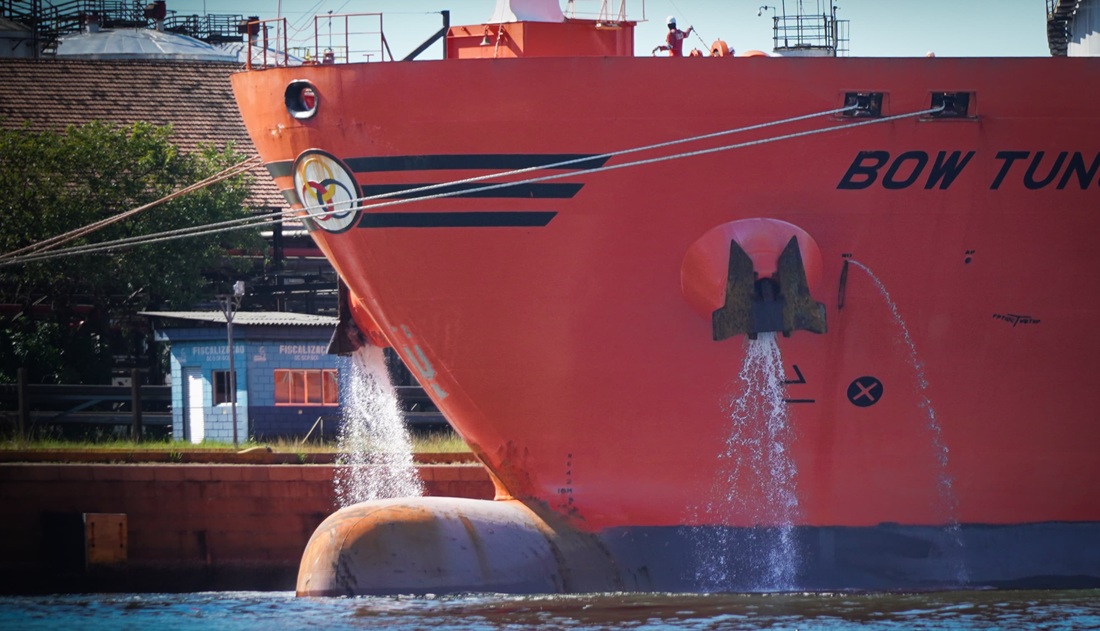
The Santos Port Authority (APS) has reinstated the rule (NAP.SUMAS.OPR.023.2024) requiring ships calling at the Port of Santos to present a certificate proving compliance with international regulations on ballast water discharge.
“The inspections help prevent environmental damage caused by invasive species that are harmful to marine life and the ecosystem. For now, no fines will be applied so that shipowners have time to comply with the regulation,” said Sidnei Aranha, APS’s Environmental Superintendent.
The APS decision follows a ruling by Justice Teodoro Silva Santos of Brazil’s Superior Court of Justice (STJ), who granted an injunction in favor of the Port of Santos’ management, recognizing the legal authority of Judge Diego Câmara from the 17th Federal Court in Brasília.
Judge Câmara had previously ruled in favor of APS in a legal action against the National Waterway Transport Agency (Antaq), which had declared the regulation null. The inspections ensure compliance with the International Convention for the Control and Management of Ships’ Ballast Water and Sediments, preventing improper discharges into oceans, estuaries, coves, and bays along the Baixada Santista region.
Certificate and remote inspection system
Upon presentation of the certificate, APS activates a remote inspection system — duly accredited — that uses artificial intelligence, GPS, and other technologies to verify whether ships have discharged ballast water only in authorized areas or have adopted onboard filtration systems. These procedures are required by the International Maritime Organization (IMO) and follow Brazil’s Navy Standard 401/DPC.
Ships that discharge ballast water containing waste such as sewage, toxic materials, or invasive species can cause serious environmental and public health problems. Many of these plant and animal species are endemic, lack natural predators, and can reproduce rapidly, outcompeting native species.
Bacteria and other pathogenic organisms can also be transported from one region to another through ballast water, exacerbating the problem of bioinvasion. Globally, maritime transport moves an estimated 10 billion tonnes of ballast water annually. In Brazil alone, about 80 million tonnes are released each year, as 95% of the country’s foreign trade is conducted by sea.
Source: Porto de Santos
-
Dec, 02, 2021
0
Eurasian Union expands quota for importing meat at zero tariff
-
Other Cargo
Aug, 15, 2024
0
Paraná’s honey exports register 113% growth from January to June
-
Ports and Terminals
Nov, 08, 2019
0
ANTAQ receives more than 500 contributions for the bid notice of two areas in the Port of Santos
-
Meat
Jul, 05, 2022
0
Canada adds two units to the list of export-approved Brazilian meatpackers