


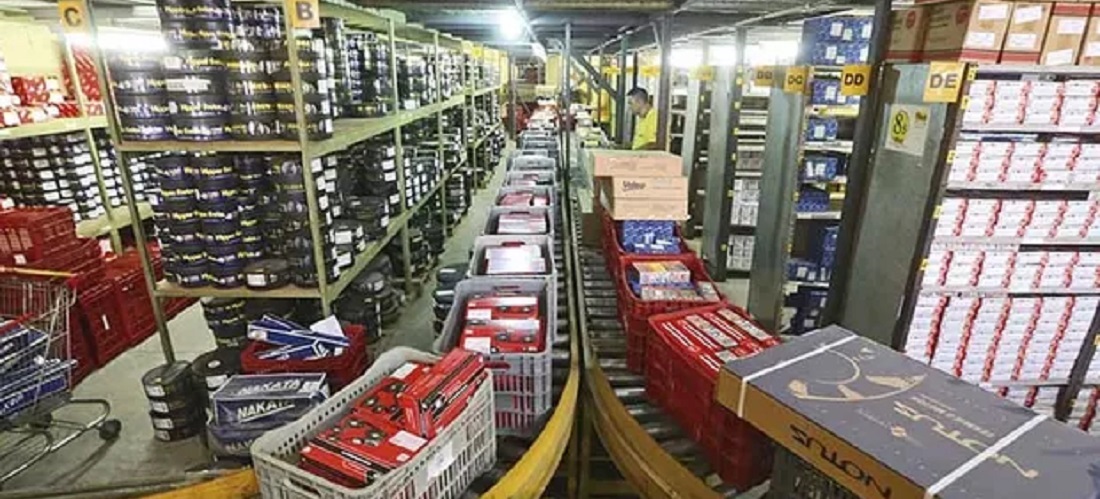
Auto parts imports continue to surge in Brazil
Oct, 23, 2025 Posted by Lucas LorimerWeek 202544
Imports of auto parts continue at a strong pace and totaled US$18.01 billion from January to September, up 16.1% from the US$15.51 billion imported in the first nine months of 2025, according to the trade balance report released by the National Union of the Automotive Vehicle Components Industry (Sindipeças).
Exports, although rising 6.7% to US$6.2 billion from January to September, were still outpaced by imports. This significantly widened the auto parts trade deficit, which reached US$11.7 billion through September — an increase of 21.7% compared with the negative balance of US$9.6 billion recorded from January to September last year. “The worsening trade deficit is a warning sign for the auto parts industry, especially given the intensive use of ex-tarifário tax waivers,” Sindipeças said.
Below is a history of Brazil’s auto parts imports from January 2022 to August 2025 in TEUs. The chart was prepared using DataLiner data:
Brazilian Auto Part Imports | Jan 2022 – Aug 2025 | TEUs
Source: DataLiner (Clique aqui para solicitar uma demo)
Monthly performance
In September, imports reached US$2.2 billion, up 2.3% from August this year (US$2.16 billion) and 23.0% higher than September last year, when they totaled US$1.8 billion.
Exports came to US$792.8 million, 16.3% higher than in August (US$681.4 million), but 1.5% lower than in September last year (US$805.2 million).
With weaker export performance, the monthly deficit reached US$1.42 billion, a 42.7% increase over the same month in 2024, which Sindipeças says reflects a sharp deterioration in the auto parts trade balance.
External uncertainty
Sindipeças notes that despite the positive export results year-to-date, the external landscape remains uncertain, especially looking ahead to 2026.
Argentina, which accounted for more than 38% of Brazilian auto parts exports through September, is a key focus. Shipments to the country totaled US$2.3 billion, up 21.4% from the same period in 2024.
“Despite Argentina’s economic recovery and the recent improvement in fiscal and inflation indicators — reflected in a more than 20% increase in Brazilian auto parts exports to the neighboring country — political and currency tensions heighten uncertainty over the government’s ability to continue its reform program, pointing to the risk of a slowdown next year.”
George Rugitsky, director of economy and markets at the Brazilian Auto Parts Industry Association (Abipeças) and Sindipeças, explained that the 21.4% increase in exports to Argentina is tied to a strong automotive market there. “The majority of auto parts that supply automakers in Argentina are produced in Brazil. Since vehicle production has picked up in the neighboring country, they are buying more Brazilian parts. But we don’t know how the country will fare next year.”
Sindipeças also says that the higher tariffs imposed by the United States on Brazilian products should affect the sector’s foreign performance for some time, unless bilateral negotiations yield a meaningful shift in the short term. Although the U.S. remains the second-largest destination for Brazilian auto parts exports, shipments fell 10.2% — from US$1.02 billion between January and September 2024 to US$923.9 million in the same period of 2025.
Rugitsky said a large portion of exports to the United States consists of components for heavy-duty vehicles. “Because this is an annualized figure and the tariff hike came mid-year, the trend is for the downturn to deepen,” he said.
China dominates auto parts imports
On the import front, Sindipeças highlights the strong and growing presence of China, driven by stronger real growth and shifts in trade flows amid intensifying commercial disputes between China and the United States — a trend likely to persist into 2026.
China is the leading source of imported auto parts, accounting for 18.4% of all shipments to Brazil’s automotive sector. Imports from China rose 19.6% year-to-date, totaling US$3.31 billion. In September alone, companies imported US$412.4 million in Chinese auto parts, up 20% from September 2024, with a market share of 18.6%, according to Sindipeças.
In an interview, Sindipeças president Cláudio Sahad said several factors explain the increase in imported auto parts, including changes in the architecture of the vehicles most commonly sold in Brazil today, such as SUVs. “As automakers pursue higher average vehicle prices, there is a need for a greater volume of imported content.”
Another factor is the behavioral shift across the automotive supply chain triggered by the pandemic’s impacts. “In our view, supply chain management has changed. To guard against supply risks, companies are increasing the volume of imported components while assessing opportunities for local production,” Sahad said, adding: “The shift from offshore to onshore production takes time, which may explain this defensive posture by a significant share of automakers and parts manufacturers.”
The Sindipeças president also noted that “despite the still-high dollar, companies can offset, at least partly, higher import costs through financial market operations because of the high interest rate differential.”
Sahad said the dynamics of the Brazilian auto parts trade balance are “highly fluid, as in all globally integrated industries. To export more and capture the opportunities created by nearshoring, we must become even more competitive.”
Import highlights
Among imports from 163 countries, China ranks first with US$3.31 billion from January to September 2025, up 19.6% and accounting for 18.4% of the total.
The United States remains in second place, with US$1.89 billion in shipments to Brazil, up 12.5% and representing 10.5% of the total. Japan ranks third, with US$1.66 billion, up 29.5% and accounting for 9.2% of the market.
Germany is fourth, with US$1.59 billion in auto parts sent to Brazil, an increase of 9.6% and an 8.8% share. Mexico exported US$1.34 billion to Brazil, up 23% from the same period last year, accounting for a 7.5% share.
Export highlights
Among exports to 194 countries, Argentina remains the top destination, with US$2.38 billion — up 21.4% from January to September 2024 — and a 38.3% share of total shipments.
The United States remains the second-largest destination, with US$923.9 million and a 14.8% share, but exports fell 10.2% through September.
Mexico ranks third, with US$554.8 million in exports, down 20.5% and representing 8.9%. Germany purchased US$329.9 million in Brazilian auto parts, up 8.0% and accounting for 5.3%.
Exports to Chile rose 14.4% compared with the first nine months of last year, totaling US$199.8 million and representing 3.2%.
Source: Transporte Moderno
-
Dec, 21, 2023
0
China ranks 1st among sugar export destinations through the Port of Santos
-
Grains
Jan, 30, 2025
0
Government Facilitates Corn Import: The Price Is Paid by All of Us
-
Ports and Terminals
Sep, 26, 2022
0
Brazil audit court to assess Port of Santos privatization and concession rules
-
Ports and Terminals
Dec, 12, 2022
0
Port of Paranagua: grain movement up 11.73% at east export corridor