


Brazil Authorizes Technical Studies to Revive São Francisco Waterway
Aug, 27, 2025 Posted by Sylvia SchandertWeek 202536
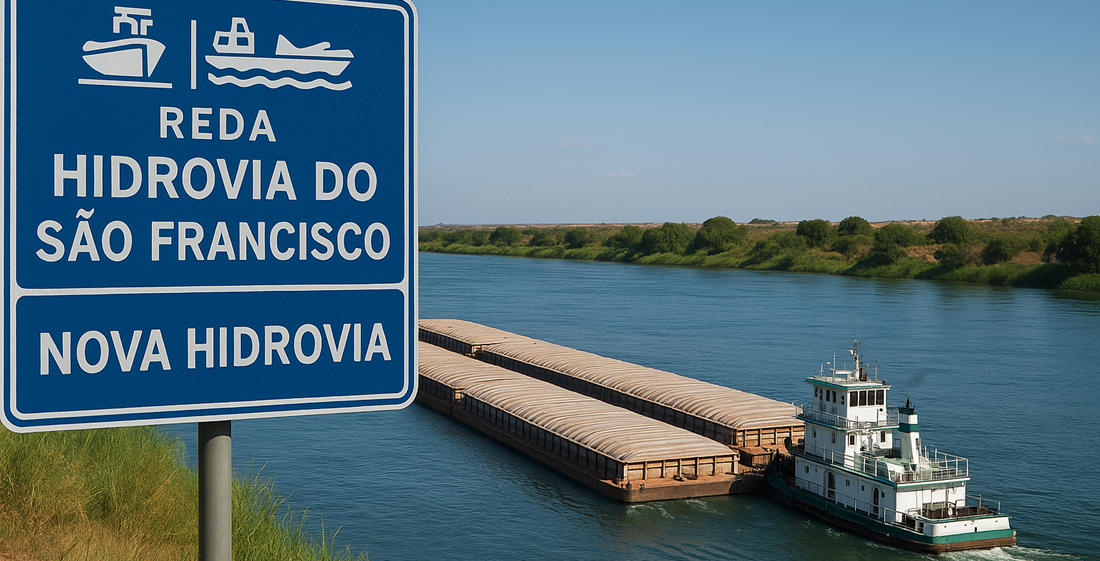
The Ministry of Ports and Airports authorized, on Tuesday (26), the Companhia Docas do Estado da Bahia (Codeba) to begin technical studies for the reactivation of the São Francisco Waterway. The measure was formalized through an ordinance signed by Minister Silvio Costa Filho and published in the Federal Gazette (DOU). According to the ordinance, the studies will analyze operational, logistical, and regulatory aspects, in addition to enabling private exploration of the infrastructure and the sustainable resumption of navigation along the waterway.
The expectation is that, in the first year of commercial operation, cargo movement along the river will reach 5 million tonnes. The project also envisions the integration of the waterway with other modes of transportation, such as railways and highways.
For Minister Silvio Costa Filho, the revival of the project will be strategic for regional development. “The reactivation of the São Francisco Waterway will strengthen the local economy, promoting more efficient, sustainable, and integrated transportation with other modes.”
With 1,371 kilometers of navigable extension between Pirapora (MG), Juazeiro (BA), and Petrolina (PE), the waterway will allow cargo transportation from the Center-South to the Northeast more economically and sustainably. A waterway convoy can replace up to 1,200 trucks, significantly reducing CO₂ emissions and wear on highways. Additionally, the energy consumption of vessels is considerably lower, making this alternative one of the most efficient and sustainable options on the market.
Regional Development
The New Waterway is also one of the most critical logistics projects for cargo outflow and regional development in the country. The route involves the transportation of various products by barge, with a focus on agricultural gypsum used as a fertilizer and soil conditioner, gypsum plaster, drywall, and limestone, which will be transported from Petrolina (PE) to Pirapora (MG). The primary objective of the route is to supply the Southeast and the region known as MATOPIBA (Maranhão, Tocantins, Piauí, and Bahia), a significant agricultural hub in the country.
Additionally, products such as sugar and oil will be shipped from Juazeiro to Pirapora, contributing to the supply of these regions. Salt, extracted in Rio Grande do Norte, will head towards Remanso (BA), where it will connect with the São Francisco River, continuing its journey to Pirapora, also destined for the Southeast.
Coffee, in turn, will make the reverse journey, departing from Pirapora towards Juazeiro and Petrolina to meet the demand of the Northeast. Corn, soy, cotton, fertilizer, and other agricultural inputs will be transported by land from the municipalities of Barreiras and Luís Eduardo Magalhães (BA) to Ibotirama (BA) and will continue along the waterway to Juazeiro. From there, they can be shipped to the Port of Aratu, in Salvador, by road or rail.
Port Facilities
To ensure the implementation of the reactivation, the project was divided into three stages, focusing on intermodal integration by road and rail to increase logistics efficiency, promote sustainability, and reduce costs.
The first stage includes interventions in a 604 km navigable stretch, between Juazeiro and Petrolina, passing through Sobradinho (BA) and reaching Ibotirama (BA). Cargo will be shipped by road to the Port of Aratu-Candeias (BA). The second stage covers 172 km of navigable routes between Ibotirama, Bom Jesus da Lapa, and Cariacá (BA), with rail connections to the ports of Ilhéus and Aratu-Candeias. The third stage foresees the extension of the waterway by 670 km, linking Bom Jesus da Lapa and Cariacá to Pirapora (MG).
The plan also foresees the construction of 17 Small Public Port Facilities (IP4) to guarantee cargo and passenger transport in the states of Bahia, Pernambuco, and Alagoas. Of these, six are in the project stage, and 11 are in the planning stage. The tenders for the IP4 of Petrolina and Juazeiro are expected to be launched in September, with works scheduled to begin in January 2026.
-
Coffee
Aug, 12, 2019
0
Coffee exports grow at the Port of Santos
-
Ports and Terminals
Jul, 17, 2024
0
Another malaria case confirmed onboard bulk carrier headed to Santos
-
Grains
Oct, 11, 2022
0
Ukraine grain backlog prompts U.N. call for faster ship checks
-
Ports and Terminals
Apr, 12, 2022
0
Wilson Sons improves cutting-edge technology and grows its presence in Brazilian ports