



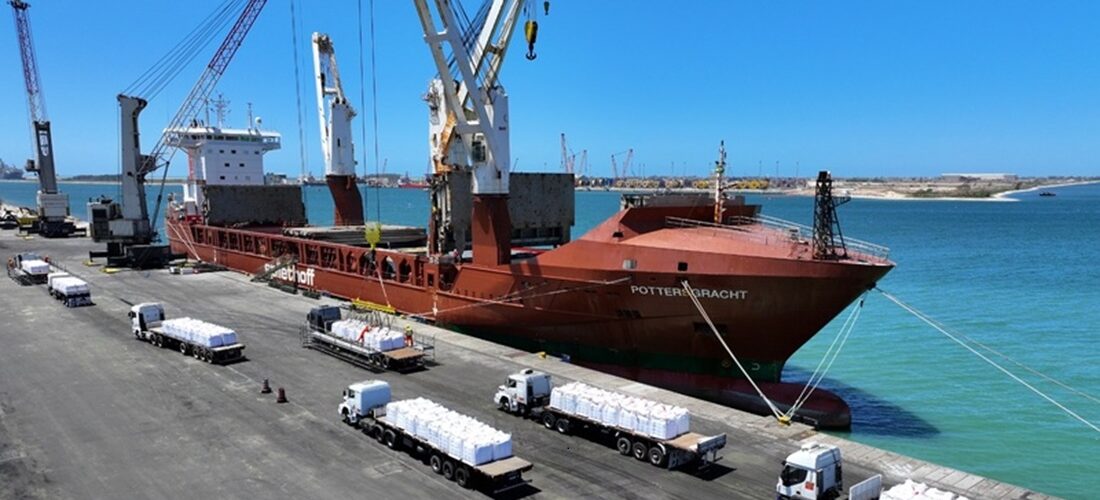
Brazil Exports Record 5.3 Million Bags of Coffee in October
Nov, 13, 2026 Posted by Gabriel MalheirosWeek 202646
Brazilian coffee exports reached an all-time monthly record in October 2026, with shipments totaling 5,326,944 60-kilogram bags, up 28.4% from the 4.149 million bags recorded in the same month of 2025. Export revenue also reached a monthly record of $1.786 billion, an increase of 7.8% year over year. The figures come from the monthly statistical report published by the Brazilian Coffee Exporters Council (Cecafé).
The previous monthly export volume record was set in October 2024, when Brazil shipped 5.176 million bags abroad. The previous revenue record was registered in October 2025, when coffee exports generated $1.657 billion. Compared with those records, October 2026 saw increases of 2.91% in volume and the previously mentioned 7.8% in revenue.
“Last month’s results confirm what we said earlier: coffee from the new harvest would begin arriving in larger volumes in September and October because this year’s harvest was delayed by rainfall across the coffee-growing belt. The record also shows the substantial volume Brazil produced in the current crop year, with a diversity of quality levels capable of meeting the demands of the world’s most discerning and stringent markets,” explained Cecafé President Márcio Ferreira.
With October’s performance, coffee exports reached 16.591 million bags in the first four months of the 2026/27 coffee marketing year, the second-highest volume on record for the period and 19.7% above the level recorded between July and October 2025. Revenue reached $5.363 billion, a record for the four-month period and 3.4% higher than the $5.189 billion generated during the corresponding months of the 2025/26 cycle.
According to Datamar data, Brazil exported 84,052 TEUs of coffee beans. The chart below provides a longer-term overview of these shipments:
Coffee Exports | Jan 2024 – Sep 2026 | TEUs
Source: DataLiner – explore our trade data
Brazilian Coffee Exports: Calendar-Year Results
Between January and October 2026, Brazil exported 34.478 million bags of coffee, the third-highest volume on record for the period and an increase of 3.5% compared with the same ten months of last year. Export revenue, however, fell 6.3% year over year, declining from $12.722 billion to $11.917 billion.
Ferreira said that, in addition to the stronger arrival of coffee from the new harvest, the increase in shipment volumes in 2026 was driven by the resumption of trade with the United States following the complete removal of additional tariffs on Brazilian coffee. Instant coffee had remained subject to the tariffs until July of this year.
“In October alone, exports to the United States grew 119%, meaning that the largest importer of Brazilian coffee has already nearly matched the volume purchased in the first ten months of 2025, with 4.6 million bags so far this year compared with 4.7 million bags previously,” he noted.
With the EU Deforestation Regulation (EUDR) set to begin applying to large and medium-sized operators on December 30, Ferreira also emphasized stronger European demand for Brazilian coffee.
“Europe, considered as a continent, is the largest buyer of our coffee and has already imported 17.8 million bags this year, representing 51.6% of the total and an increase of 6.8% compared with January through October 2025. This shows that the social and environmental sustainability of Brazilian coffee meets the strictest European legislation and that Brazil is firmly consolidating its position as the leading supplier to European buyers,” he said.
The Cecafé president also praised the growth in Brazilian coffee shipments to other producing countries, particularly Colombia, Mexico and India, which increased their imports by 83.4%, 47.9% and 367.8%, respectively.
“These countries are important instant coffee production hubs and therefore have substantial demand for our conilon and robusta coffees, which account for most of the raw material used in this product. This also shows the competitiveness of Brazilian coffee compared with other origins, the logistics bottlenecks faced by other producing countries, and the fact that these three countries essentially do not produce canephora coffees, making them heavily dependent on Brazilian beans for their instant coffee production,” he commented.
Ferreira also noted that the decline in export revenue between January and October 2026 was attributable to lower international market prices compared with the previous year and the aforementioned increase in canephora coffees’ share of total exports.
“The average export price this year is $345.64 per bag, 9.5% below the 2025 level. In addition, robusta and conilon coffees have historically commanded lower prices than arabica and processed coffees. Therefore, as their share of shipments increases—from less than 11% last year to around 18% currently—it is natural to see a decline in the average price per bag and, consequently, in total revenue,” he concluded.
Main Export Destinations
With U.S. imports resuming in August, the United States regained the top position in September and retained it in October in the ranking of leading destinations for Brazilian coffee exports during the first ten months of 2026.
U.S. buyers purchased 4.575 million bags, a volume still 2.9% below that recorded during the same period in 2025 but equivalent to 13.3% of all coffee exported by Brazil between January and October 2026.
Germany ranked second, accounting for 11.1% of total shipments, with imports of 3.812 million bags, down 11.8% from the 4.324 million bags recorded in the first ten months of 2025.
Rounding out the top five were Belgium, with 3.275 million bags (+71%); Italy, with 3.049 million bags (+13.5%); and Japan, with 1.712 million bags (-21.6%).
Coffee Types
Arabica remained Brazil’s most exported coffee type between January and October 2026, with shipments totaling 24.9 million bags. This volume accounted for 72.2% of total exports, despite a 6.4% decline compared with the same months of last year.
Canephora coffee (conilon and robusta) ranked second, with shipments of 6.065 million bags, representing 17.6% of the total and a substantial increase of 72.5% compared with January through October 2025.
Instant coffee, with 3.454 million bags (10% of the total), and the roasted and roasted-and-ground coffee segment, with 58,888 bags (0.2%), completed the breakdown.
Premium, Certified and Specialty Coffees
Premium, sustainably certified and specialty coffees accounted for 16.5% of Brazil’s total exports between January and October 2026. Shipments reached 5.702 million bags, down 13.3% from the volume recorded during the same period last year.
With an average price of $405.80 per bag, export revenue from differentiated coffees totaled $2.314 billion, equivalent to 19.4% of the revenue generated by all Brazilian coffee exports between January and October. Compared with the same period in 2025, revenue declined 17.5%.
The United States also led the ranking of destinations for differentiated coffees, importing 977,410 bags, equivalent to 17.1% of total exports in this category.
The remaining top five destinations were Germany, with 640,718 bags and an 11.2% share; Belgium, with 587,152 bags (10.3%); Italy, with 526,123 bags (9.2%); and the Netherlands, with 347,537 bags (6.1%).
Ports
The Port of Santos remained Brazil’s leading gateway for coffee exports during the first ten months of 2026, handling 24.445 million bags, or 70.9% of the country’s total shipments.
It was followed by the Rio de Janeiro port complex, which accounted for 25.2% of shipments, handling 8.680 million bags, and the Port of Paranaguá, in Paraná state, which handled 339,303 bags, representing a 1% share.
Source: Cecafé
-
Grains
Mar, 18, 2022
0
Brazil sees wheat exports as a way to reduce external dependence
-
Grains
Aug, 10, 2021
0
Damaged corn crop leads to reduced total grain harvest in the country
-
Shipping
Sep, 09, 2021
0
CMA CGM makes the decision to stop all spot rate increases
-
Economy
Dec, 03, 2024
0
Decline in Exports to Argentina Reduces Brazil’s Surplus with Mercosur, Says Itamaraty