


Brazil projects R$262.6 billion in private investment in highways and railways in 2027
Nov, 03, 2026 Posted by Sylvia SchandertWeek 202645
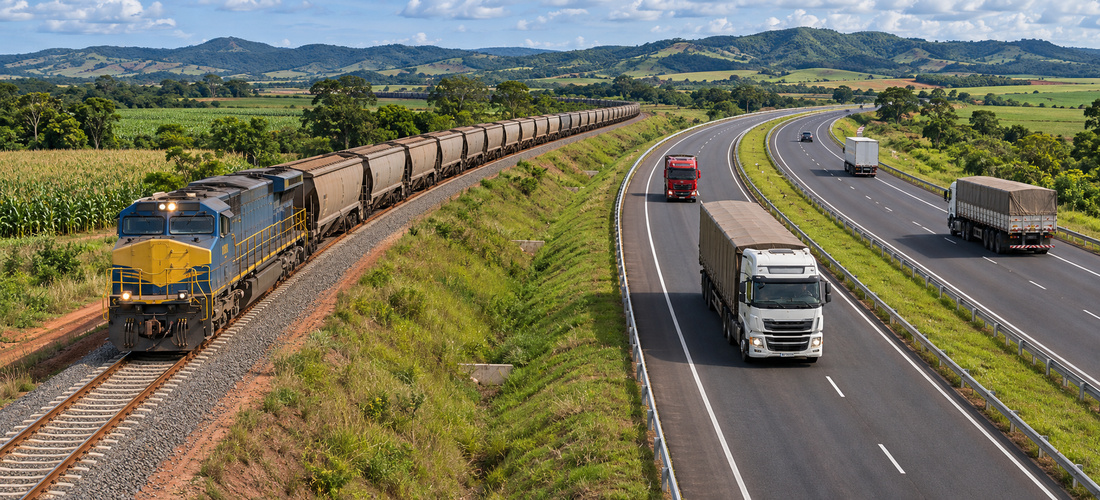
Brazil’s Ministry of Transport projects that it will attract R$262.6 billion in private capital for 29 major highway and rail infrastructure projects in 2027. Rail plays a central role in the plan, accounting for the largest share of investment to expand capacity to move domestic production, connect production areas to ports and support regional transportation.
State-owned Infra S.A. conducted the socioeconomic studies and project modeling for the 18 planned rail projects, preparing them for public consultation, review by oversight bodies and auctions. The rail portfolio totals R$160 billion in investment and combines different contracting models: eight major concessions and nine rail sections offered through public calls under the authorization framework, alongside a standing offer of greenfield terminals—new facilities on undeveloped sections—and unused rail sections.
Among the highlights of the concession portfolio is the Southeast Rail Ring, designed to connect the national rail network to ports in Rio de Janeiro and Espírito Santo. The plan also includes strategic assets such as the Malha Oeste network, the East-West Corridor, Ferrogrão, the northern extension of the North-South Railway and three corridors of the Malha Sul network: Paraná–Santa Catarina, Rio Grande and Mercosul.
Under the public-call model approved by the Federal Court of Accounts (TCU), private companies take over rail sections and submit rehabilitation plans, with the possibility of public funding.
Highway auctions
Alongside the rail expansion, the highway sector is projected to receive R$102.68 billion across 11 contracts. The plan includes nine auctions for new concessions, providing for the widening of 373.87 kilometers into divided highways and the addition of 513.36 kilometers of extra lanes, as well as two contract optimization agreements.
Infra S.A. handled the technical structuring of strategic concession packages such as Rota Portuária do Sul, Rota Vale do Café, Rota Portuária Itaqui, Rota do Açu, Rota Centro-Sul Baiano and the Santa Catarina network, divided into the Vale do Itajaí, Catarinense and Meio Oeste packages. Tender notices for the new concessions are expected to be published between March and August, with auctions scheduled between June and December.
To address distressed assets, the Ministry of Transport will apply the TCU-approved contract optimization mechanism to the Transbrasiliana Highway (BR-153/SP) and Rota Planalto Sul (BR-116/PR/SC). Together, these projects provide for the widening of 195.2 kilometers into divided highways and the addition of 36.93 kilometers of extra lanes.
The government has also launched the National Highway Connectivity Policy. The initiative provides for expanded internet access along federal highways operated under concessions. Its goal is to ensure digital infrastructure that improves road safety and fleet and cargo monitoring.
Funding
The rail sector will receive R$808.61 million in direct public funding, waterborne transportation will receive R$640.73 million and aviation will receive R$212.61 million. Among state-owned companies, investment in waterborne transportation falls from R$1.79 billion to R$1.04 billion, while aviation investment declines from R$522.44 million to R$412.95 million. The National Transport Confederation (CNT) warns that the R$12.46 billion allocated to highways directly managed by the federal government covers only a fraction of what is needed. The organization estimates that R$49.93 billion would be required to meet maintenance and rehabilitation needs across the publicly managed network, four times the amount provided for in the budget legislation.
CNT reports decline in public transportation funding
While the R$262.6 billion portfolio presented by the Ministry of Transport represents estimated private investment to be attracted through concessions and auctions through 2027, planned direct public funding for the sector is moving in the opposite direction.
An analysis by the National Transport Confederation (CNT) of the 2027 Annual Budget Bill (PLOA) shows that the federal government and state-owned companies will have R$16.07 billion budgeted for transportation, a 4% decline from the 2026 proposal of R$16.73 billion, adjusted for inflation.
The difference between the two amounts stems from the sources of capital: the government’s target relies on infrastructure placed under private concessions, while the CNT analysis measures public budgets. The 4% decline in public funding is driven mainly by reduced investment by state-owned companies in the sector, such as Infraero and the Companhias Docas port authorities, from R$2.31 billion in the 2026 proposal to R$1.45 billion in the 2027 bill. Direct federal funding, by contrast, increases slightly, from R$14.42 billion to R$14.61 billion.
Among the sector’s public funding categories, the federal highway network receives the largest share, totaling R$12.46 billion, equivalent to 85.2% of direct federal funding.
Source: A Tribuna
-
Ports and Terminals
Dec, 04, 2024
0
Bahía Blanca Positioned to Become a Logistics Hub for Argentina’s International Trade
-
Sugar and Ethanol
Mar, 22, 2021
0
US rules out new market access for Brazilian sugar imports
-
Sugar and Ethanol
Jan, 02, 2026
0
Asia, Africa expected to boost sugar demand
-
OTI Rankings
Dec, 03, 2018
0
Brazil to raise biodiesel-diesel blend to 15% by 2023