


Brazilian container trade grows through May, but second half brings new challenges
Jul, 02, 2026 Posted by Gabriel MalheirosWeek 202627
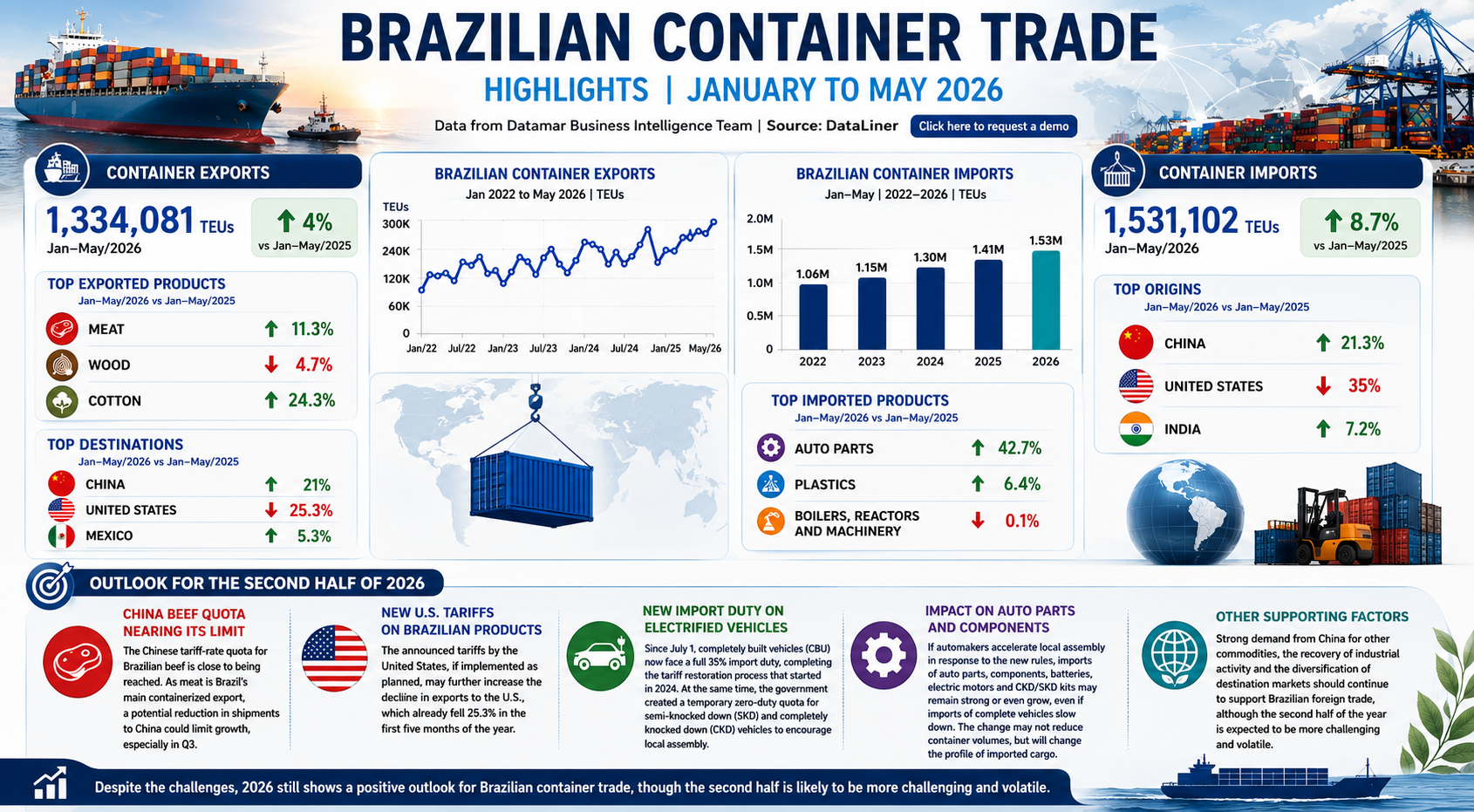
New data from Datamar’s Business Intelligence team show that Brazilian containerized exports rose 4% year on year from January through May 2026, reaching 1,334,081 TEUs shipped abroad in the first five months of the year.
The chart below, prepared with DataLiner data, compares Brazilian containerized exports in the January-May period since 2022:
Brazilian Exports | Jan-May | 2022-2026 | TEUs
Source: DataLiner (click here to request a demo)
Meat products remained Brazil’s leading containerized export cargo in the first five months of 2026, with volumes up 11.3% from the same period last year. Wood ranked second, despite a 4.7% decline in shipments, followed by cotton, which grew 24.3%.
China remained Brazil’s top destination for containerized exports, with volumes up 21% from January-May 2025. The United States ranked second, with shipments down 25.3%, followed by Mexico, where volumes rose 5.3%.
Imports
Brazilian containerized imports reached 1,531,102 TEUs from January through May 2026, up 8.7% from the same period in 2025.
The chart below, also prepared with DataLiner data, compares Brazilian containerized imports in the first five months of each year since 2022:
Brazilian Imports | Jan-May | 2022-2026 | TEUs
Source: DataLiner (click here to request a demo)
Auto parts were Brazil’s leading containerized import cargo in the first five months of the year, with volumes up 42.7% from the same period in 2025. Plastics ranked second, with inbound volumes up 6.4%, while reactors, boilers and machinery slipped 0.1% year on year.
China also remained Brazil’s main source of containerized imports, shipping 21.3% more volume to the country than in the first five months of 2025. The United States followed, with volumes down 35%, while India ranked third, up 7.2%.
Source: DataLiner (click here to request a demo)
Outlook
Although the January-May figures confirm that Brazilian container movement continued to grow in 2026, the second half of the year is likely to be shaped by important shifts in international trade.
On the export side, one of the main issues to watch is the possible exhaustion of China’s tariff-rate quota for Brazilian beef. Since meat products lead Brazil’s containerized exports and grew 11.3% in the period, any slowdown in shipments to China could limit the pace of growth seen so far, especially in the third quarter.
Another point of attention is the new U.S. tariffs announced for Brazilian products. If implemented as planned, the measures could deepen the decline in exports to the U.S. market, which were already down 25.3% between January and May.
On the import side, volumes may also be affected by recent changes to Brazil’s tax policy for electrified vehicles. Since July 1, fully built imported vehicles, known as CBUs, have been subject to the full 35% import duty, completing the tariff restoration schedule that began in 2024. At the same time, the government created a new temporary zero-tariff quota for completely knocked down and semi-knocked down vehicles, known as CKD and SKD kits, to encourage local assembly.
That shift could change the profile of containerized imports. Automakers are expected to gradually reduce imports of fully built vehicles and increase local production. In this context, auto parts have become even more relevant. They were Brazil’s top containerized import cargo from January through May, with volumes up 42.7%.
If manufacturers accelerate local assembly in response to the new rules, imports of auto parts, components, batteries, electric motors and CKD/SKD kits could remain strong, or even increase, in the coming months. In other words, the tax change may not necessarily reduce container movement, but it could alter the composition of imported cargo, especially on routes from China, Brazil’s main origin for containerized imports.
Even so, Brazilian foreign trade should continue to receive support from Chinese demand for other commodities, the recovery of industrial activity and the diversification of export destinations. As a result, while the outlook for container movement in 2026 remains positive, the second half of the year is expected to be more challenging and volatile than the first five months.
-
Other Logistics
Nov, 20, 2025
0
VLI raises R$2 bln in debentures to fund upgrades to FCA railway and Tiplam terminal
-
Coffee
Aug, 31, 2023
0
Korea marks first drop in coffee imports in 5 years
-
Ports and Terminals
Jul, 03, 2023
0
Portos RS to allocate BRL 160 million to increase throughput of agricultural commodities
-
May, 28, 2020
0
Brazilian orange juice exports grow by 17% in 2019/20 harvest