


Brazil’s dairy imports surge 25% as cheese purchases nearly double
Nov, 24, 2026 Posted by Gabriel MalheirosWeek 202648
Brazil’s dairy imports rose 25.14% year over year in October 2026, widening the country’s dairy trade deficit and adding pressure to a domestic market already grappling with rising milk supplies and weaker demand.
According to data from Brazil’s Secretariat of Foreign Trade (Secex) compiled by the Center for Advanced Studies in Applied Economics (Cepea), dairy imports totaled 268.7 million liters in milk equivalent in October, up 7.65% from September.
Exports also increased, although at a much slower pace. Brazilian dairy shipments totaled 5.58 million liters in milk equivalent, rising just 0.25% month over month but 22.72% compared with October 2025.
The disparity between imports and exports pushed Brazil’s dairy trade deficit to US$116.4 million, a 5.4% increase from September. In volume terms, the deficit widened by 7.8% to 263.1 million liters in milk equivalent.
Milk powder and cheese dominate Brazil’s dairy imports
Milk powder remained Brazil’s largest dairy import category, accounting for 71% of the volume purchased from overseas in October.
Combined imports of whole and skim milk powder reached 190.84 million liters in milk equivalent, up 9.6% from September and 8.87% year over year.
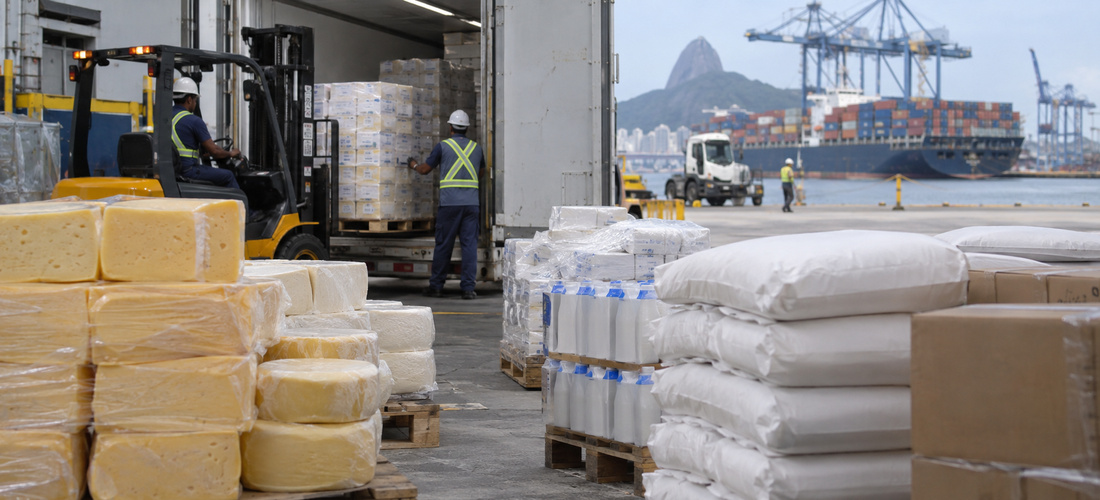
Cheese recorded an even more pronounced increase on an annual basis. Imports reached 76.05 million liters in milk equivalent, nearly double the volume recorded in October 2025, representing an increase of 99.2%.
Compared with September, cheese imports grew 2.91%. The product accounted for 28.3% of Brazil’s dairy import volume during the month.
Looking specifically at containerized shipments by sea, Brazil’s cheese imports rose 42% between January and September 2026 compared with the same period a year earlier. The chart below provides a monthly breakdown of import volumes:
Cheese Imports | Jan 2024 – Sep 2026 | TEUs
Source: DataLiner – explore our trade data
Butter imports also increased, rising 10.82% month over month and 46.44% year over year, although they represented a considerably smaller share of overall purchases.
South American markets remain key destinations for Brazilian dairy exports
Cheese and condensed milk remained Brazil’s leading dairy exports in October, accounting for 30.6% and 27.9% of total export volume, respectively.
Despite their leading positions, shipments of both products declined compared with September.
Cheese exports fell 20.1% to approximately 1.71 million liters in milk equivalent, although they remained 10.8% above October 2025 levels. Argentina and Paraguay were the leading destinations, receiving 29.15% and 16.23% of shipments, respectively.
Condensed milk exports declined 12.81% month over month to 1.56 million liters in milk equivalent but increased 20.53% year over year. Chile accounted for 30.42% of shipments, followed by Paraguay with 21.21%.
Meanwhile, milk powder exports grew 47.83% from September, while cream shipments increased 14.94%.
Rising imports put additional pressure on Brazil’s domestic dairy market
The increase in overseas purchases comes at a challenging time for Brazilian dairy producers, as the seasonal recovery in domestic milk production coincides with weaker demand.
Cepea’s milk collection index rose 2.16% between August and September, reflecting greater availability of raw milk, particularly in southeastern Brazil.
The national average net price received by dairy farmers fell to R$2.765 per liter in September, a nominal decline of 4.22% from August. Despite the monthly decrease, prices remained 8.31% above September 2025 levels in inflation-adjusted terms.
Competition from imported dairy products has compounded the pressure on domestic prices.
In São Paulo state, prices negotiated between dairy processors and distributors continued to fall in October. In inflation-adjusted terms, UHT milk prices declined 4.48% from September, while mozzarella and milk powder prices fell 2.35% and 1.3%, respectively.
At the same time, dairy farming costs increased by 0.94% in October, driven primarily by higher feed costs and mechanized operations, particularly diesel-related expenses.
Cepea expects abundant supplies and difficulties selling dairy products to continue weighing on domestic prices in the coming months. Market conditions will depend largely on the pace of domestic production growth, import volumes and demand for milk and dairy products.
Source: Cepea/Esalq-USP, Dairy Bulletin, No. 377, November 2026
-
Ports and Terminals
Jul, 23, 2024
0
Lease contracts in Rio Grande do Sul ports tell-tale signs of sustained growth path
-
Dec, 03, 2025
0
Super Terminais announces R$240 million port project in Itacoatiara
-
Automotive
Aug, 15, 2024
0
Brazil Auto Parts Industry Sees 18% Export Decline, Trade Deficit Widens
-
Ports and Terminals
May, 23, 2022
0
The Port of Rio de Janeiro resumed break bulk operations with a coffee load