


Brazil’s reliance on fertilizer imports exposes structural vulnerabilities
Nov, 26, 2025 Posted by Lucas LorimerWeek 202548
Brazil is the world’s largest importer of fertilizers, but remains highly sensitive to external fluctuations in supply, price, and transport, while facing internal limitations to diversify suppliers and expand domestic production, said a study by Insper Agro released this Wednesday (11/26) at an event in São Paulo.
The survey shows that the country accounts for 23% of all global demand, but even so, its bargaining power remains limited due to the high concentration of international supply, dominated mainly by Russia and China, which together are responsible for 41% of global exports, said the study’s coordinator and head of Insper Agro, Marcos Jank.
The study also highlights that 45% of the countries supplying fertilizers to Brazilian agribusiness are considered geopolitically unstable.
According to compiled data, Brazil imported 44 million tonnes in 2024, comprising 43% potassic fertilizers (K), 35% nitrogen-based (N), and 22% phosphate-based (P). “Potassium is the Achilles’ heel of Brazilian sovereignty,” said Alberto Pfeifer, policy fellow at Insper Agro Global, noting that 97% of what is consumed in Brazil is imported, and 40% of that total comes from Russia.
In the short and medium term, the analysis indicates that Russia will remain a central and hardly replaceable supplier for Brazil. This dependency heightens the country’s exposure to price volatility, as fertilizers currently account for more than 20% of production costs for the main agricultural crops.
In 2022, geopolitical and energy shocks pushed international prices up by 129%. The study also notes that in 2025, there is an additional risk of new United States tariffs on buyers of Russian inputs, including petroleum derivatives and fertilizers.
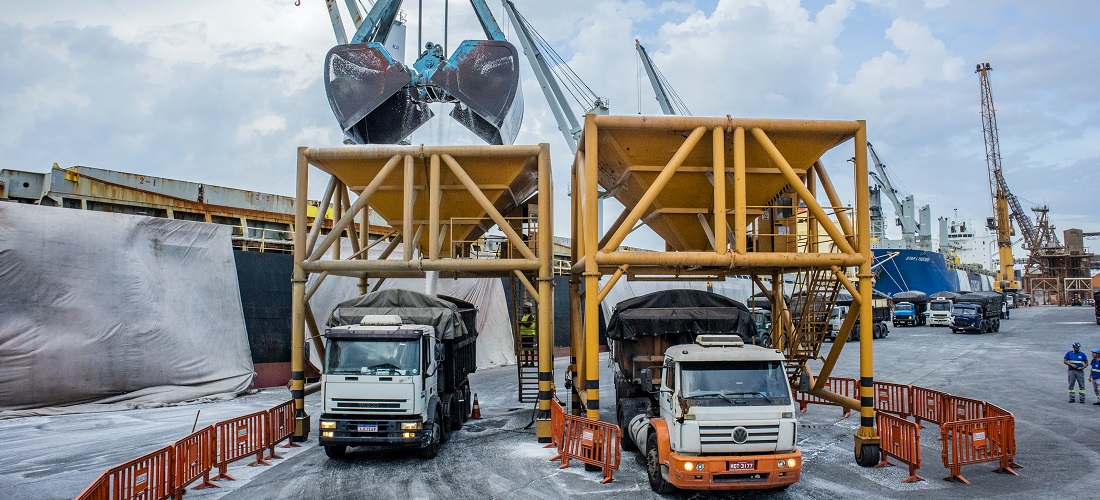
Logistics was also identified as a critical factor, due to “extremely sensitive” routes, according to Pfeifer. Brazilian imports depend on routes exposed to external bottlenecks, such as the Strait of Hormuz, the Suez Canal, the Panama Canal, and the Baltic Sea, and also face internal barriers, including long inland transport distances, limited highway networks, and a high concentration of cargo discharge in a few ports.
Reducing dependency
The report indicates the short-term need to diversify suppliers, particularly among countries considered less exposed to external instability, such as the European Union, Morocco, Norway and Chile, for example.
In addition, researchers suggest greater coordination of fertilizer import windows at the ports of Paranaguá and Santos. The document also notes that current tax policies in the sector need to be reassessed for effectiveness, such as ICMS Agreement 26/2021.
For the medium and long term, the study emphasizes the importance of measures to strengthen domestic production capacity by attracting companies with advanced technologies and developing public–private partnerships. “The sector has programs in place today to build domestic production, but everything is long term,” Jank said.
Another point emphasized is the use of so-called “fertilizer diplomacy”, linking the negotiation of fertilizer purchases to Brazil’s agricultural export flows.
The expansion of integrated contracts between grain suppliers and fertilizer suppliers in regions served by railways and waterways, such as the Arco Norte, as well as the diffusion of precision agriculture and the creation of alternative logistics routes, are also listed as paths to reduce foreign dependence.
Legal certainty
Public policies and legal certainty are still insufficient to encourage new investments in fertilizer production in Brazil and reduce dependence on imported inputs, according to representatives from industry associations.
“Brazil, despite having a strong agribusiness sector and food security, cannot say that it has food sovereignty because we depend on fertilizers. If agribusiness is the engine of the country, fertilizer is the fuel,” said Bernardo Silva, executive director of the National Union of Raw Materials for Fertilizers Industry (Sinprifert).
Silva stressed that some strategic inputs, such as sulfur — essential for the production of sulfuric acid — are almost entirely imported. “Brazil is practically 100% dependent on sulfur. Without sulfur, there is no sulfuric acid used in the production of many fertilizers,” he said, noting the national potential in natural gas, biomethane, renewable energy and phosphate and potassium reserves.
According to Silva, the country has natural resources and energy conditions to expand domestic production, but faces a combination of institutional and regulatory constraints. “Show me the incentive and I’ll show you the result,” he said, noting that the sector spent years without specific public policies and with a reduced presence of large national companies. He emphasized that the country is living a “moment of reversal of this cycle” but warned of geopolitical risks tied to the current dependency.
In his assessment, even with the National Fertilizer Plan (PNF), which sets long-term goals through 2050, Brazil will remain dependent on international supply. “The PNF aims to reduce dependency from 90% to somewhere between 45% and 50% by 2050. We will still be dependent. We will not be self-sufficient — and that’s not the goal,” he said.
Also present at the event, Ricardo Tortorella, executive director of the National Association for Fertilizer Diffusion (ANDA), said the PNF is “quite reasonable on paper” but that its implementation has made little progress.
According to him, business leaders still lack sufficient legal certainty to justify major investments in new plants and industrial projects, which limits the expansion of domestic production capacity.
Source: Globo Rural
-
Ports and Terminals
Jan, 10, 2023
0
Transpetro conducts green bunker performance tests
-
Ports and Terminals
Jul, 21, 2022
0
Port in Rio de Janeiro carries out first double banking operation
-
Oil and Gas
Dec, 18, 2018
0
CNPE approves sixth-round auction of pre-salt oil area
-
Grains
Sep, 03, 2025
0
Agribusiness grows more than 10% in Q2 2025