


Brazil’s trade boom puts Southeast ports at center of logistics push
Jan, 13, 2026 Posted by Gabriel MalheirosWeek 202603
As Brazil celebrates the strongest three-year stretch in its trade balance on record (2023–2025), ports in the Southeast have emerged as the backbone of the country’s logistics infrastructure. Consolidated data through November 2025 show that terminals in the region handled 635.3 million tonnes of cargo, acting as the main engine of Brazil’s foreign trade. The volume represents a 6.01% increase from the same period a year earlier, underscoring the region’s ability to efficiently handle both bulk commodities and higher value-added cargo.
“The Southeast demonstrates, in practice, the concept of multimodal efficiency. Public ports and private terminals are operating in sync to ensure Brazil does not miss trade opportunities,” said Ports and Airports Minister Silvio Costa Filho.
The performance of terminals in São Paulo, Rio de Janeiro and Espírito Santo was decisive in pushing Brazilian exports to a record $348 billion last year. In 2025, the Southeast operated as a multipurpose hub, supporting iron ore and oil exports while also moving agricultural output and receiving industrial inputs. Exports through the region rose 8.3% through November, alongside a 6.58% increase in long-haul shipping, reinforcing the view that Brazil’s trade surplus has been built on a solid base of logistical and operational efficiency.
Year-end acceleration
The close alignment between production and logistics became particularly clear toward the end of 2025. According to data from the Ministry of Development, Industry, Trade and Services (MDIC), the record level of exports in December was driven in part by the resumption of oil platform operations after scheduled maintenance shutdowns.
Ports in the Southeast responded quickly to the surge in demand. In November alone, the movement of liquid bulk cargoes—including crude oil and derivatives—reached 19.2 million tonnes, up 22.54% year on year. From January to November, liquid bulk throughput totaled 206.6 million tonnes, an increase of 9.01%.
Overall cargo handling in the region reached 59.6 million tonnes in November, a 17% jump compared with the same month in 2024. The strong performance helped prevent logistical bottlenecks at a time of peak international demand for Brazilian exports.
Iron ore, agribusiness and general cargo
On a year-to-date basis, data from Brazil’s waterway regulator Antaq highlight the dominance of mineral commodities in the region’s cargo mix. Iron ore remained the leading product, with 215.9 million tonnes handled, mainly through terminals in Espírito Santo and Rio de Janeiro, including Tubarão (72.6 million tonnes), Itaguaí (52.6 million tonnes) and Ilha Guaíba (28.7 million tonnes). Crude oil and petroleum products also posted strong results, totaling 167.8 million tonnes.
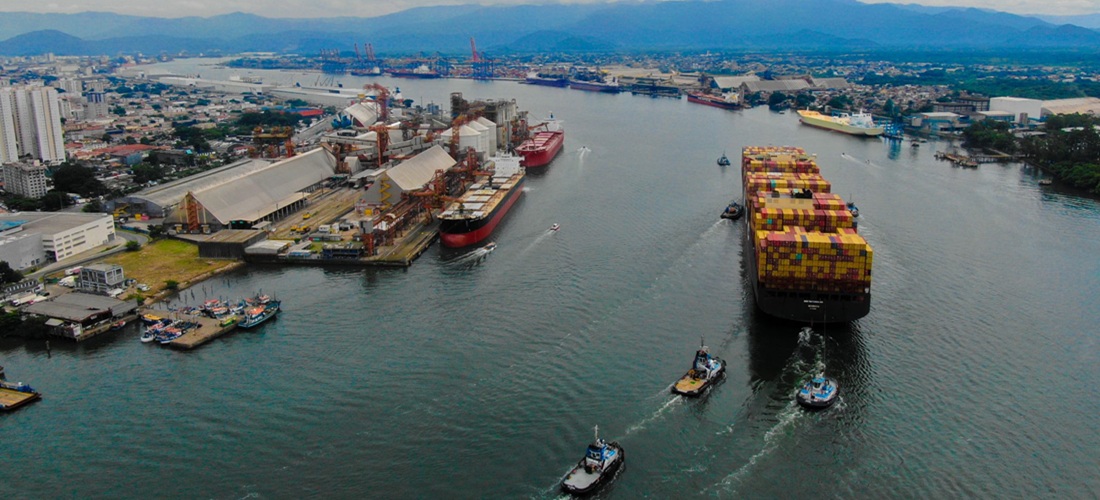
The Port of Santos, the largest port complex in Latin America and Brazil’s main gateway by cargo volume, reaffirmed its strategic role for both agribusiness and industry. The complex handled 131.7 million tonnes over the period.
The chart below provides an overview of containerized exports and imports (measured in TEUs) at the Port of Santos, featuring Datamar data.
Port of Santos | Exports x Imports | Jan 2022 – Nov 2025 | TEUs
Source: DataLiner (click here to request a demo)
Beyond serving as the country’s primary hub for containerized, higher value-added cargo, Santos remained critical to agricultural exports, particularly soybeans, which totaled 38.5 million tonnes in the region.
Source: Ministry of Ports and Airports
-
Fish
Jul, 11, 2025
0
Trump Tariff Halts Brazilian Fish Exports to the U.S.
-
Ports and Terminals
Nov, 01, 2024
0
Super Terminais recognized for efforts to amend drought woes in Amazonas
-
Grains
Mar, 08, 2022
0
How is the hike in vegetable oil prices linked to the Black Sea conflict?
-
Economy
Nov, 26, 2024
0
Trump Announces Tariff Hikes on Mexico, Canada, and China Over Drugs and Immigration