


Chinese copy paper floods Brazilian market after U.S. trade barriers
Jul, 30, 2026 Posted by Gabriel MalheirosWeek 202631
Trade barriers imposed by the United States on China and other Asian countries are directly affecting Brazil’s paper industry, which is now facing a surge of Asian supply.
With sales to the U.S. market virtually blocked, China and Indonesia have redirected to Brazil part of the surplus paper they had intended to sell to American buyers.
Foreign trade data from Datamar show a sharp 44.3% increase in Brazil’s paper imports from China in the January-May period of 2026. The chart below shows the main paper categories that entered the country during the period by market share:
Main Categories of Chinese Paper Imports | Jan-May 2026 | TEUs
Source: DataLiner (click here to request a demo)
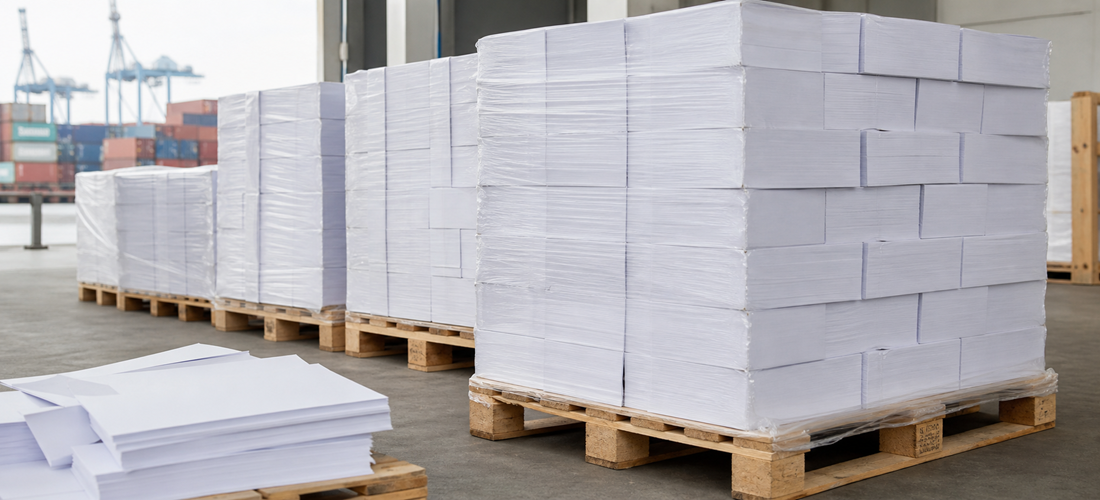
Asian copy paper has reached Brazilian consumers at prices below those of domestic products, triggering an unprecedented influx into a market that is self-sufficient and ranks among the global leaders in pulp and paper. The situation has prompted the industry to ask President Luiz Inácio Lula da Silva’s government for urgent measures, including doubling the import tariff on these products.
According to information obtained by Folha de S.Paulo, the request was made by Ibá, the Brazilian Tree Industry Association, which represents around 50 major pulp and paper producers in the country.
Last week, the association filed a request with the Secretariat of Foreign Trade, linked to the Ministry of Development, Industry, Trade and Services, asking that the current import duty on so-called cut-size paper be raised from 16% to 30%. The category includes standard A3 and A4 sheets widely used around the world. The requested rate is the maximum allowed under Mercosur’s Common External Tariff.
“The international cut-size paper market has seen a converging trend of foreign markets closing, redirecting surplus Asian supply to more open destinations, notably Brazil,” Ibá said in its request.
Between January and May 2026, Brazilian imports of the product rose 160% from the same period last year, according to official data compiled by the association, jumping from 3.3 million kilograms to 8.5 million kilograms. In value terms, imports increased 123%, from $2.9 million to $6.3 million.
The surge in Asian paper imports has been driven by falling foreign prices. The average import price declined from $0.90 to $0.77 per kilogram, a 14% drop. According to Ibá, imported paper can reach the Brazilian market at prices between R$7 and R$35 below those of brands produced domestically.
“Domestic producers of cut-size paper are increasingly concerned, as they have been negatively affected by the recent exponential increase in import volumes into Brazil at unjustifiably aggressive prices,” the association said.
Brazil’s consumption of this type of paper has historically been supplied almost entirely by domestic production. The country is one of the world’s largest pulp and paper producers and exports a significant share of its output.
The scale of Brazil’s domestic production, now under pressure from Chinese copy paper, shows what is at stake. Installed capacity at Brazilian mills is equivalent to 143% of domestic consumption, meaning the industry could produce 43% more than the local market absorbs. In other words, there is idle capacity.
“The damage already felt by domestic producers of this product, together with the risk of disinvestment in Brazil by these companies, justifies the urgent adoption of a measure raising the import duty,” Ibá argued.
Folha said it contacted the ministry for comment but had not received a response by the time its report was published. Requests of this kind are normally reviewed by internal committees at the ministry before a decision is made.
Industry data show that while imports are accelerating, Brazilian paper exports have weakened. From January to May 2025, Brazil exported around 150 million kilograms of paper. In the same period this year, the volume fell to 129 million kilograms.
Ibá says Brazilian companies are facing pressure on two fronts: growing difficulty selling abroad and, at the same time, loss of market share at home.
José Carlos da Fonseca Júnior, Ibá’s international director, confirmed the request.
“Amid this disorder in the international system, China has started looking for other markets because it lost access to the U.S. market. Europe has also started moving in search of other countries,” he said.
Fonseca Júnior acknowledged that products made from Brazilian pulp exported to China eventually return to the Brazilian consumer market at prices below those of domestically made paper.
“Brazil is the world’s largest pulp exporter, the sixth-largest producer of packaging paper and exported more than $15 billion in products in 2025. We have never depended on protectionism. On the contrary, we fought to win markets,” he said. “But we are turning to the government now because cut-size paper is a recent phenomenon, and it has started entering the country at prices below even our own local competitiveness.”
Fonseca Júnior said paperboard, used in packaging for medicines, food and hygiene products, was also the subject of a similar request by the industry in June.
Ibá had already appealed to Brazil’s foreign trade chamber, Camex, in 2024 to seek protection for paperboard. At the time, it asked the government to raise the import tariff from 12.5% to 25%. The government authorized an increase to 16%.
That annual tariff, which has already been renewed once, expires in October. In its new request, Ibá says the situation has worsened and is asking for the rate to be raised to 35%.
“We have started to see imports entering at prices that clearly reflect a structure that lacks transparency and is highly opaque,” Fonseca Júnior said.
The United States maintains antidumping duties and countervailing measures on paper produced in China and Indonesia, in addition to imposing an extra 25% tariff on Chinese paper. The Office of the United States Trade Representative, or USTR, has also opened investigations this year into Chinese industrial overcapacity and trade practices in the sector.
The paper industry is not the first to ask the Brazilian government to double import duties to protect itself from Chinese exports, even if the reasons differ.
In addition to paper, an increase in imports of cooking gas cylinders from China—driven by the creation of the federal Gás do Povo program—has led to a trade dispute between Brazilian manufacturers and distributors importing the product from abroad, as Folha previously reported.
Source: Folha de São Paulo
-
Trade Regulations
Oct, 25, 2019
0
Bolsonaro meets Chinese president to sign agreements
-
Meat
Dec, 05, 2019
0
JBS plans US$1.91bn investment in Brazil
-
Grains
Jul, 14, 2020
0
Chinese soy imports up 71% YoY in June, with most of it sourced from Brazil
-
Economy
Jan, 13, 2026
0
Brazil keeps nearly $3 bln in trade with Iran in 2025 raising concerns over tariff threats