


Logistics Park in Cubatão Expected to Shorten Truck Routes to Port of Santos
Oct, 26, 2026 Posted by Sylvia SchandertWeek 202644
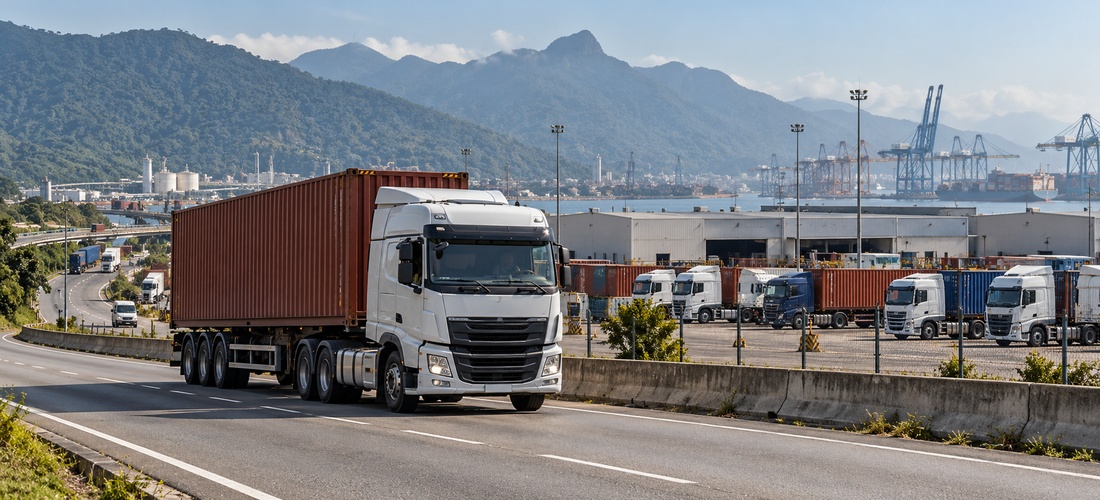
A planned logistics park for trucks on Ilha do Tatu, near Ilha Caraguatá in Cubatão, is expected to reduce from 15 to four kilometers the distance traveled by trucks descending the mountains on the Anchieta Highway en route to terminals on the right bank of the Port of Santos.
The estimate is included in the Environmental Impact Study and Report (EIA-Rima) submitted to São Paulo State’s environmental agency, Cetesb, by Condilog Operações, the winning bidder, to obtain an environmental license for the project. The application remains under review by the state agency.
According to the document, the three truck staging yards currently accredited by the Santos Port Authority (APS) are on the left bank. As a result, vehicles must travel approximately 15 kilometers round trip along the Cônego Domênico Rangoni Highway (SP-055). With the new development, that distance would fall to approximately four kilometers using the Anchieta-Imigrantes connector road. The change is intended to manage and redistribute vehicles across the highway network, easing traffic on the Cônego Domênico Rangoni Highway.
The Tatu Logistics Complex (CLT), as the company calls it, will occupy a vegetated site alongside the road connecting the Anchieta and Imigrantes highways. The 412,500-square-meter property lies within the official boundaries of the Port of Santos.
The project was designed to accommodate a projected increase in truck traffic heading to the port from 8,000 to as many as 18,000 vehicles per day by 2060, carrying agricultural dry bulk, mineral dry bulk, containers and general cargo.
According to the company’s justification for the project, the facility “is no longer merely an operational improvement but a necessary condition for organizing logistics flows, expanding capacity to support port operations and allowing investments in terminals, land access routes and other strategic infrastructure to be fully utilized.”
Investment and timeline
According to the EIA-Rima, total investment is estimated at approximately R$1.492 billion—a figure that stands out because it is roughly half the R$3 billion previously projected by APS. The amount includes environmental impact mitigation measures and permitting.
Construction is expected to take 36 months and employ up to 400 workers at its peak. The document calls for prioritizing local hiring, particularly from Cubatão, Santos and São Vicente, in partnership with municipal governments and industry organizations. It also outlines emissions control measures, including equipment maintenance and priority use of equipment incorporating cleaner technologies.
Site layout
Condilog plans to allocate 97 square meters within the logistics park to warehouses and administrative buildings. The complex will have a container yard with 1,999 spaces and a pile-supported pavement structure designed to accommodate large cargo volumes, a truck staging yard with 845 spaces and facilities for truck drivers.
There will also be a parking facility within the port area with 593 spaces, an administrative building and supporting infrastructure, including a fueling station and ancillary facilities. This facility will subsequently be transferred to APS. The complex will have two access gates, one exclusively for vehicles entering the CLT from the Anchieta-Imigrantes connector road.
Vegetation removal
Construction of the Tatu Logistics Complex will require the removal of 456,000 square meters of native vegetation and 313,800 square meters of mangroves, as well as work affecting built-up areas and open water. According to the project’s Environmental Impact Study (EIA), work within Permanent Preservation Areas (APPs) will cover nearly 500,000 square meters.
These figures underpin the municipality’s opposition to the project. In a technical opinion submitted to Cetesb opposing the development, Cubatão’s Department of the Environment, Climate Security and Animal Welfare (Semam-SCB) and Municipal Environmental Council state that “Ilha do Tatu must be considered an integral part of an estuarine system of major environmental importance, whose conservation is linked to maintaining the mangroves, native vegetation and ecological processes that shape the coastal landscape of Cubatão and the Baixada Santista region.”
The municipal report highlights the risk to the scarlet ibis, the city’s symbolic bird and one of the species of greatest scientific significance in the area. “The habitat’s ability to function depends on the integrity of the full range of environments used by the birds, including mangroves, tidal channels, mudflats, shallow-water areas, feeding grounds and roosting sites (…). Altering any of these components may change the availability of food, shelter, and breeding and resting sites,” the municipal opinion adds.
Environmental mitigation and compensation
For its part, the EIA submitted to Cetesb establishes programs to rescue, safeguard, conserve and monitor wildlife and plant life. The document provides for R$7.160 million in environmental compensation payments, to be allocated to Serra do Mar and Xixová-Japuí state parks. The study also cites compensation through the designation of an area equivalent to 2.2 million square meters of native vegetation, at least 1.9 million square meters of which will consist of mangroves.
Because of “the presence of a thick layer of soft soil at the development site, robust foundations will be used, and their design will need to be reassessed based on geotechnical studies and project guidelines,” the study states. The project also includes a drainage network sized to direct water generated within the complex to the Casqueiro River.
Regarding energy use and operations, “the lighting system throughout the complex will use high-efficiency LED technology, with occupancy sensors and automatic controls based on ambient light levels, reducing energy consumption during operation.” The EIA also specifies that “the installation of a photovoltaic generation system on warehouse and administrative building roofs will be evaluated, with the aim of generating part of the facility’s electricity on-site and reducing reliance on the public grid and associated emissions.”
Three yards
In addition to Ilha do Tatu, the Santos Port Authority’s plans include two other logistics parks. On the right bank, in Santos, a 20-year paid land-use agreement has already been signed with the Portlog consortium for a facility on Avenida Augusto Barata, between Alemoa and Saboó.
The project will occupy 242,000 square meters and include a truck staging yard with an initial capacity of 400 spaces, expandable to 530, as well as services and a rest area for drivers. The company will pay APS R$289,000 per month beginning in the 36th month. The development is the subject of a legal dispute with the Brazilian Association of Container Terminals (Abratec) and is on hold. On the left bank, in Guarujá, the logistics park will be built in the Conceiçãozinha neighborhood of Vicente de Carvalho. The Marlog-Petrasalis Logística consortium won the tender, and the project remains in the implementation phase.
Source: A Tribuna
-
Automotive
Apr, 08, 2022
0
Truck exports from Brazil increased by more than 40% in March
-
Other Logistics
Jan, 24, 2023
0
Shipyards faced with vexing capacity issues
-
Economy
Feb, 29, 2024
0
Brazil central government posts primary surplus of $15.95 bln in January
-
Blog News (ENG)
May, 28, 2025
0
Dredging and Expansion: Itajaí Port Secures R$ 689 Million Mega Investment During Lula’s Visit