


DataSmart Shipping 2026: Day 2 highlights data, science and decision-making as pillars of maritime decarbonization
Mar, 18, 2026 Posted by Gabriel MalheirosWeek 202512
The second day of the 2026 DataSmart Shipping Conference deepened discussions on maritime decarbonization, placing data and science at the center of strategic decision-making in the sector. The program, led by DatamarLab, was structured around two main sessions — a technical panel and a market discussion — showing how applied intelligence can reshape how global trade measures, manages and responds to its environmental footprint.
DatamarLab panel: Environmental footprint in foreign trade
The first session offered a technical and innovative approach to using real operational data to measure and model emissions in maritime transport. Walter Teixeira Lima Junior, professor and researcher at UNIFESP and chief scientist at DatamarLab, argued that the main challenge today is not the lack of data, but the ability to identify “structuring vectors” within massive datasets.
During his presentation, he highlighted the development of an application based on Datamar’s database, integrating maritime distance algorithms, emissions engines and scientific methodologies. What began as proof-of-concept work on a single vessel is now advancing toward predictive models using machine learning and the development of a “digital twin,” capable of simulating operational scenarios with greater accuracy, reducing error margins and even allocating emissions at the cargo level.
Complementing this view, Thiago Nobre Mascarenhas, head of data and architecture at DatamarLab and Engineering Brasil, emphasized the need to replace traditional top-down models based on aggregated estimates with a bottom-up approach built on granular, real-world data. By incorporating variables such as engine type, speed, hull condition and cargo characteristics, this methodology enables far more precise emissions measurement and more robust predictive models. He noted that progress in decarbonization depends on closer integration between academia and industry to ensure that knowledge is effectively applied.
The session also featured Marcos Silva, Datamar’s CIO, who reinforced the importance of connecting technical expertise with practical application and translating research into real-world solutions for the sector.
DatamarLab panel: Market discussion on environmental footprint
The second session shifted from technical analysis to practical implementation, bringing together executives and specialists to discuss how these solutions can be applied across the logistics chain.
Walter Teixeira Lima Junior revisited the discussion with a critical perspective on artificial intelligence, noting that its value lies not in the technology itself but in its ability to generate cognition and support decision-making. He stressed that decarbonization is ultimately an economic and cultural challenge, requiring structural changes in how the sector shares data and collaborates.
Thiago Nobre Mascarenhas expanded on the role of AI as a key tool for handling complex, high-cognition decisions, such as trade-offs between speed, cost and emissions. According to him, highly granular data — including second-by-second port operations data — is already available, and AI is what enables the transformation of this data into simulations, projections and actionable business insights.
From an operational standpoint, Jeferson Kalckmann Gilgen, pricing and commercial planning coordinator at Porto Itapoá, offered a practical view of the energy transition in ports. While initiatives such as equipment electrification represent tangible progress, he noted that the sector still faces significant challenges related to cost and scale in adopting alternative fuels. Progress, he said, will depend on economic alignment and regulatory pressure.
Cecílio Perez, executive director of the RCGI-USP Carbon Registry, highlighted that the urgency of the environmental agenda is already being driven by increasingly visible climate impacts. He emphasized the growing importance of Scope 3 emissions — indirect emissions across the value chain — and the challenges of measuring them, including the need for reliable data and the risk of distortions such as greenwashing. In this context, data-driven solutions are gaining importance by providing transparency and traceability.
Closing the session, Marcos Silva and Cristiano Kaehler, Datamar’s business intelligence manager, pointed to the historical gap between academia and the market and the need to turn knowledge into practical application. Kaehler highlighted the market’s innovation cycle — from initial enthusiasm to caution and ultimately to the challenge of implementation — noting that the main barrier today is not technological, but execution and management.
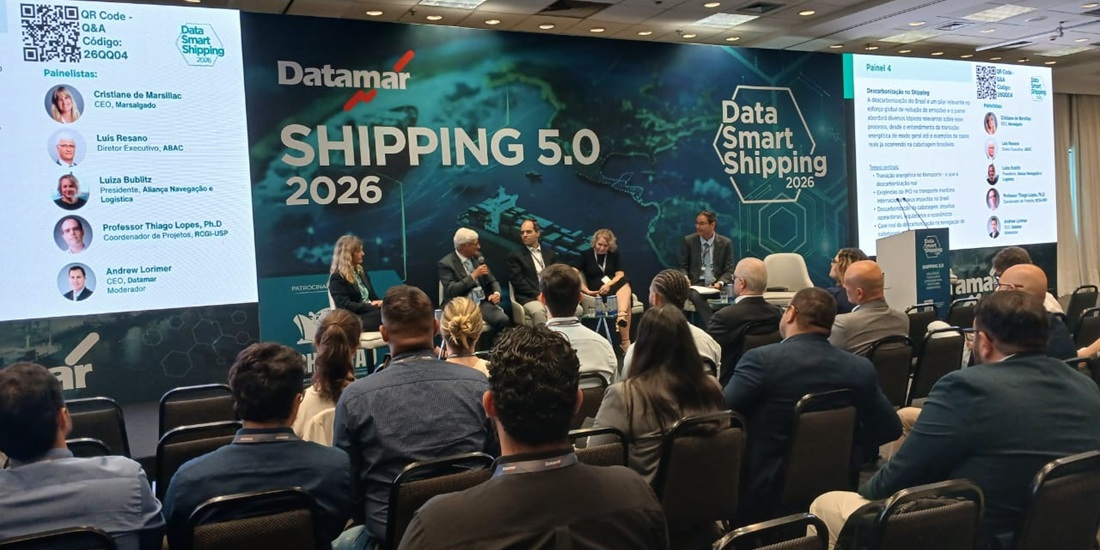
Decarbonization in shipping panel
The decarbonization panel brought together academic, regulatory and industry perspectives to discuss pathways for the maritime sector’s energy transition, underscoring that the issue has become a central strategic priority.
Opening the session, Andrew Lorimer, CEO of Datamar, noted that maritime transport accounts for about 2.8% of global greenhouse gas emissions, reinforcing the need to advance transparency, measurement and the use of data to support more sustainable decisions. He also linked the discussion to artificial intelligence initiatives and the growing impact of carbon markets, highlighting the increasing technical complexity of the issue.
Cristiane de Marsillac, CEO of Marsalgado Brasil, offered a historical and strategic perspective, comparing the current transition to past technological shifts such as the move from sail to steam. She emphasized that, unlike previous transitions, the current shift is driven not only by efficiency but also by environmental, regulatory and social pressures. Energy strategy, she said, is becoming a key factor in competitiveness, with regulation playing a decisive role in providing predictability and enabling investment, particularly given the high costs of emerging technologies. She also highlighted Brazil’s strong biofuels base as a potential competitive advantage in the low-carbon economy.
Tiago Lopes, a scientist and professor at USP’s Research Centre for Greenhouse Gas Innovation (RCGI), provided a technical perspective, stressing that lifecycle cost remains the primary decision factor in the sector. He said decarbonization will not occur spontaneously but will be driven by regulation and increasing societal pressure. There will be no single solution, he added, with multiple technologies coexisting — electrification advancing in lighter applications, while hydrogen and other high energy-density fuels gain traction in long-distance heavy transport.
Luís Resano, executive director of the Brazilian Association of Cabotage Shipowners (ABAC), focused on operational realities, noting that fuel choices still depend on cost, availability and infrastructure. While cabotage is the most environmentally efficient transport mode, its share in Brazil’s logistics matrix remains low, representing an immediate opportunity for emissions reduction through expansion. He pointed to biodiesel as a viable short-term solution due to compatibility with existing infrastructure, while emphasizing the need for clear public policies and consistent investment.
Luiza Bublitz, president of Aliança Navegação e Logística, said decarbonization has moved beyond an environmental issue to become a strategic business decision. She highlighted the challenges of a capital-intensive industry with long investment cycles, noting that the transition requires investment, innovation and willingness to act despite uncertainty. Among ongoing initiatives, she cited technologies such as shore power (AMP) and operational improvements to boost energy efficiency. She also stressed the role of cabotage in reducing truck traffic, while noting that its expansion depends on greater multimodal integration and cultural change.
Overall, the panel underscored that maritime decarbonization will be a gradual, multifaceted process dependent on collaboration across the value chain. More than a trend, it is emerging as a core element of industry competitiveness, requiring alignment between technology, regulation, infrastructure and business strategy.
At the close of the second day, participants agreed that the maritime sector already has the data, technology and knowledge needed to advance the decarbonization agenda. The key challenge now lies in integrating these elements, fostering collaboration across stakeholders and, above all, turning information into concrete decisions with real impact.
-
Other Logistics
Jan, 03, 2019
0
Bolsonaro plans to fetch quick R$7bn from infrastructure concessions
-
Steel and Aluminium
Feb, 10, 2025
0
Trump to Announce 25% Tariffs on All Steel and Aluminum Imports
-
Ports and Terminals
Sep, 22, 2020
0
Port of Santos to gain new access road
-
Ports and Terminals
Jun, 04, 2025
0
Porto Central Advances Construction with Quarry Preparation for South Breakwater