



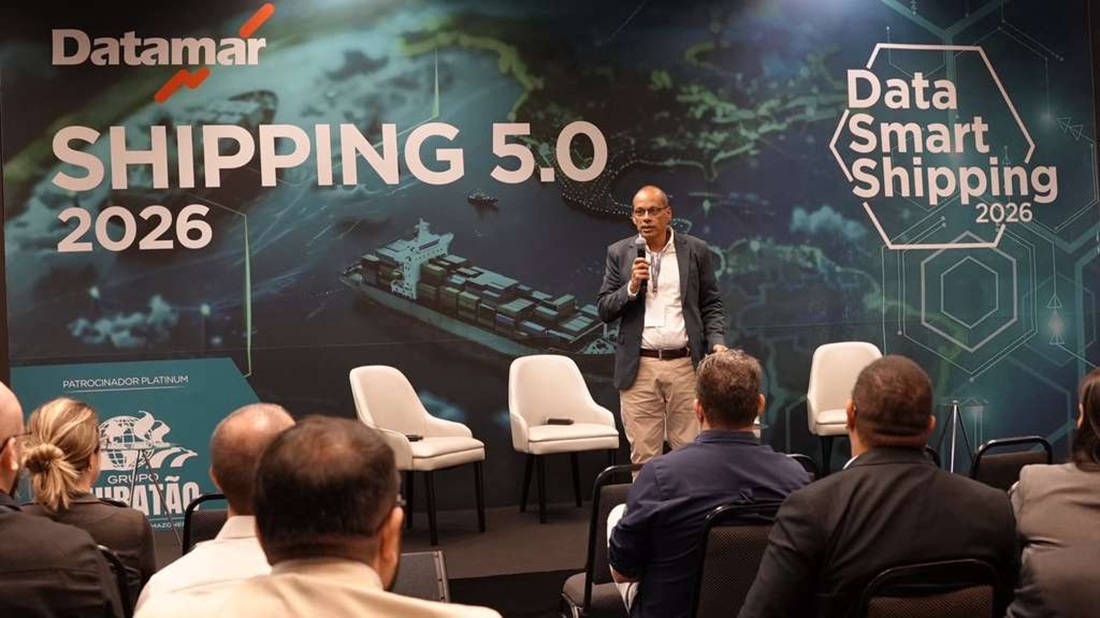
DataSmart Shipping 2026: First Day Focuses on Resilience, Data, and the Human Role in the New Maritime Landscape
Mar, 17, 2026 Posted by Sylvia SchandertWeek 202612
The first day of the DataSmart Shipping Conference 2026 featured an intense agenda of strategic discussions, bringing together executives, experts, and authorities to explore the future of maritime transport in an increasingly complex global context. In the opening session, Andrew Lorimer introduced the concept of Shipping 5.0, highlighting that the industry is under significant pressure, with rising fuel and insurance costs, the impact of geopolitical conflicts—particularly in the Middle East—and direct consequences for supply chains, such as delays, vessel rerouting, and higher freight rates, which have more than doubled on the China–Brazil route. In this context, he emphasized that resilience, technology, and the central role of human decision-making are key pillars for the sector’s future.
Following this, the keynote speech by Professor Walter offered a deep reflection on the sector’s transformation, stressing that the challenge is not the lack of technology but rather the depth of its use. Drawing on over four decades of experience integrating theory and practice, he pointed out that artificial intelligence is likely to take over operational functions, while critical thinking and the ability to interpret complex contexts will make the human factor even more relevant. According to him, the true competitive advantage will lie in developing professionals capable of thinking independently and connecting different fields of knowledge in an increasingly integrated environment.
The first panel of the day delved into resilience in maritime transport, bringing together representatives from shipping lines, terminals, and industry associations. The discussion highlighted how recent events—such as the pandemic, climate change, and geopolitical tensions—have exposed structural weaknesses in the global logistics chain. Concrete challenges in Brazil were discussed, including the drought on the Amazon River, which disrupted access to Manaus for 45 days and required costly emergency measures, as well as infrastructure bottlenecks and the need for greater regulatory predictability. At the same time, it became clear that investments in operational efficiency, logistics integration, and forward planning are essential to reduce vulnerabilities and sustain the growth of Brazilian foreign trade.
In the panel on the transition from information to decision-making, the focus shifted to the strategic use of data and artificial intelligence. Participants emphasized that the challenge is no longer generating data, but transforming it into actionable insights. In this context, the importance of human judgment—especially in critical decisions—was once again highlighted, along with the need to develop professionals with a broad perspective and strong analytical capabilities to navigate the sector’s complexity.
Closing the day, the panel on building Shipping 5.0 underscored the importance of collaboration between academia, government, and the private sector. Discussions made it clear that the sector’s evolution depends on data integration, more coordinated institutional environments, and overcoming cultural and operational barriers. Issues such as the lack of system interoperability, fragmented information, and the need to strengthen a sense of port community were widely debated. Concrete progress was also presented, including innovation hubs and initiatives to modernize port management.
At the end of the first day, it was clear that the maritime sector is undergoing a profound structural transformation. More than simply adopting new technologies, the challenge lies in rethinking models, strengthening collaboration, and developing a strategic vision capable of dealing with uncertainty. The combination of data, artificial intelligence, and human protagonism has emerged as the central axis of this new phase of global shipping.
-
Grains
Jan, 05, 2022
0
Anec says that soybean exports were 5.2% higher in 2021
-
Ports and Terminals
Jun, 12, 2026
0
Santos truck-yard project stalls as cost tops R$3 billion
-
Trade Regulations
Dec, 02, 2025
0
China issues first batch of new licenses for rare earth exports
-
Grains
Nov, 21, 2022
0
China’s October soybean imports from Brazil slide