


Federal Government encourages shipbuilding in Brazil and aims to generate jobs
Nov, 11, 2025 Posted by Lucas LorimerWeek 202547
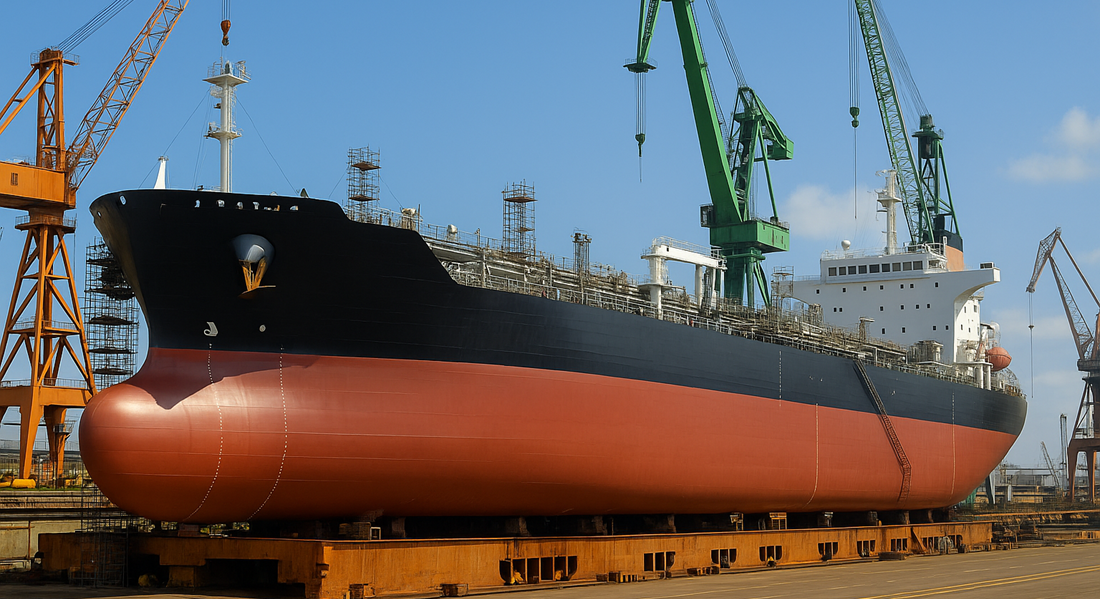
Valuing the naval industry and generating qualified jobs are the goals behind the Federal Government’s decision to encourage the construction of oil tankers in Brazil. According to the resolution from the Ministry of Development, Industry, Trade, and Services (MDIC), approved last month by the National Energy Policy Council (CNPE), part of these ships used to transport gas, oil, and derivatives must be built in the country.
According to the established rule, at least half of the parts and services used in the construction of large oil tankers (over 15,000 tonnes) must be sourced from the domestic industry. For smaller vessels that support maritime activities, this percentage rises to 60%.
“Local content is a public-policy tool for industrial development. Many countries adopt it, and it is part of the New Industry Brazil (NIB) plan. Its objective is to develop industrial supply chains in sectors where Brazil already has internal capabilities, generating technological development, jobs, and income in the country,” explains the MDIC in a statement.
Decrees
The ministry notes that the requirement applies to companies wishing to benefit from Accelerated Depreciation for ships, as provided in Decrees 14.871/2024 and 12.242/2024. The two decrees authorize and regulate the granting of differentiated depreciation quotas for new machinery, equipment, devices, and instruments, as well as for oil tankers and maritime support vessels.
“Whenever a company acquires a capital asset, the business owner may deduct its value from Corporate Income Tax (IRPJ) and Social Contribution on Net Profit (CSLL). Under normal conditions, this deduction is gradual and can take up to 20 years. With accelerated depreciation, the deduction occurs in just two years,” details the MDIC. “The vessels benefiting from the early deduction must meet the local-content requirements in their construction,” the ministry adds.
Measurement and oversight
The National Agency of Petroleum, Natural Gas, and Biofuels (ANP) will be responsible for measuring and monitoring compliance with the required local-content percentages to obtain the accelerated depreciation benefit.
“The ANP, in an activity that is already part of its routine, will audit the local-content certificates issued and forward the relevant information to the Ministry of Development, Industry, Trade and Services (MDIC), which is responsible for monitoring, control and final evaluation of the benefit,” the agency said in a statement.
The information related to compliance with the local-content index will be sent by the ANP within up to three months after the completion of each stage of ship construction. It will be up to the MDIC to define the construction phases for the oil tankers.
Reactivating the market is a challenge and may generate bottlenecks
Andre Zajdenweber, director of Graf Infra Consulting, notes that implementing the local-content policy brings certain burdens and challenges to the sector. Regarding employment, he says that the requirement for high percentages of engineering and assembly demands heavy investment from companies in workforce training and in restoring infrastructure, increasing initial costs.
Brazil’s naval sector has experienced a sharp decline in employment, going from more than 80,000 direct jobs in 2014 to fewer than 15,000 — a drop of more than 80%. There are around 20 large shipyards in Brazil.
“In this scenario of shrinking naval supply chains in Brazil, reactivation after years of low demand creates the risk of local suppliers being inexperienced or having small-scale production. This may lead to bottlenecks, delays, low quality, and higher costs in purchasing machinery and equipment.”
Regarding the competitiveness of the national fleet, the expert notes that the domestic industry risks operating with insufficient production scale and discontinuous orders. “This may create a cycle of dependency, where the competitiveness of the supply chain does not mature enough to compete internationally, remaining vulnerable to future changes in domestic policy,” he says. Increasing the competitiveness of the naval industry, he explains, will depend on the long-term stability of this policy.
Resilience and sovereignty
If the local-content policy is successful, experts expect a significant impact on the oil and gas supply chain, bringing resilience and energy sovereignty to Brazil.
“The policy seeks to ensure that Brazil maintains industrial capacity to renew its logistics fleet, essential for pre-salt exploration and cabotage transport, reducing vulnerability to global supply shocks or unavailability of foreign shipyards,” he states.
Requiring specific percentages for machinery, equipment and materials fosters the development and qualification of the naval supply chain, notes Zajdenweber. “By developing local ship-component suppliers, the policy reduces operational risk and maintenance, repair and overhaul costs for the complex offshore fleet,” he concludes.
Positive effects
Ariovaldo Rocha, president of the National Union of the Shipbuilding and Offshore Construction Industry (Sinaval), considers the decision by the National Energy Policy Council (CNPE) extremely positive for the sector and says it has direct effects on the competitiveness of Brazilian shipyards. “Setting minimum local-content levels at 50% for oil tankers and 60% for maritime support vessels is essential for Brazilian shipyards to participate on equal footing in international bids, such as those from Transpetro, where they compete with heavily subsidized Asian shipyards,” he argues.
Enabling the accelerated depreciation mechanism, according to Rocha, improves financing conditions for projects and makes the final price of ships produced in Brazil more competitive. “In practice, it reduces the asymmetry between domestic costs and the prices practiced in countries like China and South Korea, where the shipbuilding industry receives strong incentives and structured public financing.” Beyond the direct economic impact, the decision represents an important step in strengthening the Brazilian naval industry, as it “stimulates the creation of qualified jobs, drives the local supply chain, and increases the country’s ability to produce strategic vessels with greater technological and industrial autonomy.”
Source: A Tribuna
-
Economy
Aug, 14, 2026
0
Argentina, Brazil and Chile absorb 73% of Paraguay exports
-
Meat
Jan, 28, 2025
0
Brazil Expands in Halal Meat Markets: Understanding What Ensures This Certification
-
Tank and Reefer
May, 08, 2023
0
ZIΜ invests in refrigerated container fleet
-
Shipping
Dec, 27, 2024
0
China launches probe into beef imports as farmers struggle